
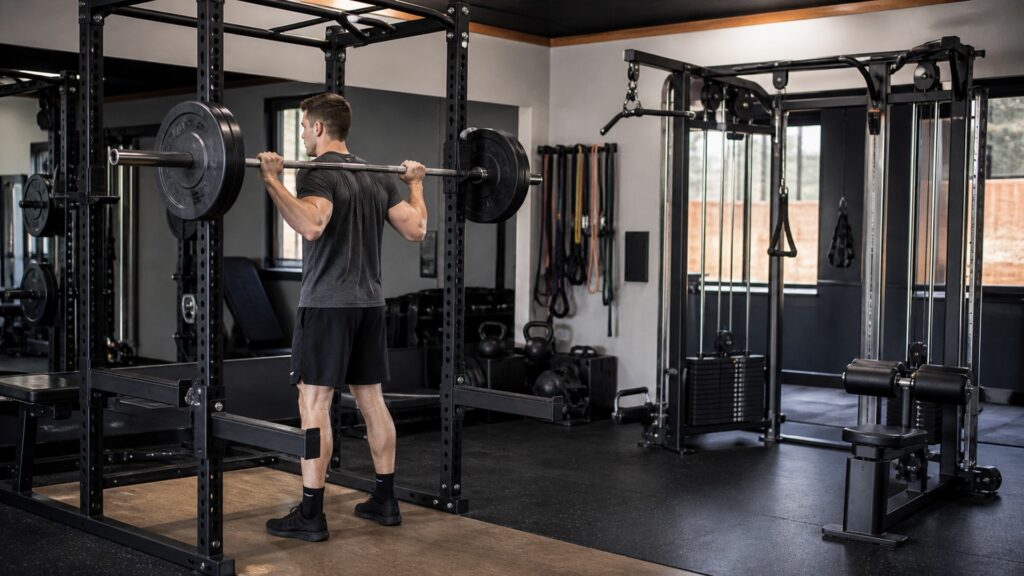
When to Use Power Racks & Squat Racks Instead of Cable Machines

Use power racks and squat racks instead of cable machines when the training plan depends on loaded barbell lifts. Racks are built for squats, bench presses, overhead presses, rack pulls, pull-ups, and other movements where the barbell needs hooks, safeties, and open lifting space.

A cable machine is better when the main need is adjustable resistance from different angles. Choose the rack when free-barbell loading, safeties, and progressive strength work are more important than cable-based accessory variety.

By: Review Streets Research Lab
Updated: September 25, 2026
Explainer · 8-12 min read
power racks & squat racks explainer hero image for Review Streets
What You'll Learn

When A Rack Is The Better Fit

A practical decision path for choosing barbell support over cable-focused training.

  • When barbell lifts should drive the purchase
  • Why hooks and safeties matter for home training
  • Where cable machines stay better for accessory work
  • How space, plates, and clearance affect the choice
  • What to check before choosing rack-based training

Tip: Judge the rack by the lifts it supports safely and repeatedly, not by the largest number on the spec sheet.

Definitions

Key Concepts Behind Power Racks & Squat Racks Instead of Cable Machines

These concepts clarify how rack design affects barbell training in a home gym.

Rack-Based Training

Rack-based training uses a rack as the main support for loaded barbell lifts.

  • Example: squats, bench presses, and overhead presses in a rack
  • Check: confirm the routine depends on barbell lifts
  • Limit: it requires a bar, plates, and space

Cable Machine

A cable machine uses pulleys and attachments for adjustable resistance angles.

  • Example: rows, pulldowns, curls, and pressdowns
  • Check: review whether cable work is the main need
  • Limit: it does not provide a free-barbell rack setup

J-Hooks

J-hooks hold the barbell at the starting height.

  • Example: hooks set for a back squat
  • Check: set hooks evenly and at a usable height
  • Limit: wrong height makes unracking harder

Safeties

Safeties catch or stop the bar if a lift is missed.

  • Example: safety arms below a bench press
  • Check: set safeties for each lift
  • Limit: they work only when placed correctly

Cable Accessory Work

Cable accessory work uses adjustable cable resistance for targeted movements.

  • Example: face pulls or triceps pressdowns after main lifts
  • Check: decide whether accessories or main lifts are the priority
  • Limit: accessories should support the program

Equipment Priority

Equipment priority is the main training job the home gym must solve first.

  • Example: choosing a rack because squats and bench press are non-negotiable
  • Check: list weekly must-have exercises
  • Limit: some users eventually need both tools

Tip: A rack is most useful when its frame, safeties, spacing, and room fit match the user's main lifts.

Best Fit

Choose A Rack When Barbell Lifts Are Central

If the user's program is built around squats, bench presses, overhead presses, and rack pulls, a rack is the more direct tool.

  • Use racks for loaded free-barbell work.
  • Set hooks and safeties for each lift.
  • Plan space for plates and bar movement.

The rack wins when the barbell is the main training tool.

Safety

Safeties Make Home Barbell Work More Practical

Home lifters may not have a spotter. Rack safeties help manage missed reps when they are positioned for the lift.

  • Use safeties for heavy sets.
  • Test setup with an empty bar.
  • Choose a rack style that supports the lift.

Safeties are a key reason to choose rack-based training.

Progression

Barbells Make Loading Flexible

Racks pair with bars and plates, which lets users progress in small or large jumps and use different barbell movements from the same station.

  • Plan plate storage.
  • Use collars and balanced loading.
  • Choose a rack with enough capacity and clearance.

The rack supports long-term barbell progression.

Cable Advantage

Cable Machines Stay Better For Angle-Based Accessories

Cable machines are still the better choice when the routine depends on pulldowns, rows, curls, pressdowns, rotations, and other adjustable-angle movements.

  • Choose cables for accessory variety.
  • Use pulley angles that match the movement.
  • Add cable work later if the rack leaves a gap.

Cables complement racks when accessory work matters.

Decision

Start With The Main Training Need

The first purchase should solve the primary training problem. If that problem is barbell setup, choose the rack. If it is adjustable cable resistance, choose the cable machine.

  • List non-negotiable exercises.
  • Match them to the equipment's strength.
  • Avoid buying versatility that misses the core need.

The right choice follows the program's center.

Quick Reality Check

Where Racks Beat Cable Machines And Where They Do Not

The choice depends on barbell support versus cable-angle flexibility.

Racks Win When

Squats, bench presses, overhead presses, and rack pulls are central.

The user needs safeties and free-barbell progression.

Cable Machines Win When

The routine depends on adjustable pulley resistance and accessory work.

The user wants controlled angles rather than a loaded barbell station.

Common Myths

Misconceptions About Racks Versus Cable Machines

The serious choice is the one that fits the program.

Cable machines cannot build strength

They can build strength, but through a different resistance path.

Racks replace every accessory movement

Racks support barbell work, but cables can still fill important gaps.

A rack is only for advanced users

It is useful whenever barbell setup and safeties matter.

You must choose one forever

Many home gyms eventually use both tools for different roles.

Tip: Treat rack claims as setup questions: what lift, what height, what safety, and what room?

FAQ

Frequently Asked Questions About Racks Instead Of Cable Machines

Short answers for choosing and using rack-based home strength equipment.

When should I choose a rack first?

Choose a rack first when barbell lifts define the training plan.

When is a cable machine better?

Choose a cable machine when adjustable pulley resistance and accessory movements are the priority.

Can racks and cable machines work together?

Yes. Racks can handle main lifts while cables handle accessories.

What else do I need with a rack?

Most users need a barbell, plates, collars, a bench, safeties, and enough working clearance.

What is the practical takeaway?

Use racks when barbell support is the need and cable machines when angle-based resistance is the need.

Bottom Line

Power racks and squat racks make more sense than cable machines when barbell training is the center of the routine.

Cable machines remain better for adjustable-angle accessory work, while racks provide the hooks, safeties, and open space needed for free-barbell progression.

Next Steps

Go Deeper or Compare Your Options

Use these Review Streets paths to compare related categories and practical next decisions.

Home Gym Systems

Compare rack-based training with broader all-in-one stations.

Cable Machines

Review cable-focused equipment for accessory and angle-based work.