
Professional-Use Product
A product distributed or labeled for trained occupational use or a controlled service context.
- Use: identify intended operator
- Variable: label and channel
- Tradeoff: Not one quality grade
Use a professional beauty product when the result depends on choices a trained operator must make: diagnosis, concentration, mixing ratio, compatible equipment, application zone, contact time, ventilation, protective equipment, or an endpoint that must be recognized in real time. Use a consumer product when it is labeled for unsupervised home use, the goal is routine maintenance, and the directions are clear enough to follow without improvisation.
The words professional, salon-grade, and clinical are not universal regulatory performance classes. Some professional lines offer configurable systems, larger sizes, technical education, or workplace documentation; others mainly use selective distribution. The decision belongs to the product's actual hazards and complexity, not its prestige.
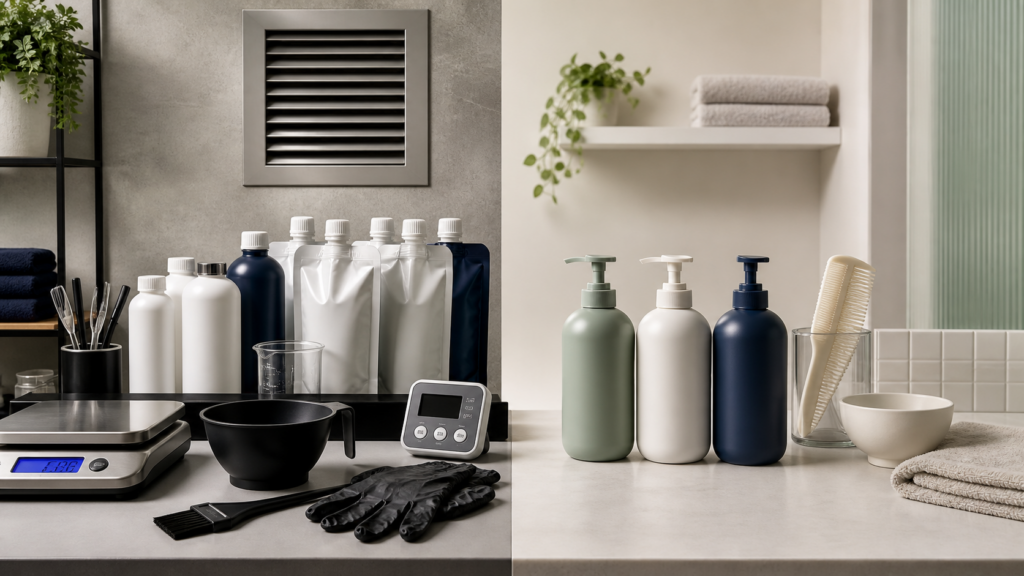
Give a risk- and complexity-based decision framework for choosing professional products when measurement, activation, exposure control, equipment, diagnosis, or monitoring materially affect safety or performance—and consumer products when routine, clarity, convenience, and low complexity matter more.
Tip: Routine success depends more on fit and adherence than exclusivity.
These professional vs consumer beauty products concepts separate mechanism, application, limits, and purchasing consequences.
A product distributed or labeled for trained occupational use or a controlled service context.
A retail product packaged and directed for ordinary personal use.
Mixing, curing, heating, or pairing needed before a product works.
Duration a formula remains on a surface before removal or neutralization.
Workplace hazard and handling document for applicable chemicals.
Ability to identify authentic product, lot, seller, and instructions.
Tip: Use these terms to test professional vs consumer beauty products instead of relying on a front-label promise.
Cleansers, conditioners, moisturizers, styling aids, and other clearly labeled products often serve daily maintenance better than a service-dependent system.
Routine success depends more on fit and adherence than exclusivity.
Color correction, strong peels, complex nail systems, concentrated smoothing chemistry, or device-paired products can require measurement, PPE, ventilation, training, and live monitoring.
The case for professional use rises with consequence and complexity.
Look for configurable shades or strengths, technical education, compatible equipment, documentation, authentic distribution, and provider follow-up—not a black bottle and a markup.
A distribution channel is not clinical proof.
Marketplace or decanted professional products may be expired, counterfeit, contaminated, stored poorly, or separated from the system and warnings they require.
A bargain loses value when identity is uncertain.
Persistent rash, scalp pain, hair loss, nail changes, infection signs, burns, or sudden sensitivity can require a qualified clinician rather than product experimentation.
Professional retail and medical evaluation are not the same thing.
Professional access can add control and support; it does not prove a formula is stronger, safer, or more effective.
The operator can explain why this product and protocol fit the starting condition.
Label, safety data, ventilation, PPE, disposal, and stop rules are available where relevant.
Decanting or buying diverted stock can remove instructions, traceability, and recourse.
A simple consumer formula used consistently can outperform an elaborate system used incorrectly.
These claims flatten the variables that determine how professional vs consumer beauty products performs in a real routine.
Some formulas are concentrated or adjustable; others differ in size, support, distribution, or branding.
Many are well designed for routine self-use and can be the safer, more practical fit.
Most cosmetics are not individually preapproved by FDA, and salon sale is not government endorsement.
Measurement, preparation, application, equipment, and removal may be integral to performance.
Prescription status is a legal medical category; professional beauty is a much broader commercial and service term.
Tip: Test the exact professional vs consumer beauty products tool, setting, and routine before generalizing from its category.
The remaining decisions about professional vs consumer beauty products concern technique, compatibility, safety, upkeep, and value.
Sometimes, if its cleansing, conditioning, dose, and support fit the hair and budget. The word salon alone does not establish value.
Only when explicitly labeled and safely directed for that setting; professional mixing and exposure risks should not be improvised.
A required diagnosis, adjustable chemistry or energy, special PPE or ventilation, and a live treatment endpoint all point toward trained use.
No. Deeper injury brings more downtime and complication risk; FDA warns against unsupervised high-concentration peel products.
Use the brand's seller locator or support channel, inspect packaging and lot information, and retain proof of purchase.
For possible disease, infection, unexplained hair loss, severe or persistent reactions, changing lesions, or a concern requiring clinical assessment.
Choose professional beauty products when trained selection, adjustable chemistry, controlled exposure, compatible equipment, workplace safeguards, or complication management materially change the outcome. Choose consumer products for appropriately labeled, repeatable home care.
Ignore prestige language and examine the real system: operator, instructions, concentration, activation, PPE, ventilation, traceability, aftercare, evidence, and total cost. Professional is a context—not a guaranteed quality score.
These Review Streets paths narrow the next professional vs consumer beauty products decision by format, goal, and routine fit.
Browse professional products, equipment, and salon-focused beauty categories.
Compare skincare and hair-removal device technologies.
Choose a retailer
Prices checked regularly. We may earn a commission at no cost to you.