
Weight Bench
A weight bench is a stable support surface for strength exercises.
- Example: using a flat bench for dumbbell presses
- Check: review height, pad stability, and capacity
- Limit: it does not provide resistance on its own
Use weight benches instead of home gym systems when the main need is stable body support for free-weight, rack, Smith machine, cable, or bodyweight exercises. A bench is not an all-in-one station. It is a positioning tool that makes many other tools more useful.
A home gym system may be better when the user wants several built-in stations in one machine. A weight bench is better when the user already has resistance tools, wants flexible setup, or needs a compact way to support pressing, rowing, core work, and dumbbell training.
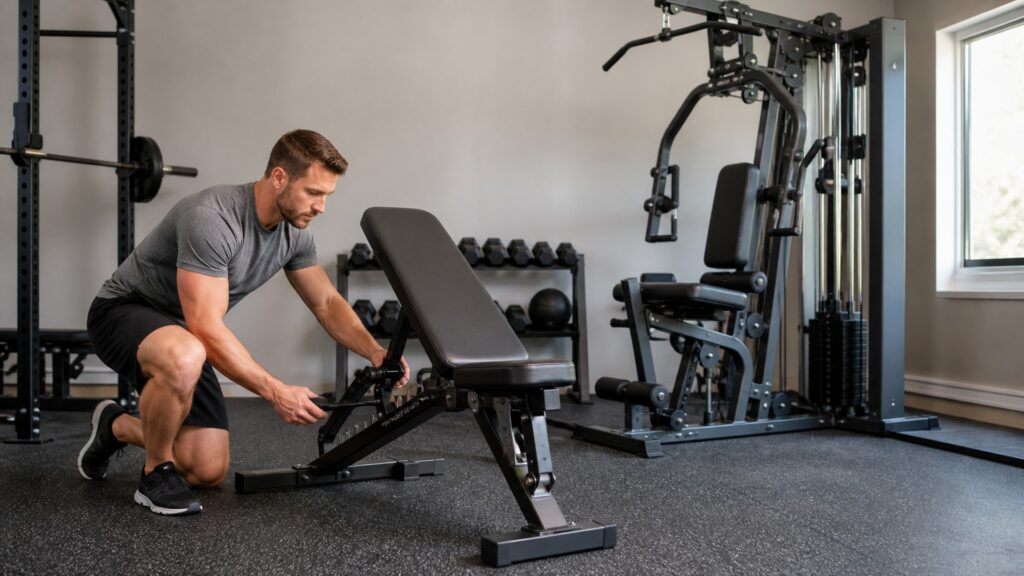
A practical decision path for choosing a bench over a broader all-in-one strength system.
Tip: Judge a weight bench by the exercises it makes stable, repeatable, and practical in the actual training space.
These concepts clarify how bench design affects home strength training decisions.
A weight bench is a stable support surface for strength exercises.
A home gym system combines several exercise stations or resistance functions in one machine.
Support surface is the pad that positions the lifter during an exercise.
Free-weight flexibility is the ability to use dumbbells, barbells, and body positions across many exercises.
Station coverage is the range of built-in exercise areas a larger system provides.
Space efficiency is how much useful training the equipment supports for the room it occupies.
Tip: A bench is useful when its height, pad, angles, and stability match the user's repeated exercises.
A bench is strongest when paired with dumbbells, barbells, racks, Smith machines, or cables. It gives those tools more exercise options.
The bench wins when body positioning solves the training gap.
A bench can move between dumbbell work, rack work, Smith machine work, and cable exercises. That flexibility can beat a larger system when the user wants a modular home gym.
A flexible bench supports several training paths without becoming the whole gym.
A home gym system makes more sense when the user wants the machine itself to provide several exercise stations and resistance options.
The system wins when all-in-one coverage is the bigger need.
Weight benches often take less fixed space than home gym systems, especially when they can be moved or stored. The working area still matters.
Compact equipment still needs usable space around it.
The decision is support surface versus built-in station coverage. If the user needs stable positioning, choose the bench. If the user needs a machine to provide the stations, choose the system.
The better purchase follows the missing training function.
The choice depends on flexible body support versus built-in station coverage.
The user already has dumbbells, bars, racks, cables, or bodyweight exercises to pair with the bench.
Space, flexibility, and modular setup matter.
The user wants the machine to provide resistance and multiple stations.
Guided all-in-one convenience matters more than modular training.
A smaller support tool can be the better choice when the rest of the setup is planned.
It is more useful only when its stations match the routine.
Bench stability and fit shape many loaded exercises.
It needs dumbbells, bars, cables, or bodyweight exercises to create training value.
Unused stations add cost and footprint without improving workouts.
Tip: A bench feature matters only when it improves setup, stability, or repeatable exercise quality.
Short answers for choosing and using weight benches.
Choose a bench when stable body support is the missing piece in a modular setup.
Choose a home gym system when built-in stations and resistance are the main need.
Sometimes. A bench can support extra dumbbell, rack, Smith machine, or cable work.
It can be enough only when paired with resistance such as dumbbells, barbells, or bodyweight exercises.
Choose benches for support and flexibility; choose home gym systems for built-in station coverage.
Weight benches make more sense than home gym systems when stable body support and flexible pairing with other equipment are the main needs.
Home gym systems are stronger when the user wants resistance and several stations built into one machine.
Use these Review Streets paths to compare related categories and practical next decisions.
Explore bench styles, adjustment features, and home-gym fit.
Compare rack setups that often pair with weight benches.
Review cable-focused equipment for accessory and angle-based work.
Choose a retailer
Prices checked regularly. We may earn a commission at no cost to you.