
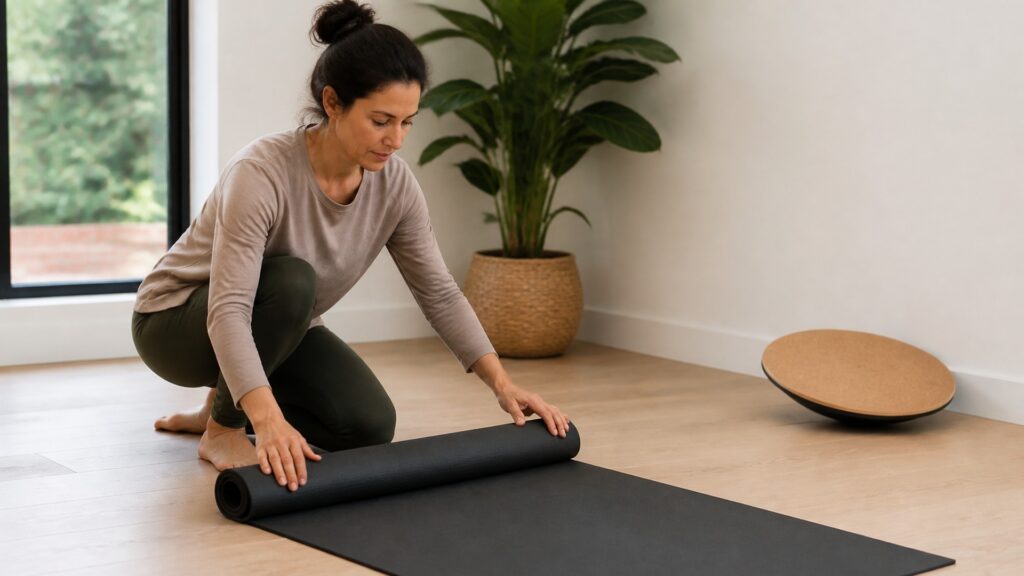
When to Use Yoga Mats Instead of Balance Training Equipment

Use a yoga mat instead of balance training equipment when the session needs stable grip, cushioning, and predictable floor contact. Yoga mats are better for ordinary yoga, stretching, mobility, floor work, and practices where the surface should support movement rather than challenge balance.

Balance training equipment is better when instability is the purpose. If the goal is not to train wobble, ankle reactions, or proprioception, a mat is usually the safer and simpler tool.

By: Review Streets Research Lab
Updated: October 6, 2026
Explainer · 8-12 min read
yoga mats explainer hero image for Review Streets
What You'll Learn

When Stable Floor Support Is The Better Fit

A practical decision path for choosing a yoga mat over balance boards, pads, discs, or other instability tools.

  • Why mats are better for stable floor-based practice
  • When balance gear creates unnecessary risk or distraction
  • How grip and cushioning support ordinary yoga sessions
  • Where balance equipment still has the stronger case
  • Why beginners often start with a mat
  • How to use both tools without confusing their roles

Tip: Use heart rate as one signal inside the workout, then confirm it with effort, pacing, recovery, and how the session actually feels.

Definitions

Key Concepts Behind Yoga Mats Instead of Balance Training Equipment

These terms keep the heart rate data tied to practical training decisions instead of isolated numbers.

Grip Surface

Grip surface is the mat texture and material that help hands and feet stay planted.

  • Example: a textured rubber mat during downward-facing dog
  • Check: test grip with dry and slightly sweaty hands
  • Limit: too much texture can feel rough for floor work

Cushioning

Cushioning is the mat thickness and density that reduce pressure on joints.

  • Example: extra padding under knees in kneeling poses
  • Check: press into the mat and see whether joints feel supported
  • Limit: too much softness can reduce balance

Stability

Stability is how steady the mat feels during standing poses and transitions.

  • Example: a firm mat that does not bunch during lunges
  • Check: try stepping and pivoting on the surface
  • Limit: very plush mats may feel less stable

Floor Boundary

A floor boundary is the defined practice area the mat creates.

  • Example: using the mat edges to position hands and feet
  • Check: choose length and width that fit the user's body
  • Limit: a mat cannot replace enough room around the body

Portability

Portability is how easy the mat is to roll, carry, store, and clean.

  • Example: taking a lightweight mat to class
  • Check: compare weight, roll size, and cleaning needs
  • Limit: very light mats may slide or wear faster

Practice Fit

Practice fit is how well the mat matches the user's yoga, mobility, Pilates, or floor-work routine.

  • Example: choosing a firmer mat for standing balance and a thicker mat for floor comfort
  • Check: match material and thickness to the main use
  • Limit: one mat may not be ideal for every style

Tip: Heart rate data gets more useful when the sensor signal, workout context, and training goal all line up.

Main Need

Choose A Mat When Stability Is The Goal

A yoga mat gives the user a predictable surface for poses, stretching, and floor work. It should make the session more stable, not more difficult to balance.

  • Use a mat for ordinary yoga and mobility.
  • Choose grip and cushion for the practice.
  • Avoid instability when the goal is alignment or comfort.

The mat fits when the surface should support the body.

Balance Gear

Use Balance Equipment Only When Instability Is Intended

Balance boards, pads, and discs are designed to challenge control. That can be useful, but it can also distract from yoga poses or floor work that need a steady base.

  • Use balance tools for targeted stability drills.
  • Keep support nearby when learning.
  • Do not add wobble to poses that already challenge control.

Instability should be planned, not accidental.

Comfort

Mats Are Better For Pressure Relief

Yoga mats help with knees, wrists, hips, elbows, and the spine during floor contact. Balance tools are usually not designed to be full practice surfaces.

  • Use mats for kneeling and seated work.
  • Add extra local padding when needed.
  • Choose dense cushioning that still feels stable.

Comfort is a valid reason to choose the mat.

Beginner Fit

A Mat Is Usually The Simpler Starting Point

Most users need a reliable surface before they need instability training. A mat is easier to set up, learn on, and use consistently.

  • Start with a stable surface.
  • Add balance tools only for a specific goal.
  • Keep the practice area clear.

A simple base helps the routine become repeatable.

Decision

Choose Support Or Challenge

The decision comes down to whether the session needs a supportive surface or a balance challenge. Mixing those roles without a reason can make training less clear.

  • Choose mats for stable support.
  • Choose balance gear for instability training.
  • Use both only when each tool has a separate job.

The right tool makes the session's purpose easier to follow.

Quick Reality Check

Where Mats Win And Where Balance Equipment Wins

The decision is stable floor support versus controlled instability.

Yoga Mats Win When

The user needs grip, cushioning, hygiene, and predictable floor contact.

The session is yoga, stretching, mobility, or floor-based strength.

Balance Equipment Wins When

The user wants targeted balance, proprioception, or ankle-control training.

Instability is the intended training stimulus.

Common Myths

Misconceptions About Yoga Mats Versus Balance Equipment

A more challenging surface is not always a better surface.

Balance equipment is an upgraded mat

It serves a different role by adding instability.

Yoga mats cannot train balance

They can support balance poses without adding a wobbling surface.

Beginners should start with balance gear

Most beginners benefit from a stable, predictable surface first.

Mats are only for yoga

Mats also support stretching, mobility, Pilates-style floor work, and bodyweight sessions.

Tip: Treat unusual readings as reasons to check the situation, not as commands to ignore your body.

FAQ

Frequently Asked Questions About Yoga Mats Versus Balance Equipment

Short answers for using heart rate data in real training decisions.

When should I choose a yoga mat?

Choose a mat when the session needs stable grip, cushioning, and predictable floor contact.

When is balance equipment better?

Balance equipment is better when the goal is deliberate instability and control training.

Can I use balance equipment on a mat?

Sometimes, but only if the setup is stable and the equipment is designed for that use.

Is a mat enough for balance practice?

It can support balance poses, but it will not create the same instability as balance equipment.

What is the practical takeaway?

Use a yoga mat for stable support and balance equipment for planned instability.

Bottom Line

Use yoga mats instead of balance training equipment when the session needs stable grip, cushioning, and predictable floor contact.

Balance equipment belongs when instability is the actual training goal.

Next Steps

Go Deeper or Compare Your Options

Use these Review Streets paths to compare related categories and practical next decisions.