
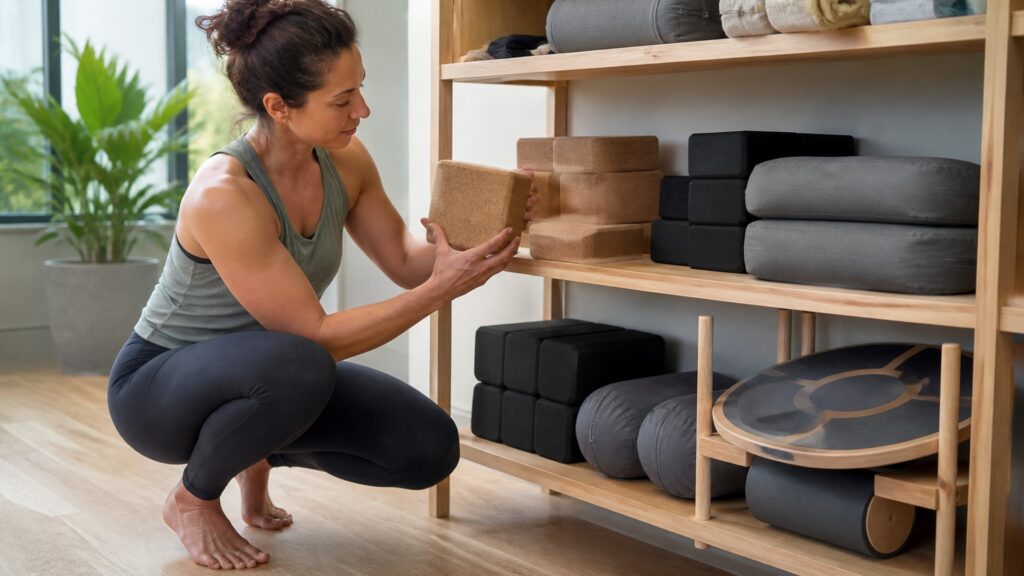
When to Use Yoga Props Instead of Balance Training Equipment

Use yoga props instead of balance training equipment when the session needs support, reach assistance, comfort, or alignment help rather than deliberate instability. Props are better when the goal is to make a pose more accessible or more settled.

Balance training equipment is better when the purpose is to challenge stability, proprioception, or ankle control. If wobble is not the point, a block, strap, bolster, or blanket is usually the clearer and safer support choice.

By: Review Streets Research Lab
Updated: October 6, 2026
Explainer · 8-12 min read
yoga props explainer hero image for Review Streets
What You'll Learn

When Support Is Better Than Instability

A practical decision path for choosing yoga props over balance boards, pads, discs, and other instability tools.

  • Why props are better for pose access and support
  • When balance equipment is better for instability training
  • How props reduce strain without adding wobble
  • Where comfort support matters more than challenge
  • Why beginners often benefit from props first
  • How to use both categories without confusing their roles

Tip: Choose the prop that solves the practice need in front of the user: reach, support, comfort, alignment, or a steadier setup.

Definitions

Key Concepts Behind Yoga Props Instead of Balance Training Equipment

These terms keep yoga props tied to practical support decisions instead of treating every accessory as interchangeable.

Support Point

A support point is the part of the body or pose that needs extra help from a prop.

  • Example: a block under the hand in a standing fold
  • Check: identify where the body is straining or losing position
  • Limit: support should not force a painful range

Range Aid

A range aid helps the user reach or hold a position without forcing mobility.

  • Example: a strap used to extend reach in a hamstring stretch
  • Check: keep the movement smooth and controlled
  • Limit: a prop cannot replace gradual mobility work

Comfort Support

Comfort support reduces pressure during longer holds or floor positions.

  • Example: a blanket under knees or a bolster under the torso
  • Check: confirm the pose feels calmer without collapsing
  • Limit: too much softness can blur alignment

Alignment Cue

An alignment cue is feedback from a prop that helps the user place the body more clearly.

  • Example: a block between the thighs to track leg position
  • Check: use the cue only when it improves the pose
  • Limit: props should not turn the session into clutter

Pose Access

Pose access is the ability to practice a position at a usable level today.

  • Example: raising the floor with blocks so the spine can stay longer
  • Check: choose the simplest prop that makes the pose workable
  • Limit: access still depends on the user's body and instruction

Setup Stability

Setup stability is how secure the prop feels under load or during transitions.

  • Example: a firm block that does not wobble under the hand
  • Check: test the prop before committing weight
  • Limit: unstable setups can create risk instead of support

Tip: Yoga props work best when the user knows what problem the prop is solving before adding it to the pose.

Main Need

Choose Props When The Pose Needs Support

Yoga props make a position more accessible, comfortable, or aligned. They are useful when the user needs help reaching, resting, or staying steady.

  • Use blocks to raise the floor.
  • Use straps to extend reach.
  • Use bolsters or blankets for comfort.

Props fit when support is the goal.

Balance Gear

Choose Balance Equipment When Instability Is The Goal

Balance boards, pads, and discs are designed to make stability harder. They belong when the session is specifically training balance reactions.

  • Use balance tools for controlled instability.
  • Keep support nearby during new drills.
  • Avoid wobble when the pose needs steadiness.

Instability should be intentional.

Safety

Props Usually Reduce Challenge Instead Of Adding It

A good prop setup can reduce strain and help the user stay within a usable range. Balance equipment raises the challenge and may raise fall risk.

  • Choose props for access and comfort.
  • Choose balance tools for stability drills.
  • Do not add instability to already difficult poses.

Support and challenge should not be confused.

Beginner Fit

Props Are Often The Better Starting Point

Many users need a reliable way to adapt poses before they need a wobbling surface. Props can make practice clearer without demanding extra balance skill.

  • Start with stable support.
  • Add balance gear only for a specific drill.
  • Keep the practice area uncluttered.

A supported setup is easier to repeat.

Decision

Choose Access Or Instability

The decision is simple: use props when the pose needs help, and use balance equipment when instability itself is the training stimulus.

  • Choose props for support and alignment.
  • Choose balance gear for proprioception work.
  • Use both only when each has a separate job.

The right tool makes the session purpose clearer.

Quick Reality Check

Where Props Win And Where Balance Equipment Wins

The decision is support-focused access versus controlled instability.

Yoga Props Win When

The user needs reach help, pressure relief, comfort, or alignment support.

The session needs steadiness rather than wobble.

Balance Equipment Wins When

The user wants targeted balance, proprioception, or ankle-control training.

Instability is the intended challenge.

Common Myths

Misconceptions About Yoga Props Versus Balance Equipment

A harder surface is not automatically a better training choice.

Balance equipment is an upgraded prop

It serves a different role by adding instability.

Props make practice too easy

Props can make practice safer, clearer, and more repeatable.

Every pose improves with wobble

Instability helps only when it matches the goal and ability.

The tools are interchangeable

Props support access; balance tools create challenge.

Tip: A prop is useful when it makes the practice clearer, more supported, or easier to repeat with control.

FAQ

Frequently Asked Questions About Yoga Props Versus Balance Equipment

Short answers for choosing and using yoga props in real practice.

When should I choose yoga props?

Choose props when the session needs support, reach assistance, comfort, or alignment help.

When is balance equipment better?

Balance equipment is better when the goal is deliberate instability and control training.

Can balance equipment be used with yoga props?

Sometimes, but each tool should have a clear role and the setup must stay safe.

Are props better for beginners?

Often, because stable support is usually more useful than instability at the start.

What is the practical takeaway?

Use yoga props for supported access and balance equipment for planned instability.

Bottom Line

Use yoga props instead of balance training equipment when the session needs support, comfort, reach, or alignment help.

Balance equipment belongs when instability is the actual training goal.

Next Steps

Go Deeper or Compare Your Options

Use these Review Streets paths to compare related categories and practical next decisions.