When Travel Clothing & Footwear Are Worth Comparing

Travel clothing and footwear are worth comparing when one specific difference would change what you take, what you expect to see, or what still needs doing before you leave. A color-specific fabric exception or an unfinished hem can settle what you pack. Sometimes the answer takes a closer look at the actual item.

By: Review Streets Research Lab
Updated: November 24, 2026
Explainer · 9–12 min read
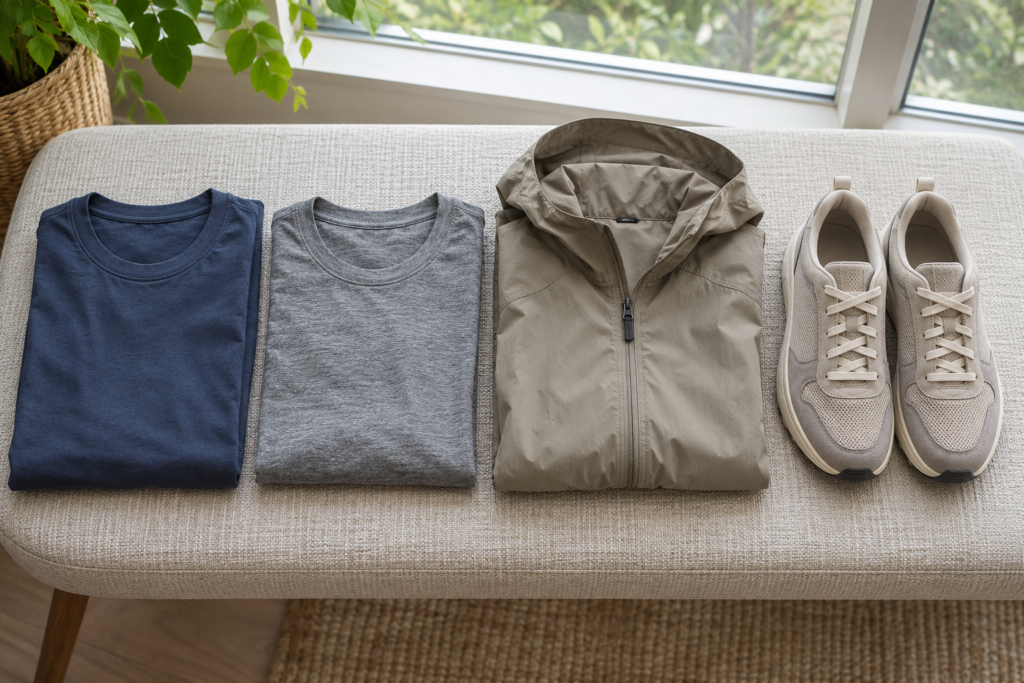
Folded navy and gray tees, a taupe jacket, and light sneakers on a bench.
Start here

What makes a difference worth comparing?

Take two plausible choices and one unresolved decision. The examples show when a listing can answer and when the item itself has the answer.

  • Read the fabric exception for a named color.
  • Keep the answer with the style you actually mean.
  • Distinguish a print name from an exact motif location.
  • Recognize separate design controls for the two shoes.
  • Read a pocket description face by face.
  • Identify when the original hem work remains.
  • Know which uncertainties you can leave open.

Tip: Finish the sentence “I’d take the other one if…” before opening another product tab. The ending tells you what answer would let you stop.

Terms

Words that tell you what a description covers

The question may point to a product version, a garment part, or the particular piece you’ll take.

Colorway

The named shade or color combination of a design.

  • Where it appears: A model name can cover multiple color options.
  • Name to match: Use the whole shade name, even if your notes just say “gray.”
  • Composition: The composition can have its own entry.

Fiber content

The fibers in a fabric and their stated proportions.

  • Percentage: Each percentage goes with a named fiber.
  • Fabric: In cotton jersey, cotton names the fiber and jersey the knit.
  • Blend: A breakdown can list cotton alongside a second fiber.

Print placement

Where the printed design appears on the garment.

  • Motif: One element of the artwork, such as a flower.
  • Panel: A section of the garment, such as the bodice, or upper part of a dress.
  • Exact position: A named panel can leave individual motif positions open.

Backtab

The section at the back of a shoe near the heel.

  • Viewing angle: Think of a view from behind to see the backtab.
  • Separate location: The tongue sits at the upper front opening.
  • Inscription: A description may name the backtab as a place for lettering.

Reversible garment

A garment made so that either face can be worn on the outside.

  • Outward face: The face visible to someone looking at the wearer.
  • Side names: A description can distinguish the faces by pattern.
  • Feature location: A feature may be listed for one face or both.

Finished hem

A completed garment edge, here at the bottom of each trouser leg.

  • Part of the garment: Here it’s the edge of the leg opening.
  • Supplied condition: The description can specify how that edge is supplied.
  • Scope: Other adjustments a traveler wants are separate decisions.

Tip: Put the question in ordinary words. “Where does the lettering go?” asks for a location. “Can each shoe have different lettering?” asks how the controls work.

Fabric

When the shirt color decides the fabric question

Imagine choosing a pocket tee for a weekend away. Either color suits your outfits. You have one firm preference for the shirt itself. You want it to be all cotton.

  • The US Carhartt Iconic K87 lists all-cotton jersey by default, with exceptions.
  • Black falls outside the named exceptions, so the default applies to that K87 color.
  • For Heather Gray, Carhartt specifies 90% cotton and 10% polyester.
  • Imagine the traveler set the gray shirt on top of the case because it goes with the rest of the clothes. The all-cotton requirement still points to Black.
  • The Dearborn lists all-cotton solids and the same Heather Gray blend. Each result comes from its own model’s listing.

In a different version of the same trip, the traveler might be happy with either fabric and care more about the color. Then the listed blend needn’t change the outcome.

Pattern

Where the print lands on a dress

Imagine planning a paired vacation photo. One dress is already in hand. In the shot you have in mind, a particular flower sits at the same point beside a front seam on both dresses. A matching print name gets you partway.

  • City Chic says the placement can vary on its Layla La Mont Print Black Midi Dress. The name identifies the print while leaving that flower’s position on the second copy open.
  • Casa Ru’s listing for the Lapis Meadow Matilda Dress describes a print on the bodice. That identifies the region and leaves the position of any individual motif open.
  • For the paired photo, a view of that flower beside the seam on each actual dress would settle the comparison. If the picture only calls for the same named print, that closer view is optional.

A precise alignment takes a view of the two dresses at the level the photo needs.

Custom shoes

Which design choices can differ within one pair

Imagine a small show on a trip. The audience sees the traveler’s left shoe in profile in one scene and the right in another. The traveler wants a distinctive treatment in the first view and a plain one in the second. If the staging changes so the audience only sees one side, the traveler can decide whether the second treatment still matters for this trip.

  • Nike describes separate left and right customization for its Dunk Low Unlocked By You. It excludes character personalization from that statement.
  • The regular Dunk Low By You record mentions choices for the Swoosh and backtab, along with backtab lettering. Those details leave separate color or material control by foot open.
  • For the show, the relevant evidence would put both intended treatments together in the exact design tool, assigned to the intended sides.

Separate control opens the possibility of two profiles. If the intended combination stays unconfirmed, the traveler can decide how much of either treatment the scene actually needs.

Reversible jackets

Which face has the pockets

Imagine a child with two reversible jackets already on hand for a weekend away. Either would work for the trip. During a wait, the child wants somewhere to rest their empty hands whichever face they wear outward.

  • The UK Joules Primrose Blue Quilted Reversible Jacket, style 750-052, has a floral face and a striped face. Joules identifies only the striped face as having front pockets.
  • The UK Helly Hansen Kids’ Dalen Reversible Jacket, style 41805, lists hand pockets for each face. That covers the family’s question about provision whichever face is worn outward.
  • Say the child wants to choose a face on the day. The Dalen description answers for either choice. On the Primrose, the documented front-pocket provision would make the outward face part of the decision.

If both faces are an option, the useful comparison is whether the record covers both. If the family has chosen one face already, the description of that face can be enough.

Hems

Whether the trouser hems are finished

Suppose two otherwise acceptable pairs of trousers are already on hand for a ceremony trip. Both retain their as-supplied condition. You want to put one straight into the case, so an outstanding job at the lower edge would matter. The case has to be closed tonight. The next morning the traveler is leaving directly for the ceremony, with no intermediate stop.

  • Moss says its Italian Tailored Fit Grey Morningwear Unhemmed Pants need hemming.
  • Brooks Brothers specifies finished hems for its Classic Fit Stretch Wool 1818 Dress Pants, style MJ00436. In its supplied condition, the initial edge work is complete.
  • If there’s time for hemming, either pair remains an option.

For immediate packing, only the finished pair clears the hem requirement in this example.

Reality check

When the description can only get you partway

Two situations can call for a closer look after you find the right listing.

How close does the match have to be?

Imagine arranging two portraits in a trip scrapbook. For a loose visual match, it’s enough to show a print across the upper part of each dress. Casa Ru’s Matilda description gives that broad location for Lapis Meadow.

Change the layout so both crops need a blue area in the upper right corner. Now you need a view of each dress within that intended frame.

Which point in the garment’s life are you looking at?

Imagine borrowing a pair. Moss describes the unfinished original. The owner may already have had them hemmed.

If the answer would change what you pack, look at the borrowed pair’s lower edge.

Common misreadings

What similar wording can lead you to assume

Similar names and pictures can suggest more than the details support.

Can every K87 color without “Heather” in the name be treated as all cotton?

Brite Lime and Brite Orange are blends, too.

Does the product photo fix the crop of the print on every copy?

Never Fully Dressed says the print on its Black Rio Maxi Dress can land differently from the photos. It links that variation to how it cuts the fabric to reduce offcuts.

Does the shared Dunk Low By You name tell you where your lettering goes?

The Unlocked listing puts the inscription on the tongue. The regular listing puts it on the backtab. Which page you’re reading matters for a view of the heel.

Does hand-pocket provision on both faces mean the openings match?

The US listing for The North Face Girls’ Reversible Shasta Full-Zip Jacket describes zippered hand pockets on the outer face and open ones on the reverse.

Does “Tailored Fit” in the name tell you the hem is already finished?

The Moss name combines “Tailored Fit” and “Unhemmed.” The trousers still require hemming.

Tip: Say the exact claim you’re tempted to infer. It becomes easier to tell whether the description actually makes it.

Questions

What would resolve the remaining uncertainty?

The follow-up can be smaller than the original comparison.

What does Carhartt list for the K87’s other heather colors?

Other K87 heathers are listed at 60% cotton and 40% polyester. Heather Gray has its own entry.

Would a photo establish the fabric content of a tee I already own?

A clear photo of the composition label can show what that label declares. Color alone leaves the composition open.

What should a photo of the second printed dress show?

Show the relevant part of that dress with a reference point, such as the edge of a neckline. A crop of just the artwork leaves its position on the garment open.

Can I infer a different word on each shoe from the regular Dunk’s character limit?

The cited regular listing gives a backtab ID limit of five characters per shoe. It leaves open whether you can enter a different string for each one.

What if the shoe builder never displays the two specific treatments together?

Even if both treatments appear in separate previews, their availability together remains unconfirmed.

What if the striped face stays outward for the whole trip?

Joules assigns the Primrose’s front pockets to the striped face. If that face stays outward throughout, the other face drops out of the pocket question.

Does the Dalen description provide a pocket count for each face?

The cited passage establishes hand-pocket provision for both faces and leaves the number per face open. If that detail matters, a view of each face of the actual jacket could answer it.

Does a finished hem settle every task left before I pack the trousers?

It settles the initial finishing of the trouser edge. Any separate change you already had in mind remains its own decision.

Tip: If the trip decision stays the same either way, keep the answer you have and leave the follow-up open.

Bottom line

Compare the detail that can change your plan. Think ahead to the moment when the answer would matter, whether you’re closing the case or looking through the camera.

Once you can make the choice, stop. If each scene still needs a different shoe profile, look for both treatments in one preview.

Related reading

More on travel clothing and footwear

Open a format archive for travel clothing and footwear.