When Travel Comfort Are Worth Comparing

Travel comfort products are worth comparing when similar descriptions could hide a difference you need to know. One sound machine’s lock guards against startup when engaged for travel. Another lock protects settings while the machine runs. If you need the machine to stay off, the first claim answers a question the second leaves open.

By: Review Streets Research Lab
Updated: November 25, 2026
Explainer · 10–12 min read
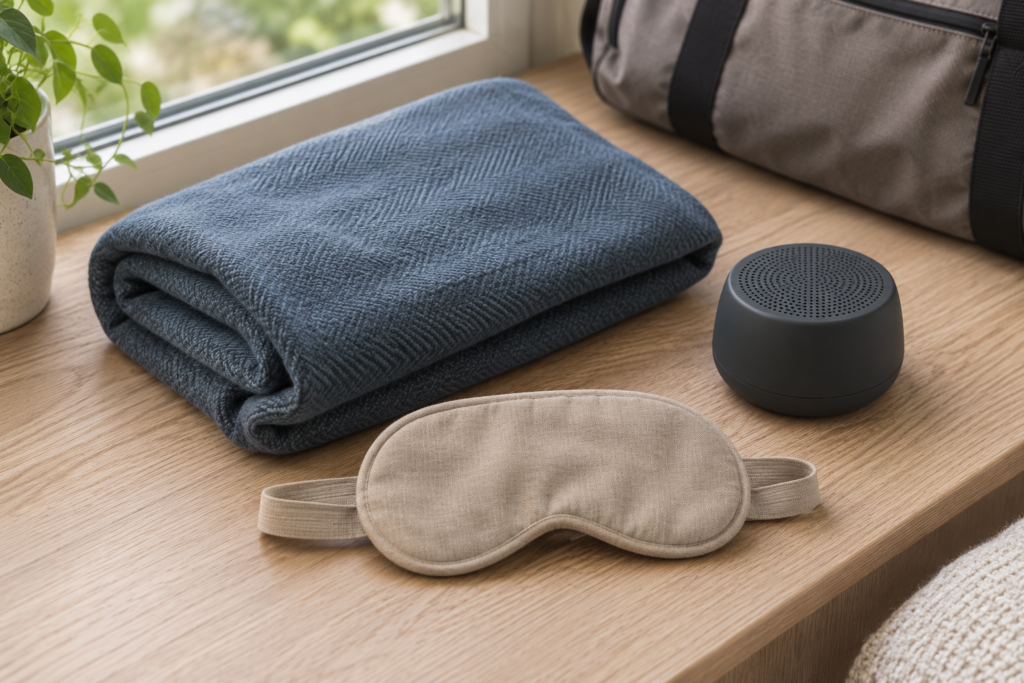
A folded blue travel blanket, beige eye mask and compact black sound machine on a wooden bench beside a travel bag.
What you’ll learn

Where a closer look pays off

Name the action you’re about to take. The same fact can settle a packing choice for one traveler and leave another traveler’s plans unchanged.

  • How to pin down what a sound machine’s lock protects in a given power state.
  • How to read a printed request and a choice about displaying one.
  • Where to look for the access level attached to a specific audio entry.
  • How to find the organization or park work named in a purchase statement.
  • When a maker’s own statement can answer a materials question and when you need an independent account.
  • How to distinguish a claim you can use for a decision from a result you would need to observe.
  • How a comparison can settle one question and leave another open.

Tip: Complete the sentence “I would change my plan if I found out that…” An empty blank is a reason to pause.

Definitions

Six terms for reading product records

Find the subject of the promise first. Is it one catalog entry, a particular sale, or the state a device starts in?

Starting state

The condition an item is in just before the action you’re asking about.

  • Before: Name the starting condition, such as already off or already running.
  • After: The outcome is what you want to preserve, whether a setting or silence.
  • Model: Use the instructions for the exact model.

Outward request

Words placed where someone else could see the request you want to make.

  • Audience: The audience is the person you would make the request to directly.
  • Wording: Read the words the item is meant to show.
  • Choice: Decide whether sometimes you want to show nothing.

Access tier

The level of access needed to use a particular service or entry, such as included access or access through a membership.

  • Entry: Find the exact item you want in the audio catalog.
  • Heading: The column heading gives context to the entry beneath it.
  • Available to you: Match the tier to the access you can actually use.

Beneficiary

The organization or work a seller says a purchase or a named collection helps support.

  • Who says it: Keep the seller’s name with the offer you read.
  • What it covers: A collection statement names the range it describes.
  • Specificity: If a particular place matters, look for it in the description of the supported work.

Maker declaration

A statement a manufacturer makes about its own product or product line.

  • Coverage: Check whether the sentence covers one item or a named range.
  • Exceptions: Read any exclusions before applying the statement to an item.
  • Proof: Your decision may depend on whose assurance you can accept.

Decision threshold

The condition that would change your next step if the answer went the other way.

  • Baseline: Put your current plan in words before you read.
  • Priority: Decide whether the condition is essential or a preference.
  • Next move: Think of an action for each possible answer.

Tip: Keep the sentence that answers your question. If another passage seems to extend it, check whether the two describe the same item and situation.

Power state

Which state does the sound machine’s lock preserve?

Hypothetical example. You can borrow either of two portable sound machines. You want the one you pack to stay switched off if something in your bag presses a button.

  • In the hypothetical, write down what you need to be true before you put the machine into the bag. That worded requirement is what you take to the manual.
  • In the SoundSpa Ultra instructions for SS-6050, HoMedics says the lock blocks startup during travel.
  • The same manual says engaging the lock while the machine runs shuts it down.
  • Yogasleep describes the Hushh+ lock as guarding sound and timer settings against accidental changes. Its manufacturer-authored setup guide, available through a manual mirror, starts the procedure with the unit on.
  • The Hushh+ records describe protection for settings while it runs and leave startup from off undetermined.

For the hypothetical trip, the SS-6050 manual supports packing the machine switched off with the lock engaged.

Visible wording

Can the eye mask make a request optional?

Hypothetical example. Two people are traveling by train together. One wants the words on an eye mask to request a quiet pause sometimes and wishes to wear it without a message at other times.

  • Anya Hindmarch’s ink-blue Travel Eye Mask has DO NOT DISTURB printed across the front.
  • Lipault lists a do-not-disturb option for Sleep Mask item 1550711041 and says you can wear it with no message showing.
  • If the request itself is the whole requirement, both listings supply it. If the wearer sometimes wants a blank mask, the explicit option in Lipault’s listing matters.

The text expresses a request for a quiet pause. Whether the companion notices or responds remains open.

Audio access

Which audio entry is included with the device?

Hypothetical example. An adult has permission to use the Restore 3 at their accommodation and already has whatever platform and account access this setup requires. They want a particular audio entry without taking out a new membership.

  • Hatch makes basic device use available without Hatch+. Its Restore 3 support table identifies which Unwind entries are included.
  • In that table, The Great Gatsby is an included Unwind audio entry. Pride and Prejudice is an Unwind audio entry on the Hatch+ side.
  • Base access covers the first entry. Authorized Hatch+ access covers the second.

The device can stay where it is. This comparison changes the audio choice or the decision to use an existing membership.

Purchase terms

What work does the seller say the purchase supports?

Hypothetical example. You want a blanket as a souvenir of Glacier National Park. You also want the seller’s offer to name work in the park. A Glacier design can serve the first purpose. The sale terms answer the second question.

  • The Glacier National Park Conservancy’s offer for the Rumpl Glacier Original Puffy Blanket, item 802445, says purchase proceeds help fund projects and programs within Glacier National Park.
  • On its page for Glacier National Park Throw With Carrier, item 74273, Pendleton names the National Park Foundation as the organization it supports.
  • Pendleton separately says that part of the proceeds from purchases in its National Park Collection goes toward the Foundation’s work. The collection statement has its own scope.

The Conservancy offer gives the visitor the park-specific statement they wanted. Pendleton’s disclosures name the Foundation and leave the ultimate project destination open.

Sourcing evidence

When does the source of a materials claim matter?

Hypothetical example. It’s worth comparing who checked a materials claim when the purchase turns on the source of the answer. For your own travel wrap, you accept the maker’s word that it uses no animal-derived materials. Friends joining the trip want independent evidence of that same fact for the same wrap before you order theirs.

  • COCOON identifies merino wool and silk in its Merino wool / Silk Travel Blanket. That disclosure rules out the named wrap under the group’s rule. Here, it’s enough to have the maker name a material you already mean to exclude.
  • Rumpl identifies Deepfoam Fade as a Travel Puffy Blanket. In its statement about products made without animal inputs, Rumpl names three exceptions. These are the Down Puffy Blanket, the FeatherLite Puffy Blanket and the Merino SoftWool blanket. Travel Puffy falls within the maker’s statement about the rest of its range. Together the FAQ and listing give you the maker’s answer for your own purchase.
  • The listing and FAQ come from the same maker. For the group to act, an independent account would need to establish the same fact for this wrap through its own work. A page that repeats the manufacturer’s assertion gives you another place to read it.

The maker’s documents can answer the personal question under the traveler’s standard. The same evidence leaves the shared order pending, even though everyone agreed on the materials rule.

Reality check

What the records can settle

Draw the conclusion at the same scale as the support you have.

When the borrowed unit is hard to identify

Imagine your companion is about to pack a borrowed device and the model label is unreadable. A photo of the unit can help you and its owner discuss the same object. You still need some way to match that object to the instructions you plan to pass on.

Ask the owner whether they have the instruction sheet or a purchase record that identifies the model. If that question is still open when you hand the bag over, tell your companion exactly what you were unable to confirm. They can see where your packing note needs an answer.

A catalog and permission answer different questions

Hatch’s table tells you the tier for a selection. Permission to use equipment in your accommodation is a separate question for whoever controls it.

If you see a device in an accommodation photo, start with whoever can authorize you to use it. Describe what you want to do so they can give you an answer about the stay.

Myths and misconceptions

Five tempting shortcuts

These readings put more weight on a label or a line of text than the record can carry.

“A lock on a sound machine means I can lock it off.”

The word covers different outcomes in these records. A lock can hold a running machine’s settings in place. Keeping a machine from starting is a separate claim that needs its own support.

“A mask that displays a request gives me the option of a blank front.”

Look for an explicit choice if a blank front matters to you. Lipault describes a blank option. Anya Hindmarch’s listing describes the lettering on the front.

“If I can use the device without membership, the audio I wanted is included.”

Basic use and access to one piece of audio are separate.

“The park on the blanket tells me where the purchase money goes.”

The park name identifies the theme. Read the seller’s written commitment to find the work or organization it names.

“A brand’s materials statement applies across its entire catalog.”

A maker can make an affirmative statement about its range and put named lines outside that statement. Those exceptions are part of the answer for the item you’re considering.

Tip: Put the source sentence next to your conclusion. If yours reads more broadly, find the words that extend the promise.

FAQ

Questions that come up when you compare

Use these follow-ups when you need one more detail to read the record or work out whom to ask.

How do I find the right instructions when products have similar names?

Match the model number on the unit or offer to the maker’s instructions. HoMedics indexes the SS-6050 in its directory of manuals.

What does it mean when the Hushh+ lock indicator goes dark?

The Hushh+ guide says the indicator can go dark while the lock stays engaged. In that documented state, the light alone gives you an incomplete read on the lock.

When is there enough information to stop comparing the two masks?

If all you want is the request to be left undisturbed, both listings document it. Any other preference needs its own question.

What does the star next to a sound in the Restore app mean?

In Hatch’s Restore guidance, a star marks a Hatch+ sound. Entries without one are free to use.

Can I calculate how many dollars of my order go to the work named in these blanket listings?

The disclosures leave the amount for a specific order open. A named beneficiary tells you whose work the seller says it supports.

What if I get a statement from someone outside the company?

Ask whether the author is describing work they did or information they got from the maker. If you share it with someone else, carry that answer along with the statement.

What if my group asks for an independent certificate?

The evidence here comes from the manufacturers. Ask whose certification your group accepts before requesting documentation.

Does the comparison have to change what I take on the trip?

A comparison can leave your plan in place and give you a better question. Name the detail you still need before you can treat the plan as settled.

Tip: Note what the page supports and the question left open. A model number or entry name will help you find the record again.

Bottom line

Compare when the documented difference answers a choice you’re making. For a traveler who wants to leave the front of a mask blank, Lipault expressly offers that option. Anya Hindmarch’s listing documents its printed request.

You can settle which words you want to show. Whether a companion notices the request still depends on that person and situation. That part of the trip remains open even after you can make the product decision.

Related reading

Explore Travel Comfort

Choose the reading format that suits the question you still have.