
Set Point
Temperature or level requested through the control.
- Use: choose an initial exposure
- Variable: electronics and calibration
- Tradeoff: Not identical to hair temperature
Adjustable heat settings matter because the temperature needed to complete a style is not constant. Fine, bleached, fragile, short, or already-dry sections may respond at lower exposure than dense, resistant, or wetter sections, while technique and tool geometry change the contact dose.
A useful control provides stable, distinguishable levels that can be reached without accidental changes. The displayed number is only a set point: temperature across the plate or air stream, contact time, distance, moisture, pressure, and repeated passes determine what hair experiences. Adjustment matters most when it helps the user find the lowest setting that works reliably.
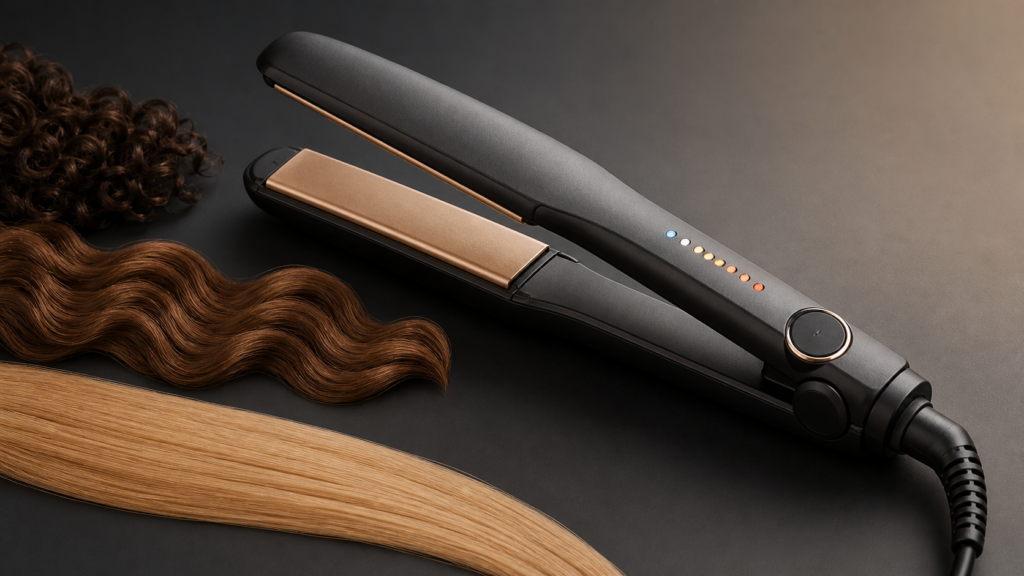
Show how usable heat ranges create an exposure-control system for different water states, fiber condition, section sizes, techniques, and tools, while calibration, dwell time, and repetition remain essential.
Tip: A setting should be earned by the result.
These adjustable heat settings concepts separate mechanism, application, limits, and purchasing consequences.
Temperature or level requested through the control.
Combined effect of temperature, time, and repetition.
Ability to remain near the intended output during use.
Return toward the set point after a section absorbs energy.
Size and number of available setting steps.
Unintended setting change caused by grip or button placement.
Tip: Use these terms to test adjustable heat settings instead of relying on a front-label promise.
Start with the lowest workable level on a hidden prepared section, then increase only if efficient technique fails. Existing damage and chemical processing justify more caution.
A setting should be earned by the result.
A lower number does not help if the tool lingers or repeats the same section. Track the complete exposure rather than treating temperature as the only variable.
Time and repetition turn a setting into a dose.
Hairlines, ends, lightened panels, and previously damaged areas may need less exposure than dense untreated roots. One global setting can overtreat the weakest zone.
The weakest fiber sets the safety margin.
Useful buttons can be read, reached, and locked or avoided during styling. A precise number is unhelpful when the switch changes under the hand or output surges.
Ergonomic control is part of temperature control.
Look for a genuinely low option, sensible steps, fast but controlled recovery, auto shutoff, and a return policy. Maximum heat is rarely a benefit for vulnerable hair.
A broad usable range is more valuable than an extreme ceiling.
Adjustable controls widen the usable range; they do not certify accuracy or make every listed temperature appropriate.
A lower stable setting completes the target with few corrections.
The user can adapt exposure for changing sections and hair condition.
Tiny displays and many levels may create false precision.
Low heat paired with prolonged or repeated exposure can still be excessive.
These claims flatten the variables that determine how adjustable heat settings performs in a real routine.
Lower temperature generally reduces one risk variable, but long dwell, repeated passes, wet contact, tension, and frequent styling still create cumulative exposure.
The interface may offer many steps while actual plate or air temperature varies. Calibration, uniformity, stability, and control placement matter more than the count.
Density and strand diameter can increase styling time, but sectioning, pre-drying, tension, and geometry may improve efficiency without the highest setting.
Displays report a set point or internal measurement. Contact, plate position, airflow, moisture, product, and movement create different fiber conditions.
A protectant may reduce selected damage in a product-specific way, but it does not provide a universal temperature guarantee. Follow both product and tool directions conservatively.
Tip: Test the exact adjustable heat settings tool, setting, and routine before generalizing from its category.
The remaining decisions about adjustable heat settings concern technique, compatibility, safety, upkeep, and value.
Use the lowest level likely to work on a hidden prepared section, following the manufacturer's directions. Increase one step only after correcting section size and technique.
They often warrant a more conservative approach because prior processing can weaken fibers. Reduce frequency, setting, dwell, and repeated passes, especially at the ends.
Numbers can improve repeatability only when controls are stable and reasonably calibrated. Clear low, medium, and high levels may be sufficient for a careful routine.
Hair absorbs energy and control systems cycle. Recovery depends on heater power, sensors, plates, airflow, and section size; slow recovery may encourage harmful repeated passes.
Not necessarily. Vulnerable hairlines, ends, or lightened areas may need less exposure, while better sectioning can address resistant zones without raising heat globally.
Scorching odor, smoke, painful scalp heat, steam from inappropriately wet hair, abrupt roughness, discoloration, or increasing breakage means stop and reassess.
Adjustable heat settings matter because they let the user match exposure to water state, hair condition, section, geometry, and technique. Their value is the lowest stable level that completes the style without repeated correction.
Treat the setting as one part of thermal dose. Include dwell, distance, pressure, passes, frequency, calibration, and vulnerable zones when selecting and buying a tool.
These Review Streets paths narrow the next adjustable heat settings decision by format, goal, and routine fit.
Compare dryers, irons, wands, multi-stylers, and their buying paths.
Explore airflow, heat control, attachments, ergonomics, and long-term versatility.
Choose a retailer
Prices checked regularly. We may earn a commission at no cost to you.