
Slide-Pin Service
Cleaning and lubricating the guide pins that let floating calipers move.
- Purpose: Keeps clamp force balanced
- Watch: Torn boots or dry pins
- Limit: Wrong grease can damage rubber
Brake caliper maintenance matters because a caliper can fail gradually before it looks broken. Slide pins dry out, boots split, pad clips collect rust, and piston surfaces can start binding long before the driver sees fluid on the wheel.
Maintenance is not about polishing a caliper for appearance. It is about preserving the small movements that let pads apply evenly and release cleanly, so new pads and rotors are not forced to work around old friction points.
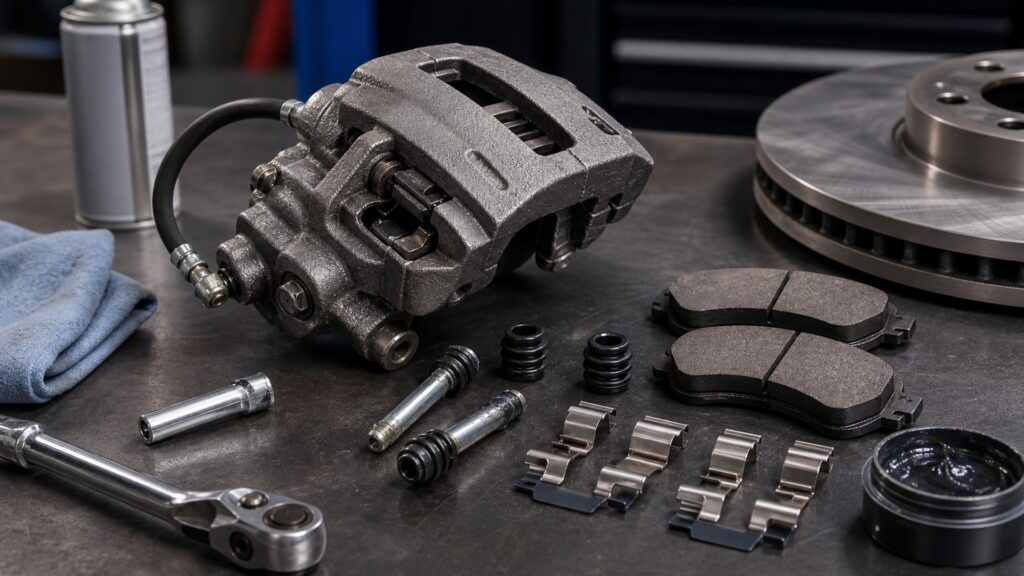
A clear explanation of brake calipers maintenance role, focused on role, mechanism, fit, service limits, and repair decisions.
Tip: Read the concept as part of a system, then connect it back to the use case.
These definitions connect the main idea to the variables, limits, and practical signals readers need to compare options.
Cleaning and lubricating the guide pins that let floating calipers move.
Checking rubber dust boots that protect pistons and guide pins.
Removing rust where pad ears and clips sit in the caliper bracket.
Looking for pitting, roughness, or seal damage around the piston.
Replacing clips, shims, retainers, and boots when they no longer guide pads correctly.
Comparing both sides of the axle after service.
Tip: Keep the definitions connected; the strongest answer usually comes from the whole system, not one term.
A caliper's maintenance role begins with the parts that guide motion. If they bind, every stop can become uneven even when the new friction parts are correct.
Maintenance protects movement before the caliper becomes a replacement problem.
Floating calipers depend on guide pins more than many shoppers realize. When those pins seize, the piston side and outer pad no longer share work evenly.
A smooth slide path is part of caliper function.
Pad hardware is small, but it controls where pads rest and how they move. Rust under a clip can pinch a pad tightly enough to mimic a caliper fault.
Hardware maintenance keeps the pad from fighting the caliper.
Neglect can turn a basic brake service into repeat wear. Drag creates heat, heat changes friction behavior, and corrosion keeps the same cycle going.
A neglected caliper can consume new pads faster than expected.
Maintenance work should also answer a question: did the caliper move freely before and after the service? That check is more useful than simply replacing visible parts.
Good maintenance leaves evidence that the caliper can apply and release.
Maintenance is most useful when it protects motion before the caliper becomes an expensive failure.
It can reduce drag caused by dry slides, rusty brackets, and tired boots.
It can help new pads seat and release without fighting old contact points.
It cannot repair a leaking piston seal or cracked caliper body.
It cannot compensate for a wrong rotor, wrong pad shape, or collapsed hose.
Common shortcuts and misunderstandings can make the topic seem simpler than it is.
Dry guide pins and rusted pad channels can create trouble before fluid appears.
Only the correct high-temperature lubricant should go on approved contact points, never on friction surfaces.
Clips, boots, and retainers help pads move quietly and return correctly.
A piston can compress yet still have damaged boots, corroded guides, or poor release behavior.
Tip: Treat strong claims as starting points for comparison, not final answers.
Concise answers to common questions readers may have after the main explanation.
Typical work includes inspecting boots, cleaning brackets, servicing slide pins, checking pad hardware, and watching for leaks.
It can when wear comes from binding slides or pad contact points, but other causes must be ruled out.
They should be inspected and serviced when the design calls for it, using brake-safe lubricant.
The pad channel can tighten and keep pads from sliding freely.
Leakage, severe piston corrosion, stripped threads, or damaged mounting points usually require replacement.
Caliper maintenance matters because small friction points decide whether the brake releases properly.
The best brake job checks the parts that move, not just the parts that are visibly worn.
Use these Review Streets paths to connect the explainer to related categories, comparisons, and next decisions.
Use the Automotive Replacement Parts path for related brake component explainers and comparisons.
Use the Brake Components path for related brake component explainers and comparisons.
Use the Brake Calipers path for related brake component explainers and comparisons.
Choose a retailer
Prices checked regularly. We may earn a commission at no cost to you.