
Fluid Leak
Brake fluid escaping around a piston seal, hose connection, or bleeder.
- Risk: Reduces pressure and can contaminate friction surfaces
- Signal: Wetness, fluid loss, or a sinking pedal
- Limit: Diagnosis must identify the exact leak point
Brake caliper safety factors matter because a caliper handles hydraulic pressure, high heat, and wheel-end loads every time the vehicle slows. The caliper does not guarantee safety by itself, but its condition affects whether the disc brake can apply and release force predictably.
A useful safety view focuses on leakage, secure mounting, pad support, hose routing, corrosion, and heat damage. Those details help readers understand when a caliper is only worn-looking and when it may be part of a higher-risk brake condition that needs proper service attention.
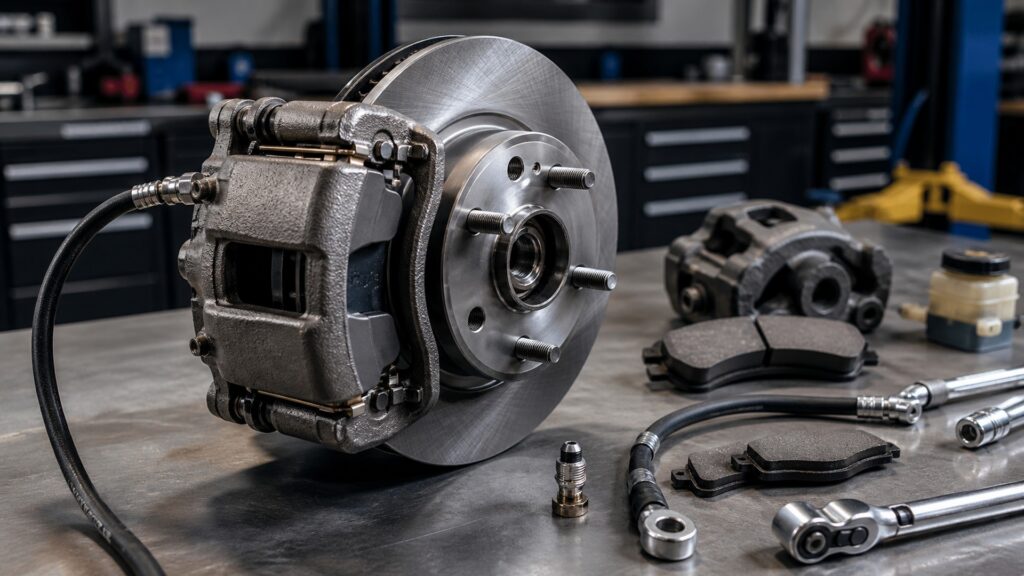
A practical explanation of leakage, mounting, heat, corrosion, and movement concerns around brake calipers.
Tip: Read the concept as part of a system, then connect it back to the use case.
These definitions connect the main idea to the variables, limits, and practical signals readers need to compare options.
Brake fluid escaping around a piston seal, hose connection, or bleeder.
The condition of caliper bolts, threads, brackets, and ears.
The clips, bracket surfaces, and caliper shape that keep pads positioned.
The thermal stress created during repeated braking or dragging.
The point where rust changes movement, sealing, or structure.
The need for both sides of an axle to brake consistently.
Tip: Keep the definitions connected; the strongest answer usually comes from the whole system, not one term.
The safety concern begins with whether hydraulic pressure can be created, contained, and released. A caliper with a leak or stuck piston can change that pressure path.
Pressure control is the first safety-related caliper question.
A caliper holds force close to a spinning wheel. Its bracket, fasteners, and guide surfaces need to hold alignment under vibration, heat, and repeated brake loads.
Mounting is part of caliper safety, not an afterthought.
A caliper that sticks can overheat one corner of the brake system. That heat can affect pad friction, rotor condition, nearby rubber parts, and driver confidence.
A stuck caliper is not just a wear problem.
Safety-related caliper inspection is about patterns. A torn boot, wet piston, corroded slide, or overheated rotor matters more when it matches a symptom.
Inspection is strongest when visual clues and behavior agree.
No replacement caliper can promise safety in isolation. The right response is a complete brake-system repair that respects torque, bleeding, friction material, and axle balance.
Safety comes from the repaired system, not from one part label.
Safety factors help prioritize inspection, but they should not become unsupported guarantees.
They highlight leaks, sticking, mounting problems, and heat damage that can make caliper condition more urgent.
They remind readers to treat braking as a system involving hydraulics, friction, tires, and installation.
A caliper can look rusty without being the root cause of a brake complaint.
Stopping safety cannot be guaranteed by a replacement part without proper diagnosis and installation.
Common shortcuts and misunderstandings can make the topic seem simpler than it is.
Surface rust is common; the concern is corrosion that affects movement, sealing, mounting, or pad support.
Brake-fluid leaks can worsen and reduce pressure, so they should be treated as a serious service issue.
Heat can come from hoses, pad binding, parking brake faults, bearings, or installation issues.
Correct fit, condition, installation, bleeding, and system balance matter more than price alone.
Tip: Treat strong claims as starting points for comparison, not final answers.
Concise answers to common questions readers may have after the main explanation.
Fluid leakage, seized movement, damaged mounting points, torn boots with piston corrosion, and severe drag are more concerning than cosmetic rust.
Uneven braking force or severe drag can affect pull and stability, but tires, suspension, and other brake components also matter.
A properly matched and correctly rebuilt caliper can be appropriate, but fitment, condition, and installation quality still need verification.
Side-to-side comparison on the same axle is useful because imbalance can reveal wear, drag, or pressure differences.
Yes. A leaking or dragging caliper can contaminate or overheat pads, changing the scope of the repair.
Brake caliper safety factors matters most when it is read as part of a brake system, not as an isolated catalog label.
The practical takeaway is to treat leakage, sticking, mounting damage, and heat patterns as system-level warnings that need diagnosis rather than marketing promises.
Use these Review Streets paths to connect the explainer to related categories, comparisons, and next decisions.
Use the Automotive Replacement Parts path for related brake component explainers and comparisons.
Use the Brake Components path for related brake component explainers and comparisons.
Use the Brake Calipers path for related brake component explainers and comparisons.
Choose a retailer
Prices checked regularly. We may earn a commission at no cost to you.