
Spring Renewal
Replacing tired return and hold-down springs.
- Purpose: Restores shoe return
- Check: Rust or distortion
- Limit: Does not fix a bad drum
Brake drum maintenance matters because the mechanism hides springs, adjusters, shoes, and hydraulic parts inside a shell. Those parts can corrode, weaken, seize, or leak while the outside of the drum still looks ordinary.
Maintenance keeps the shoe clearance, return action, parking brake linkage, and friction surface from drifting out of range. It is the difference between a drum brake that quietly supports rear braking and one that drags, pulses, or wears unevenly.
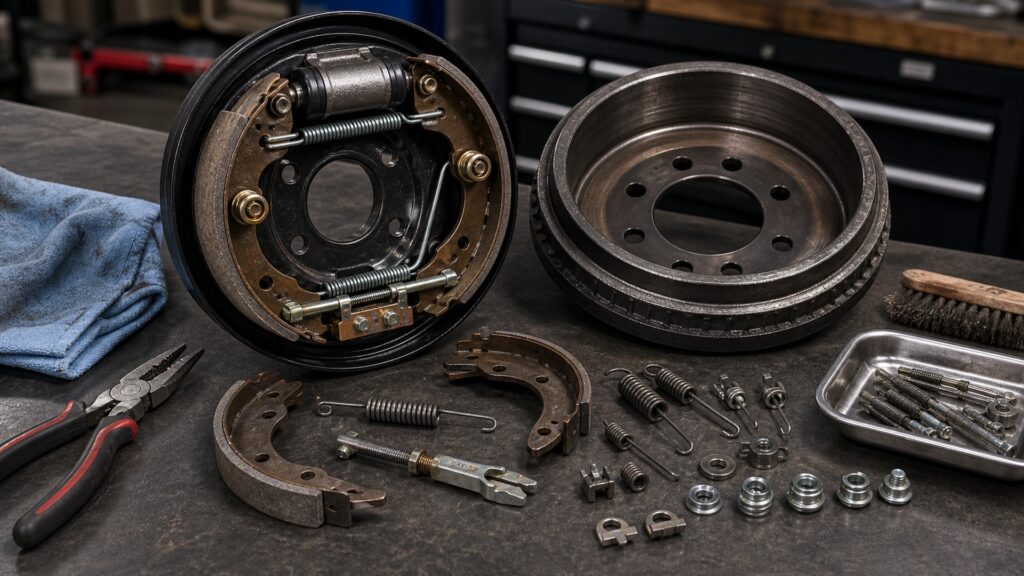
A practical explanation of brake drums maintenance role for brake-component comparison and service decisions.
Tip: Read the concept as part of a system, then connect it back to the use case.
These definitions connect the main idea to the variables, limits, and practical signals readers need to compare options.
Replacing tired return and hold-down springs.
Freeing the star wheel and related lever.
Raised pads on the backing plate where shoes slide.
Inspecting or replacing the internal friction surface.
Levers and cables that apply the rear shoes mechanically.
Cleaning accumulated brake dust safely during service.
Tip: Keep the definitions connected; the strongest answer usually comes from the whole system, not one term.
Drum service is about restoring hidden motion.
Every small part affects shoe movement.
An adjuster that cannot move leaves the shoes too far from the drum or too close to it.
Clearance is maintenance, not a guess.
Return springs finish the stop by pulling the shoes back.
The stop is not complete until the shoes return.
Fresh hardware cannot make a damaged shell round or smooth.
The shell and hardware age together.
The assembly should move, adjust, and release before the wheel goes back on.
Maintenance should leave a working sequence, not just new parts.
Maintenance catches hidden wear before it becomes drag or long pedal travel.
It explains why spring, adjuster, and contact-point service matters.
It helps protect new shoes from old movement problems.
It cannot save a drum beyond service diameter.
It cannot repair a leaking wheel cylinder without hydraulic work.
Common shortcuts and misunderstandings can make the topic seem simpler than it is.
The enclosure hides wear; it does not stop it.
Leaks and frozen adjusters can stay quiet for a while.
Heat and corrosion weaken spring function over time.
Cleaning helps inspection, but worn or leaking parts still need repair.
Tip: Treat strong claims as starting points for comparison, not final answers.
Concise answers to common questions readers may have after the main explanation.
Inspection of shoes, springs, adjusters, wheel cylinders, contact points, parking brake parts, and drum surface.
Rust, dust, heat, and lack of movement can freeze the threads.
Yes. Weak or incorrect springs may not return shoes fully.
Yes. Internal diameter determines whether the drum remains usable.
It is often more hidden and hardware-heavy, so careful assembly matters.
Brake drum maintenance preserves shoe movement, clearance, and return.
The practical takeaway is to service the hidden mechanism before it turns ordinary wear into heat, drag, or poor pedal feel.
Use these Review Streets paths to connect the explainer to related categories, comparisons, and next decisions.
Explore related Review Streets coverage in Automotive Replacement Parts.
Explore related Review Streets coverage in Brake Components.
Explore related Review Streets coverage in Brake Drums.
Choose a retailer
Prices checked regularly. We may earn a commission at no cost to you.