
Wheel-Cylinder Force
Hydraulic pressure pushing the shoes outward.
- Role: Starts shoe movement
- Check: Leaks and stuck pistons
- Limit: Cannot work correctly with contaminated shoes
Brake drum operating function matters because the assembly depends on several hidden movements happening in the right order. The wheel cylinder pushes the shoes outward, the shoes react against anchor points, friction slows the drum, and springs pull everything back.
If one part of that sequence is off, the symptom may look like weak braking, long pedal travel, noise, drag, or uneven shoe wear. Understanding the operating sequence helps readers compare drums, shoes, hardware, and wheel cylinders without treating the drum as a simple metal cover.
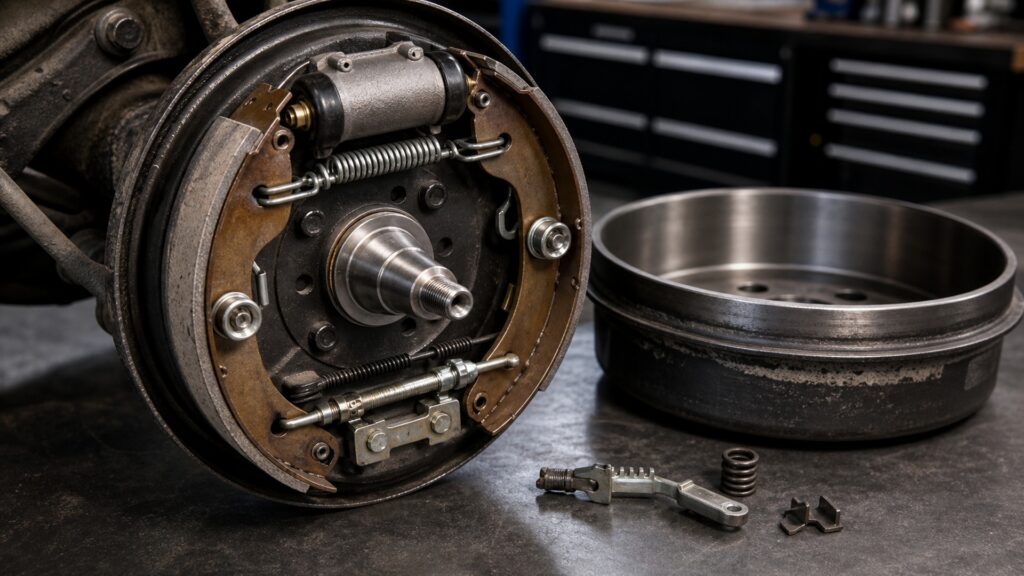
A clear explanation of brake drums operating function, focused on role, mechanism, fit, service limits, and repair decisions.
Tip: Read the concept as part of a system, then connect it back to the use case.
These definitions connect the main idea to the variables, limits, and practical signals readers need to compare options.
Hydraulic pressure pushing the shoes outward.
The outward motion that brings linings into the drum.
The fixed points that stabilize shoe force.
The force that pulls shoes away from the drum.
The mechanism that keeps shoe clearance in range.
The small working gap between shoes and drum.
Tip: Keep the definitions connected; the strongest answer usually comes from the whole system, not one term.
Drum operation is a chain of hidden movements. Pressure does not stop the vehicle until the shoes travel correctly and contact the drum evenly.
The drum brake works only when apply and return both happen cleanly.
Shoes need to expand smoothly without binding at the backing plate or anchor points.
Controlled expansion keeps friction predictable.
The adjuster determines how far the shoes must travel before contact. That distance shapes pedal feel and braking response.
Adjustment turns hidden shoe wear into pedal feel.
Return springs complete the cycle. If they are weak or installed incorrectly, shoes may keep rubbing the drum.
A drum brake is only done braking when the shoes return.
Inspection should confirm the whole sequence, not just the drum surface.
A good drum service proves movement, contact, and return.
The operating view explains why hidden parts inside the drum must move in sequence.
It connects wheel-cylinder force, shoe travel, anchors, springs, and adjustment.
It explains why drum symptoms often require opening the assembly.
A symptom still has to be traced to the exact failed part.
Hydraulic, friction, parking-brake, and hardware faults can overlap.
Common shortcuts and misunderstandings can make the topic seem simpler than it is.
The shell matters, but shoes, wheel cylinders, springs, anchors, and adjusters create the operating sequence.
Air can cause it, but poor drum adjustment or worn parts can also increase travel.
Weak or wrong springs can leave shoes dragging after release.
Adjusters can seize, wear, or be installed incorrectly.
Tip: Treat strong claims as starting points for comparison, not final answers.
Concise answers to common questions readers may have after the main explanation.
Hydraulic pressure moves the wheel-cylinder pistons, which push the shoes outward.
They stabilize shoe force and help control how the shoes react against the rotating drum.
Shoes may return slowly or drag, creating heat and accelerated wear.
Too much clearance makes the pedal travel farther before the shoes contact the drum.
Yes. Out-of-round drums, uneven shoe contact, or hardware issues can contribute to pulsation or vibration.
Brake drum operating function is a hidden sequence of pressure, shoe travel, friction, adjustment, and return.
The practical takeaway is to inspect every part of that sequence rather than treating the drum as a passive cover.
Use these Review Streets paths to connect the explainer to related categories, comparisons, and next decisions.
Use the Automotive Replacement Parts path for related brake component explainers and comparisons.
Use the Brake Components path for related brake component explainers and comparisons.
Use the Brake Drums path for related brake component explainers and comparisons.
Choose a retailer
Prices checked regularly. We may earn a commission at no cost to you.