
Foil Shaver
Reciprocating cutters operating beneath one or more perforated foils.
- Use: choose a linear system
- Variable: foil pattern and stroke
- Tradeoff: Damaged foil can expose cutters
Electric razors matter because they place a perforated foil or slotted guard between moving cutters and skin. Hair enters the openings and is cut by oscillating blades beneath a foil or by rotating cutters under circular heads. That guarded design can reduce direct blade contact, simplify dry or quick shaving, and create a more repeatable routine for people who do not need the closest possible finish.
The tradeoff is that the guard creates distance. Results depend on hair direction, stubble length, head geometry, motor behavior, skin contour, pressure, and technique. Foil shavers often reward straight overlapping strokes; rotary heads can follow curved areas and changing directions. Neither architecture is automatically gentler, closer, or better for every face, scalp, or body area.
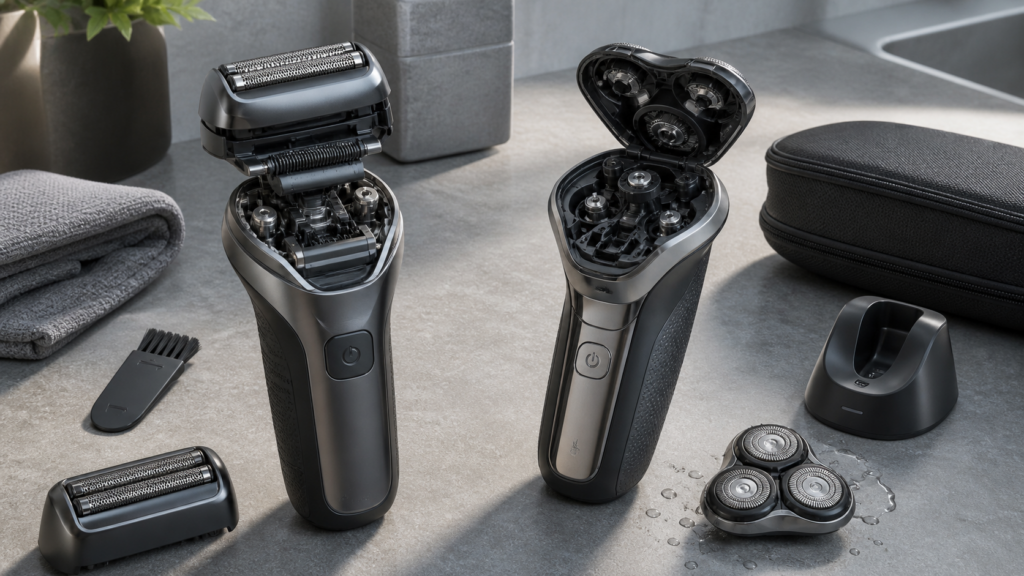
Explain the practical value of guarded powered cutting—foil and rotary architectures, comfort versus closeness, wet/dry use, hair-direction handling, sensitive-skin technique, cleaning, batteries, replacement cutters, travel, and total ownership—without claiming universal superiority over blades.
Tip: Technique supplies the navigation the motor cannot.
These electric razors concepts separate mechanism, application, limits, and purchasing consequences.
Reciprocating cutters operating beneath one or more perforated foils.
Circular cutters rotating beneath slotted floating heads.
Shape and size of openings that admit hair while separating cutter from skin.
Cutting unit that pivots or compresses to maintain contour contact.
Manufacturer-defined permission for use with water, foam, or in the shower.
Interval for changing foils, cutters, or head assemblies as they wear.
Tip: Use these terms to test electric razors instead of relying on a front-label promise.
A foil design often suits users who shave regularly and prefer controlled passes along flatter areas. Very flat or multidirectional hairs may need skin stretching and cross-grain finishing.
Technique supplies the navigation the motor cannot.
Articulating rotary heads can maintain contact around jaw, chin, neck, or scalp, though technique and cleaning differ from a foil unit.
Contour following is useful only when the cutters capture the hair.
Repeated pressure and passes can heat or irritate skin. Trim long stubble first, avoid broken skin, and change technique before increasing force.
Comfort can be a better endpoint than blade-close.
Hair dust, oil, water, and worn foils reduce cutting efficiency. Follow the exact brush, rinse, lubrication, drying, and replacement instructions.
A dirty or torn head changes both comfort and safety.
Compare head replacements, cleaning cartridges, lubricant, battery serviceability, warranty, charging connector, voltage, travel lock, noise, grip, and storage.
A discounted handle can carry expensive consumables.
Electric razors can improve speed and comfort; they do not eliminate nicks, irritation, ingrowns, cleaning, or blade replacement.
The head design matches hair direction, contour, and desired closeness.
Pressure remains light so the guard does not abrade the skin.
Cutters, foils, seals, and batteries are maintained on schedule.
Wet/dry labeling, charging rules, and washable markings are followed exactly.
These claims flatten the variables that determine how electric razors performs in a real routine.
A guard reduces direct contact, but damaged foils, pinched skin, pressure, heat, or misuse can still injure.
Hair direction, length, contour, head design, motor, and technique matter more than one broad architecture claim.
Repeated passes often add heat and friction after the remaining hairs stop entering the guard.
Water-use and charging permissions are separate; follow the model's exact safety instructions.
Docks automate part of cleaning but still require cartridges, drying, debris management, and periodic inspection.
Tip: Test the exact electric razors tool, setting, and routine before generalizing from its category.
The remaining decisions about electric razors concern technique, compatibility, safety, upkeep, and value.
Some people benefit from less-close guarded cutting, but technique, curl pattern, inflammation, and individual response still matter.
Use only an approved mode. Dry is fast and predictable; foam or water may improve glide for some users but adds cleanup.
Follow the model guidance and replace sooner after pulling, heat, reduced closeness, visible damage, or persistent irritation.
Only if the design and instructions suit both areas; contour, hair length, hygiene, and attachment needs differ.
Personal use is safest. Shared devices can transfer skin material and require reprocessing beyond a casual wipe.
Long or flat hair, clogged cutters, worn blades, low power, fast movement, or an unsuitable direction can all contribute.
Electric razors make quick, repeatable hair cutting possible by moving blades behind a protective foil or slotted rotary head. That separation can improve convenience and comfort while usually giving up some blade-level closeness.
Choose by growth direction, contour, skin response, wet/dry routine, grip, cleaning, runtime, noise, parts supply, and annual consumable cost. Light pressure and a maintained head matter more than maximum motor claims.
These Review Streets paths narrow the next electric razors decision by format, goal, and routine fit.
Browse shaving, epilation, and light-based hair-removal categories.
Compare at-home beauty devices, including light-based hair-removal systems.
Choose a retailer
Prices checked regularly. We may earn a commission at no cost to you.