
Training function
The role an elliptical plays inside a workout plan.
- It may support conditioning, intervals, or cross-training.
- It depends on settings and consistency.
- It should not promise outcomes.
Elliptical training function matters because the same machine can serve different workout roles. It can support steady cardio, interval sessions, warmups, cross-training, or lower-impact movement on days when running-style impact is not the goal.
Those roles require different settings. A smooth steady session may depend on cadence and moderate resistance. Intervals may depend on resistance changes and recovery periods. The machine should be judged by the job it is asked to perform.
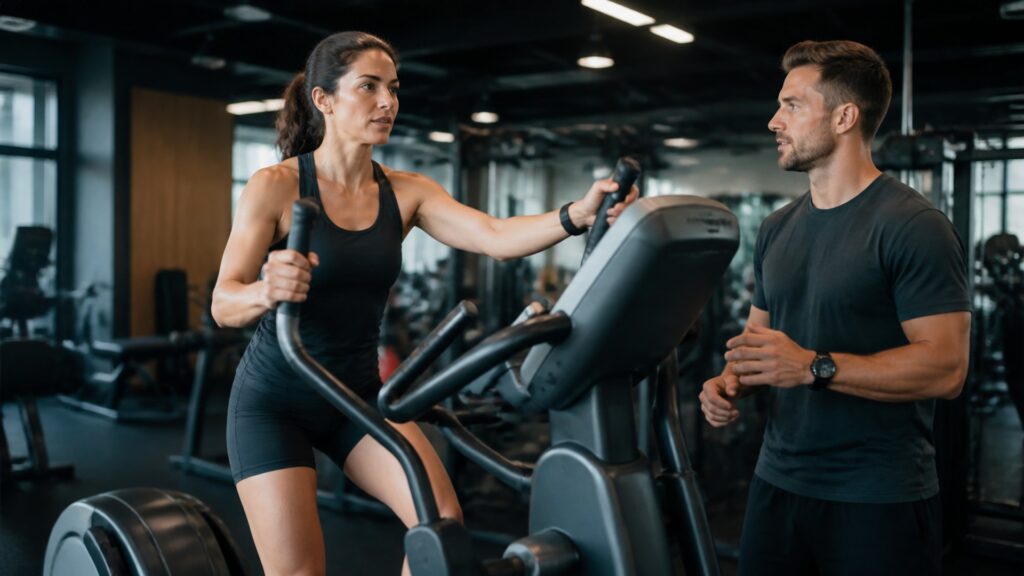
Training function links machine settings to the purpose of the session.
Tip: Name the session role before judging the console program or resistance level.
These definitions connect the main idea to the variables, limits, and practical signals readers need to compare options.
The role an elliptical plays inside a workout plan.
A sustained effort held at a manageable pace.
Alternating easier and harder effort using resistance, incline, or cadence.
Using a different movement pattern from the main sport or routine.
Managing stride rate during the session.
How incline changes the perceived muscle and stride demand.
Tip: The same setting can mean different things in a warmup, interval, or recovery-paced session.
An elliptical's training function changes with the session goal. The machine can provide sustained aerobic work, short harder intervals, low-impact variety, or a warmup before strength training.
The machine matters because it can play several roles without becoming all of them at once.
Effort changes through stride rate, resistance, incline, and duration. Raising resistance while cadence collapses creates a different session than holding rhythm with a moderate load.
Training function depends on how the variables combine.
For runners or field-sport athletes, an elliptical may provide cardio work with a guided, lower-impact pattern. That can be useful variety, but it does not train running mechanics exactly.
Cross-training is a role, not a replacement claim.
Built-in programs can change resistance or incline on a schedule. They are useful when they match the goal, but a program can be too hard, too easy, or poorly matched to the user.
A program is only helpful when its structure fits the session.
The elliptical can support cardio work, but the machine alone does not guarantee weight loss, recovery, injury prevention, or sport performance. Those outcomes depend on broader context.
The honest claim is about workout structure, not guaranteed results.
The function explains how settings support different session goals, but not guaranteed outcomes.
It shows why steady cardio, intervals, warmups, and cross-training require different resistance, cadence, and duration choices.
It gives readers a better way to judge console programs and feature claims.
It cannot promise calorie burn, fitness gains, injury prevention, or recovery outcomes.
Programming, consistency, comfort, health status, and other training all affect results.
Common shortcuts and misunderstandings can make the topic seem simpler than it is.
A steady session, hard interval block, warmup, and cross-training ride all use the machine differently.
Cadence, incline, duration, handles, and rest periods also change the work.
The elliptical can support conditioning, but the fixed pedal path does not reproduce running mechanics.
Programs can help structure effort, but manual control may fit the session better when the goal is simple.
Lower impact does not remove fit, overuse, balance, or medical context.
Tip: Treat strong claims as starting points for comparison, not final answers.
Concise answers to common questions readers may have after the main explanation.
It is often used for steady cardio, intervals, warmups, and lower-impact conditioning, depending on settings and comfort.
Resistance changes force demand; cadence changes stride rate. The workout changes when one rises and the other falls.
Incline can change posture and stride emphasis, but it is only one variable and not every machine has it.
Treat them as rough estimates. Entered profile data, algorithms, and effort patterns can all affect the number.
Many can, but fit, balance, comfort, and health context still matter. Start with manageable settings and follow product guidance.
Elliptical training function matters because settings only make sense after the workout role is named.
Use the machine differently for steady cardio, intervals, warmups, or cross-training, and keep outcome claims realistic.
Use these Review Streets paths to connect the explainer to related categories, comparisons, and next decisions.
Use this hub to compare elliptical types, stride designs, resistance systems, and console features in one place.
Use this path when the comparison turns on seated cycling, flywheel resistance, bike fit, and lower-body cardio.
Use this path when the next decision involves drive sequence, handle pull, damper feel, and full-body rhythm.
Choose a retailer
Prices checked regularly. We may earn a commission at no cost to you.