
Frame Curvature
The arc of the upper bar across the eye.
- Use: Reach inner and outer lashes
- Variable: eye shape and tool radius
- Tradeoff: A poor match leaves gaps or pinches
Eyelash curlers matter because they create visible lift without changing lash color or adding fibers. The result comes from placing the lashes between a shaped upper bar and resilient pad, then applying controlled pressure near the base and, if desired, along the length.
That simple lever can also pinch eyelid skin, crease lashes sharply, pull mascara-stiffened hairs, or bring a contaminated surface close to the eye. Fit is not universal: eye curvature, opening width, side clearance, hinge play, and pad profile determine whether the tool reaches the lash line evenly. A good curler is one that aligns comfortably, closes predictably, and has replaceable pads—not merely one with the strongest spring.
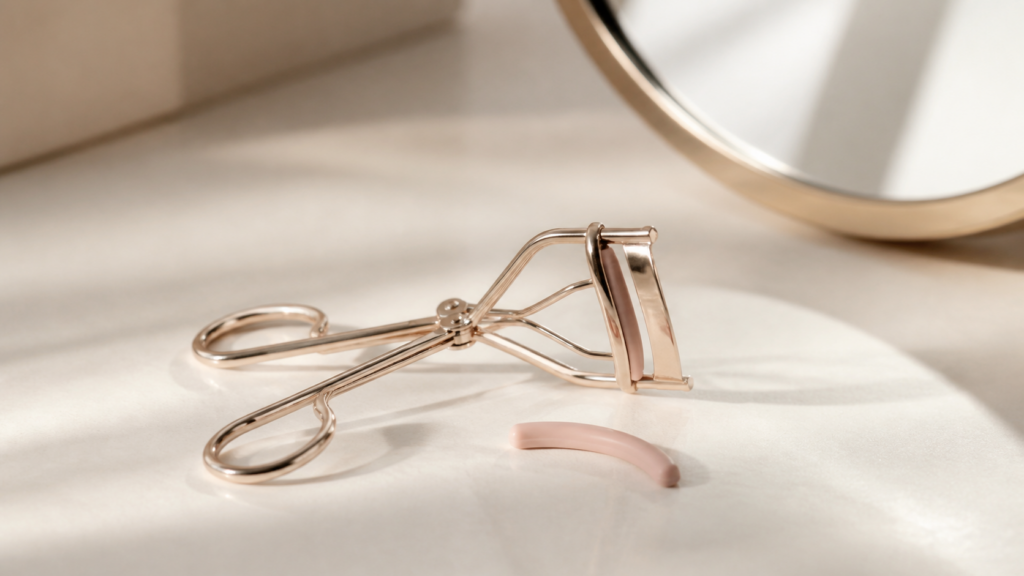
A curler should distribute modest pressure along the lash line while staying clear of eyelid skin and fragile, mascara-coated lashes.
Tip: Test alignment with an empty, clean curler before applying pressure.
Frame geometry and closing behavior matter more than spring strength or brand recognition.
The arc of the upper bar across the eye.
The usable span between the curler's side supports.
How the insert compresses and rebounds under force.
Unwanted side-to-side or uneven movement at the joint.
How force is distributed from lash base toward tips.
Opening fully before the tool moves away from the eye.
Tip: Fit the open frame first; pressure comes only after the eyelid is clear.
Place the open curler near the lashes without squeezing. The upper bar should follow the visible lash line, the sides should not press into skin, and the tool should capture useful width without requiring rotation against the eyelid.
A famous curler can still be the wrong radius for a particular eye.
A smooth, resilient pad receives the upper bar and spreads pressure. A hardened, split, deeply grooved, loose, or incorrectly sized replacement can expose a sharper edge and change how the curler closes.
The inexpensive pad is the working surface that protects the lashes.
Start near—but not on—the eyelid, close gently, release fully, then move outward if a softer curve is wanted. Several controlled presses can create a rounder profile than one forceful clamp at a single point.
Pressure cannot compensate for poor alignment.
Wet or tacky mascara can make lashes adhere to the pad, while dried mascara makes hairs less flexible. Curl first unless the specific heated tool and product directions explicitly describe another safe sequence.
The lowest-friction sequence protects both the pad and the lash fan.
Use the curler while stationary with clean hands and a clean tool. Do not share it casually, continue during eye infection, or use a bent frame that closes unpredictably near sensitive tissue.
Mechanical precision matters more around the eye than speed.
A well-fitted curler can reposition flexible lashes temporarily, but it cannot change natural growth, repair damage, or guarantee the same arc on every eye.
Lift can make lashes more visible before mascara and improve separation at the base.
A replaceable pad and accurate frame give the user direct control over placement and pressure.
The effect relaxes with time, humidity, lash characteristics, and product weight.
Poor fit, worn pads, excessive force, or bad timing can kink, pull, or pinch.
Force, universal fit, mascara timing, and replacement pads are common sources of avoidable trouble.
Extra force mainly increases compression at one line; it does not guarantee better memory. Fit, dry lashes, pad resilience, several light placements, mascara weight, humidity, and natural lash behavior all influence persistence.
Frames vary in curvature, opening width, depth, and side-post position. A mismatch may miss corner lashes or pinch skin, even when the particular tool is well made and widely recommended.
Mascara can make lashes tacky or rigid, increasing adhesion to the pad and reducing flexibility. Curling clean, dry lashes first is the conservative default unless a product's directions specifically say otherwise.
Pads that look similar can differ in length, profile, hardness, and retention tabs. An incorrect insert may shift, compress unevenly, or let the upper bar approach too closely, undermining predictable pressure.
Heat removes the clamping action but adds temperature, contact-time, battery, and product-order variables near the eye. Safety still depends on the exact design, directions, condition, cleanliness, and careful stationary use.
Tip: A controlled release is as important as a controlled squeeze.
Practical checks for choosing and using a mechanical curler near the eye.
Before squeezing, align the clean open frame with bare lashes. It should approach the base, clear eyelid skin, and reach useful inner and outer lashes without twisting or pressing toward the eyeball.
Follow the manufacturer's interval and replace sooner when the pad hardens, splits, loosens, develops a deep permanent groove, or no longer rebounds evenly. Inspect it before use rather than relying only on time.
Yes. Capture only what the frame can hold comfortably, release fully, and reposition without pulling. A model with a better curvature match may be easier than repeatedly rotating a poorly fitting full-size tool.
Remove mascara and skin residue according to the maker's material guidance, keep liquid out of vulnerable joints, dry it completely, and inspect the pad. Never use a contaminated curler near an irritated eye.
Personal use is the safer choice because the tool works very close to the eye and can carry residue. If an eye infection occurs, stop use and follow appropriate guidance for contaminated items.
Release fully and stop using the curler. Seek prompt professional care for significant pain, bleeding, persistent redness, swelling, discharge, light sensitivity, blurred vision, or concern that the eye itself was scratched.
Eyelash curlers matter because a correctly matched frame and resilient pad can create controlled temporary lift before mascara, using modest pressure rather than force.
Choose by eye fit and closing precision, inspect the pad, curl clean dry lashes while stationary, release before moving, and retire any frame or insert that no longer operates predictably.
These guides place curler geometry within a broader, hygienic beauty-tool kit.
Build a first kit around actual tasks, cleanability, storage, and replacement.
Compare applicators, grooming tools, materials, ergonomics, and upkeep.
Choose brush shapes and fibers that suit repeat daily application and cleaning.
Choose a retailer
Prices checked regularly. We may earn a commission at no cost to you.