Why Fleet Vehicles Fitment Matters

Fleet-vehicle fitment is the compatibility between a specific vehicle and the equipment installed on it. Racks, partitions, service bodies, monitoring devices, and powered tools can all need checks beyond whether they physically fit. Their attachments, electrical connections, weight, operating space, and interaction with existing equipment affect whether the completed vehicle can do its intended job.

The fleet setting makes small assumptions expensive to repeat. An installation that suits one vehicle may not transfer unchanged to another model year, body length, powertrain, or option package. Standardize only after confirming the exact configurations and documenting what each approved arrangement includes.

By: Review Streets Research Lab
Updated: October 6, 2026
Explainer · 8-12 min read
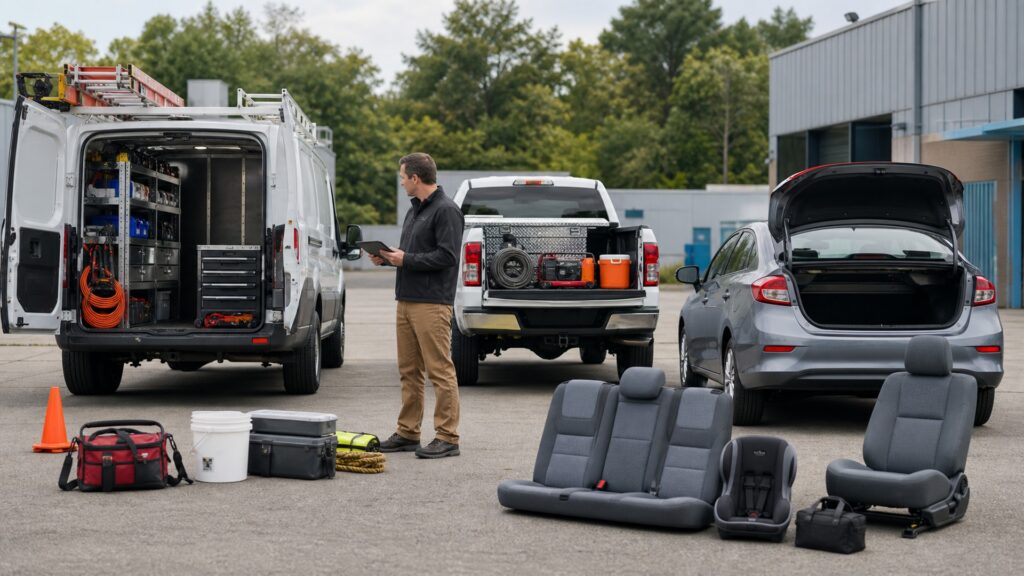
fleet vehicles explainer hero image for Review Streets
What You'll Learn

Check the Complete Installation, Not Just the Part

Connect compatibility to the vehicle’s structure, systems, and work.

  • Which vehicle details belong in a fitment decision
  • Why attachment points require model-specific evidence
  • How electrical integration differs from a matching connector
  • How equipment affects load and operating clearances
  • What to record before releasing an equipped vehicle

Tip: Provide the installer with the exact vehicle specification and intended equipment list before ordering an installation across a fleet.

Definitions

Six Fitment Checks for Working Vehicles

Physical attachment is only one part of a compatible installation.

Vehicle specification

Vehicle specification identifies the configuration relevant to an installation.

  • Example: model year, body length, powertrain, and fitted options
  • Check: the actual vehicle and its documentation
  • Limit: a shared model name may conceal important differences

Mounting interface

A mounting interface is the engineered connection between equipment and its support on the vehicle.

  • Example: a rack attached through its specified brackets
  • Check: manufacturer and equipment installation requirements
  • Limit: matching holes do not prove the attachment is suitable

Electrical integration

Electrical integration connects added equipment to the vehicle’s power and controls through an appropriate supported arrangement.

  • Example: a work light using a specified upfit connection
  • Check: compatibility, electrical demand, and approved installation details
  • Limit: a connector that fits is not proof of electrical compatibility

Load distribution

Load distribution is the placement of mass across the completed vehicle and its axles.

  • Example: tools and cabinets concentrated toward the rear
  • Check: the equipped and loaded vehicle’s relevant limits
  • Limit: meeting the total rating alone may not establish acceptable axle loads

Operating clearance

Operating clearance is the space equipment needs while it and the vehicle are being used.

  • Example: a cabinet door opening without blocking another control
  • Check: movement, access, and the intended surroundings
  • Limit: a part can fit while stowed yet obstruct operation

Installation acceptance

Installation acceptance confirms that the completed work meets the agreed requirements before use.

  • Example: documented checks and instructions at handover
  • Check: the installed configuration and required verification
  • Limit: delivery of the parts is not completion of the installation

Tip: Consider the equipment as installed, powered where relevant, and used with the intended load.

Identity

Start with the Exact Vehicle Configuration

Identify the vehicle, model year, body, powertrain, and relevant options before selecting hardware. Check the applicable manufacturer body-builder or upfitter information and the equipment maker’s fitment documentation. If an existing installation is being moved, assess the receiving vehicle independently. Similar bodywork is not enough to establish that brackets, wiring, or operating clearances remain suitable.

  • Record the vehicle identity and relevant options.
  • Use documentation for that model and year.
  • Confirm the equipment variant and installation kit.

GM publishes body-builder manuals by model year and vehicle group, illustrating why a broad fleet purchasing description is insufficient.

Reference: GM body-builder manual selection.

Attachments

Use Evidence for the Structural Connection

Shelving, a partition, or a body needs more than a convenient place to bolt it down. The specified attachment must suit the vehicle and the equipment’s intended loads and use. Have the qualified installer resolve mounting requirements and any conflicts using the applicable documentation. Avoid treating an existing hole, an improvised bracket, or experience on a different vehicle as approval for this installation.

  • Confirm the intended mounting arrangement.
  • Check that other installed equipment does not conflict.
  • Retain the installation documentation.

A cabinet may sit neatly against a wall while still lacking the correct structural attachment. Appearance is not a load assessment.

Power and controls

Confirm the Supported Electrical Arrangement

Added electrical equipment needs a compatible supply and control arrangement. Its demand and operating behavior should be considered with the vehicle and other fitted equipment, including when the vehicle is parked. Use the applicable manufacturer interfaces and installation requirements rather than inferring compatibility from a plug shape. Work involving vehicle electrical systems belongs with appropriately qualified installers.

  • Specify the equipment’s power and control needs.
  • Confirm supported connections for the vehicle.
  • Verify the required operating behavior at handover.

Ford describes its available Vehicle Integration System as a way to connect supported upfits with equipped vehicles. Such a feature is configuration-specific, not universal to all fleet vehicles.

Reference: Ford supported upfit integration overview.

Completed vehicle

Recheck Weight, Access, and Equipment Movement

Installed equipment consumes carrying allowance and can change load distribution. Assess the completed vehicle with the intended occupants, tools, and goods, using the relevant total and axle limits. Also check doors, steps, service access, visibility, and the equipment’s operating space. A rack may clear the roof while creating a height issue at a regular entrance; a cabinet may fit while preventing another item from being removed.

  • Include permanent equipment in the loading assessment.
  • Review relevant total and axle limits.
  • Check stowed and operating clearances.

Ford’s loading guidance supports checking the actual loaded vehicle. Equipment volume and remaining floor space do not establish remaining weight allowance.

Reference: Ford vehicle loading guidance.

Handover

Document the Installation Before Repeating It

Agree on the checks and evidence needed to accept the completed installation. Record installed items, configuration details, operating instructions, and applicable service needs. Make any limits clear to those who assign and use the vehicle. Before repeating the arrangement across a fleet, identify which vehicles genuinely share the relevant specification and which need a separate assessment.

  • Record the accepted equipment and vehicle combination.
  • Provide users with the required instructions.
  • Reassess compatibility when a vehicle or part changes.

For example, moving a proven shelving package into a newer electric van still requires a fresh check of the receiving vehicle’s attachments, limits, and equipment interfaces.

Quick Reality Check

Fits in the Space Versus Fits the Vehicle

A dimensional match is useful evidence, but only for one question.

Physical placement

The equipment can be positioned within the available area.

Its shape appears compatible with the surrounding body.

Completed fitment

Attachments, power, controls, weight, and clearances are supported.

Required checks, instructions, and installation records are complete.

Common Myths

Misconceptions About Fleet-Vehicle Fitment

Repeated installations still need exact compatibility.

The same model badge guarantees the same fit

Year, body, powertrain, and options can affect compatibility.

If the bolt holes line up, the attachment is approved

The complete mounting arrangement must meet applicable requirements.

A matching connector proves electrical compatibility

Supply, control behavior, and supported integration still need checking.

A successful installation can be copied to every fleet vehicle

Confirm the relevant specification of each receiving vehicle.

Tip: Standardize documented compatible combinations, rather than assuming all vehicles in the fleet are identical.

FAQ

Questions About Fleet-Vehicle Fitment

Practical checks before fitting or transferring equipment.

What information should an installer receive?

The exact vehicle identity and configuration, proposed equipment, intended use, and representative load.

Can an upfit be moved to a replacement vehicle?

Possibly, but the receiving vehicle and equipment must be assessed for compatibility and the required installation method.

Does installed equipment count toward vehicle loading?

Yes. Include its mass when assessing the completed vehicle with occupants and carried goods.

Why check equipment in operation as well as stowed?

Moving doors, drawers, racks, or other equipment can need space that is not apparent in the parked, closed arrangement.

What should be retained after installation?

The accepted configuration, installation evidence, operating instructions, relevant limits, and applicable maintenance information.

Bottom Line

Fleet fitment succeeds when the equipment and exact vehicle work together structurally, electrically, and operationally.

Check the completed vehicle and keep enough documentation to support its use, care, and any future equipment transfer.

Next Steps

Go Deeper or Compare Your Options

Use these Review Streets paths to compare related categories and practical next decisions.