Why Formulation or Design Matters for Body Treatments

Formulation and packaging shape how a body treatment meets your skin. A mist that dries in place and a scrub you rinse away can carry the same headline acid percentage. The number still leaves a question about what the rest of the blend does to the acid’s exfoliating effect.

By: Review Streets Research Lab
Updated: November 24, 2026
Explainer · 9–11 min read
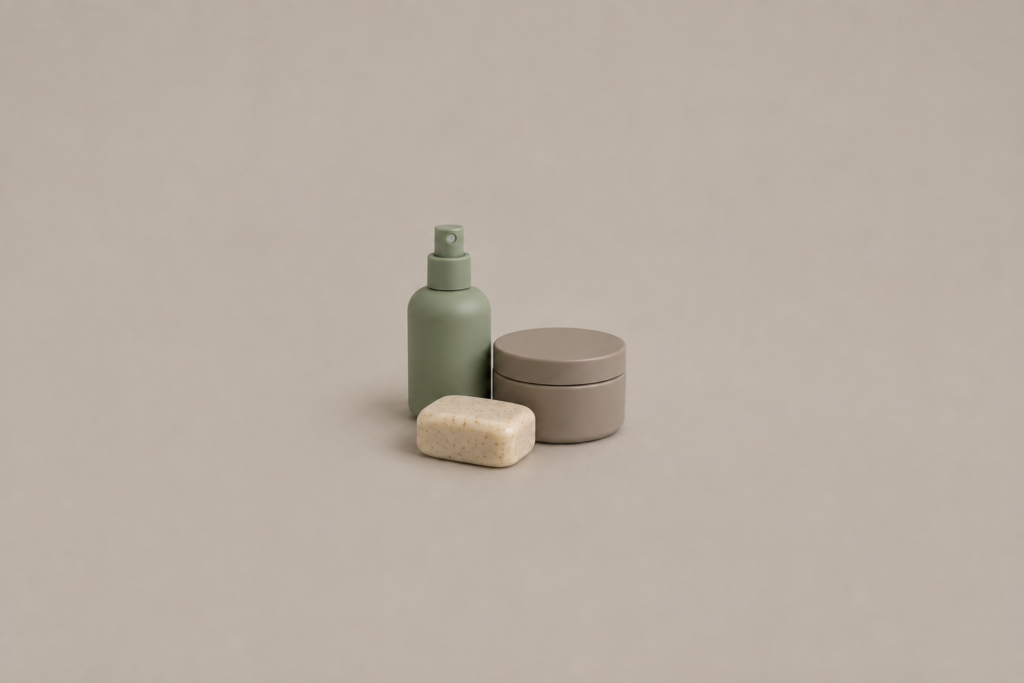
Unlabeled body mist bottle with a finger nozzle, closed scrub jar, and solid exfoliating bar.
The scope

What you’ll learn

Start with the formulation on the label and follow it through to the skin. The questions below track the parts of the design you can see and the ones researchers have to measure.

  • Reading a front-label acid percentage
  • Comparing a mist with a scrub
  • Hardness and feel in a scrub bar
  • Total and free acid in a lab report
  • Rinsing and leave-on contact in a lab test
  • Spray angles and hard-to-reach spots
  • Stress tests and split-body studies

Tip: Keep the percentage and the directions in view together. On the scrub below, the directions call for a rinse.

Vocabulary

Six terms for reading a body treatment

These terms follow the blend from the package to the skin and into the tests used to study it.

Finished formulation

The complete blend in the form intended for use.

  • Contents: One scrub can contain both exfoliating acids and particles.
  • Ingredient list: The declaration identifies what’s listed in the blend.
  • Amounts: The ingredient list leaves exact quantities open.

Vehicle

The base that carries an ingredient to the skin.

  • Forms: Examples include a solution or a cream.
  • Control: A test can compare the same base with and without the acid.
  • Change of base: A switch in vehicle changes the formula around the acid.

Physical format

The form the blend takes when you apply it.

  • Spray: The liquid comes out as a mist.
  • Particle scrub: The blend contains pieces of grit.
  • Solid bar: The scrub is shaped into a bar.

pH

A measure of acidity or alkalinity.

  • Scale: A pH value is distinct from an acid percentage.
  • Adjustment: Partial neutralization can adjust a blend’s pH.
  • Reporting: A formula report can list pH alongside both acid values.

Contact pattern

How and for how long the product meets skin.

  • Start: Application starts the exposure.
  • Rinse-off: Rinsing is the intended removal step.
  • Leave-on: A leave-on design omits the immediate rinse.

Endpoint

The particular thing a test measures.

  • Physical: A stress test can record whether a scrub separates.
  • Instrumental: Imaging can measure a skin property.
  • Reported: A perception test can record how participants say their skin feels.

Tip: Ask whether a term describes the blend, its contact with skin or what a test measured.

The finished product

Tracing the finished treatment

Saltair puts both a body mist and a scrub in its body treatment range. The pair gives us a way to follow the design from the stated purpose to what would have to be tested.

  • Start with the job. Saltair presents both products as exfoliants for textured body skin.
  • Read the percentage alongside the format. The Glycolic Renewal Body Smoother is a liquid mist, while the KP Body Smoother is a scrub. Saltair lists 10% glycolic acid for each.
  • Account for the rest of the blend. Two examples of particles in the scrub are volcanic sand and microcrystalline cellulose.
  • Follow the intended contact. The label has the mist dry on the skin. The scrub’s directions include a rinse.
  • Keep the visible result an open question. A head-to-head comparison of surface texture would need to measure that outcome for both finished products.

With the labels side by side, you can start with the number and then ask what form you’re actually holding in your hand.

Vehicle and format

The feel of a solid scrub

The blend is the bar you hold. To understand its feel, researchers can test the whole piece.

  • Researchers made five prototype scrub bars. They used a probe to measure how much the bars resisted pressure.
  • The salt bar was among the hardest and the microcrystalline cellulose bar was the softest. The particles varied in material, size and shape.
  • Ten trained testers rated the prototypes’ feel before, during and after use.

The probe tells you how the bar resists pressure. The panel tells you how the bar felt to the testers.

Formula interactions

What changes when the base changes

For alpha hydroxy acids (AHAs), the FDA links exfoliation to acid type, amount, pH and the other ingredients.

  • In one lab study, a gel and a cream each contained 15% total glycolic acid. Researchers adjusted both to pH 4 and reported 6.05% free acid in each.
  • After repeated lab exposure, the outermost skin layer measured thicker with the gel, and the researchers found no difference in the number of cell layers. The upper-arm skin came from one donor. ISDIN, the formula maker, funded the study in full.
  • The FDA reports that an AHA reached deeper into skin in a cosmetic-style cream it studied than in its test solution without the usual cosmetic ingredients.

These matched formulas gave different thickness readings despite sharing the same reported acid values.

Contact and dispensing

How the formula reaches the skin

Two questions remain once the formula is made. Where can it reach, and what happens when there’s a rinse?

  • In a lab study, Okuda and colleagues tested one reference lotion on excised samples of human epidermis, the skin’s outer tissue. They recovered more glycolic acid from the epidermis and collection fluid combined after a longer leave-on exposure than after a shorter rinse-off exposure. The lead author was affiliated with Kao.
  • PanOxyl describes a 360-degree nozzle that sprays at different angles to help reach areas such as the lower back. Its US label identifies the spray as an over-the-counter acne medication.
  • The ability to aim from more angles still comes with a boundary. The US label warns against spraying into the eyes.

The nozzle’s angle describes reach. Once the blend is on the skin, the rinse is a separate variable.

Finished-product testing

Three ways to test a finished product

Testing the whole product can mean exposing a blend to stress, asking people how their skin feels or measuring a specific property of the skin.

  • Researchers saw a coffee-ground scrub prototype separate under physical stress. They tested the whole mixture’s stability and left the effect of particle size unresolved.
  • On its scrub page, First Aid Beauty reports how smooth participants said their skin felt in a 38-person perception test after 10 days. The figures describe participants’ impressions.
  • In a double-blind trial, 20 volunteers massaged silicone and placebo gels into stretch marks on opposite sides of the abdomen for six weeks. The abstract reports higher collagen on the silicone side relative to placebo, even as collagen fell on both sides over time. Sinclair Pharmaceuticals partly funded the study.

The question matters because “tested” could refer to a scrub separating or a skin measurement after applying a gel.

Reality check

Two designs in everyday use

Imagine these situations to see where a design difference would show up and where a question would remain.

Reading the two labels

Hypothetical example. You see the same acid percentage on an exfoliating mist and a scrub and wonder what’s still touching your skin after a shower. In this example, the mist is designed to dry in place and the scrub is meant to be rinsed off.

The reference-lotion experiment compared shorter rinse-off contact with longer leave-on contact for one blend. The two products in this example are different blends. A separate measurement could show how much acid remained after either product.

A spot you can only reach at an angle

Hypothetical example. You can point a bottle at a patch on your lower back only by tipping it sideways. If the bottle can spray in that position, tipping it can give you a way to aim at the patch.

From that position you could see where the nozzle points. You’d still have to measure how much landed and how evenly it spread across the patch.

Misreadings

Where the inference goes too far

A detail can be right even when the conclusion someone draws from it goes too far.

Can a gritty scrub’s ingredient list tell you how much exfoliation comes from the grit?

First Aid Beauty lists pumice alongside glycolic and lactic acids in one body scrub. To see what the grit adds, researchers could compare otherwise matching blends with and without that grit.

Does coarser grit make a harder bar?

The bar study measured particle shape and size separately from the whole bar’s hardness. Grit descriptions leave overall hardness open.

Do creams always deliver acids less deeply than solutions?

The FDA’s comparison went the other way for the specific cream and solution it studied.

Does rinse-off evidence transfer to every scrub?

The other rinse-off samples were shampoo with malic acid and conditioner with lactic acid. The matched comparison used a lotion.

Does higher collagen than placebo mean collagen increased over time?

The comparison is between the two sides. An increase over time would be a rise from the same side’s earlier reading.

Tip: The reference point matters. When you see “higher,” find out what it was higher than.

FAQ

Questions about labels and tests

A few design details only make sense once you know what a label or study actually reports.

Does glycolic acid’s place on a scrub’s ingredient list give me its exact amount?

US cosmetic labels generally list ingredients in order of predominance. There are exceptions, including for ingredients at 1% or less. The list gives names and some clues to relative amounts. Reconstructing an exact formula would take more information.

What’s the difference between total and free glycolic acid?

Total is the full amount reported. Free is the unneutralized portion.

Do two 10% exfoliants necessarily use the same acids?

Look at what the number measures. Saltair’s spray says 10% glycolic acid. First Aid Beauty’s 10% AHA scrub lists glycolic and lactic acids, with the share of each left unspecified on the page.

Does the mist’s “dermatologist tested” badge tell you how it compares with the scrub?

Saltair lists the badge for its mist. The page gives no test method or result that compares the mist with the scrub.

Does a spray’s angle range tell me the amount per press?

The nozzle description covers aim. Amount per press needs a separate figure.

Can a prototype stress test give an unopened scrub’s shelf life?

The coffee scrub experiment showed separation under some test conditions. A shelf-life figure for an unopened retail scrub would require data that cover that product and its storage conditions.

What did the gel trial isolate about massage alone?

Both sides got gel and massage. The abstract describes no unmassaged comparison, so it leaves the separate contribution of massage open.

Does the FDA’s AHA sunburn alert apply when the acid is only an incidental ingredient?

The FDA’s US guidance excludes cosmetics with an insignificant level of AHA that has neither a technical nor a functional effect in the product. For covered products, the alert addresses possible increased sun sensitivity during use and for up to a week afterward.

Tip: Read a test designation as far as the published details take it.

The takeaway

Picture the treatment as the blend that actually touches the skin. For AHAs, concentration, pH and the surrounding blend all matter.

When a design claim catches your eye, name the difference it actually describes. Reaching a spot on your back is a question about the dispenser. What happened to skin at that spot is a question for a study that measured it.

Related reading

More on body treatments

Explore the category’s lists, comparisons and buying guides.