Why Formulation or Design Matters for Foot Care

A foot cream’s formula helps determine how readily it spreads. The shape of a mask or file helps determine where it touches the foot. A preloaded mask sock, for instance, brings formula to the area it sits against. Those details explain how contact happens. Whether it changes skin hydration takes a finished-product test.

By: Review Streets Research Lab
Updated: November 25, 2026
Explainer · 11–13 min read
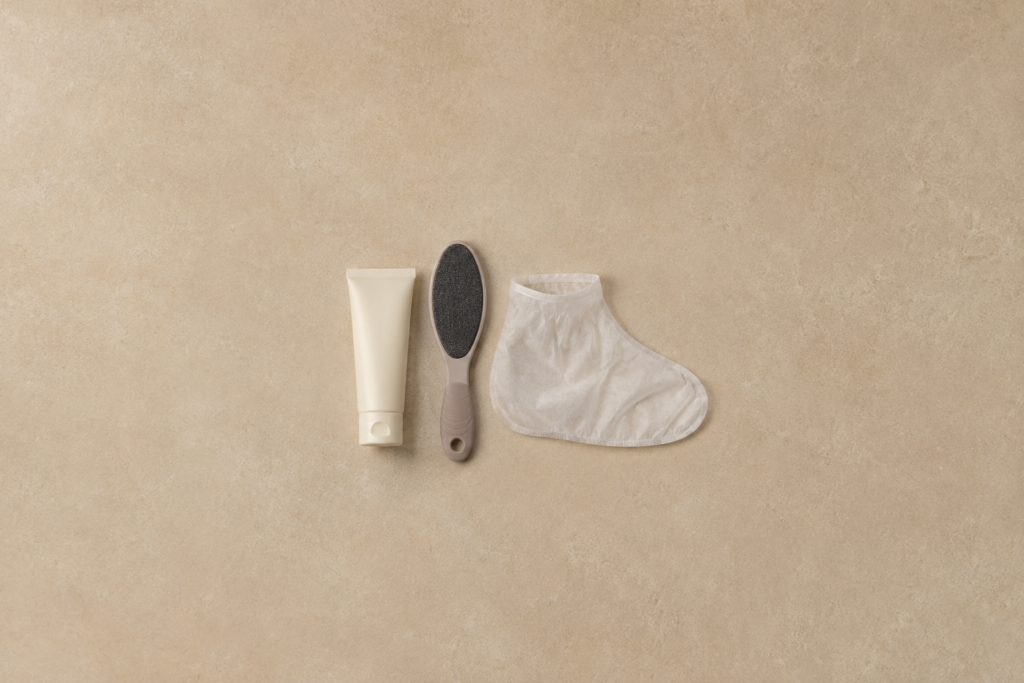
An unmarked squeeze tube, a textured manual foot file and a foot-mask bootie on warm stone.
What you’ll learn

From product form to skin contact

Start with the part you hold, then follow what reaches the foot. That simple distinction helps make sense of both formulas and hand tools.

  • Recognize five ways a product or tool can reach the foot.
  • Tell the base of a formula from the package or sock that holds it.
  • See what a mask’s shape and ankle closure each do.
  • Picture how a file’s grip and head affect where its face lands.
  • See how one blend can flow differently when its proportions change.
  • Separate the time a sock is worn from what happens to the formula left behind.
  • Tell a hydration reading from a water-loss reading.

Tip: Start with the physical description on the label. It tells you what to picture when the product name alone leaves that open.

Key terms

The language of foot care design

These terms name different parts of the same picture, from what’s inside the package to the surface that meets the foot.

Physical format

The form in which a product or tool comes into your hands.

  • Dispensed: A tube holds cream that comes out of the package.
  • Shaped: A solid balm can form its own application surface.
  • Handheld: A manual file has a working surface and a grip.

Vehicle

The base of a topical formula that carries its other ingredients.

  • Formula: The vehicle is part of what goes on the skin.
  • Study comparison: A test can compare a formula with a base version.
  • Particles: In a scrub, the base can carry loose abrasive grains.

Emulsion

A mixture in which one liquid is held in small droplets inside another liquid.

  • Surrounding liquid: The liquid that the droplets sit in is the continuous phase.
  • Droplets: The liquid broken up into droplets is the dispersed phase.
  • Boundary: An emulsifier helps keep the droplets dispersed.

Spreadability

How readily a formula moves across a surface as it’s rubbed out.

  • Pickup: Firmness describes how the formula feels as it’s picked up.
  • Movement: It describes what happens as the portion moves, once contact has started.
  • Stickiness: A formula’s tack can be described separately from its spread.

Wear time

The labeled time a removable carrier stays in place.

  • Wearable part: A bootie can serve as the carrier.
  • Endpoint: The interval ends when the bootie comes off.
  • Residue: A separate direction can cover formula left on the skin.

Filing face

The abrasive working surface of a manual file.

  • Surface texture: The pattern on the face describes one feature of the tool.
  • Second face: Some files put a different texture on the reverse side.
  • Grip: The handle is the part you hold to orient the face.

Tip: When a product has several parts, name what does the carrying and what touches the foot. Sometimes one part does both.

Product form

What reaches the foot

Start by asking what you’re actually holding. With some designs it’s a package, and with others it’s the piece that touches the skin.

  • O’Keeffe’s sells its Healthy Feet cream in a tube. The package dispenses the portion that goes on the skin.
  • The Earth Therapeutics heel balm comes in a holder that twists to advance the solid stick. The exposed portion is the formula itself.
  • GEHWOL’s Canadian listing describes its Health Refreshing Gel as lightweight and designed to be rubbed into the skin.
  • Aquaphor’s foot mask comes as a sock already infused with its formula. The two are handled as one piece.
  • On Dr. Scholl’s glass file, a fixed textured surface does the work as you move the tool by hand.

Once you know what comes out of the package or stays in your hand, you can work out what has to reach the heel.

Delivery

How the design places contact

Contact starts with a simple constraint. A formula or filing face can only meet the part of the foot it can physically reach.

  • A heel stick puts the hand in charge of placement. The exposed balm can transfer only where the stick can touch.
  • The shape of a Dr. Scholl’s mask bootie surrounds the foot, while a tab closes its opening at the ankle. The two features solve different fit problems.
  • A file’s handle positions its head. Earth Therapeutics describes a large ceramic head and a wide handle. The space available to swing the handle helps determine which part of the face can meet a heel’s curve.

A drawing of the contact area could show where the product meets the foot. It would take measurements to say how evenly the formula lands or how much a file removes.

Formulation

What gives a formula its physical form

A formula can need to hold its shape in the package, then give way at the skin. The parts that make those actions possible do different jobs within the same product.

  • Suppose you want to know whether a cream will reach around the outer curve of a heel. The ingredient names leave that question open. In three body-lotion prototypes, changing only the proportions of the emulsifier blend changed how the lotions flowed. A heel test would have to track where the cream actually goes.
  • Earth Therapeutics describes waxes giving its heel stick a solid shape and oils helping it glide. A stick has to hold together in the tube and let balm transfer when it meets the skin.
  • Freeman lists pumice in a water-containing foot scrub. The spreadable formula carries the grains into contact with skin. The word pumice alone leaves the size and feel of those particles open.

An ingredient list gives you clues about the parts. The way those parts are put together explains why the finished product holds a shape or moves across a surface.

Handling

What the design asks of you

Some handling demands only become clear once you picture the product in use. For a wearable mask, that includes how long the carrier stays in place.

  • The Aquaphor mask sock has a ten-minute interval. The Dr. Scholl’s bootie specifies half an hour. In both cases the time describes how long the wearable stays on.
  • Dr. Scholl’s labels its glass file for use on either wet or dry feet. That range is a stated feature of this model.
  • In a lab study of model creams, researchers examined how easily each poured, how firm it felt at pickup, and how it spread during rubbing. Getting a portion out and distributing it over a surface are two different handling demands.

A single texture word can miss the part that matters to you. How the cream behaves during application might be the relevant detail if what you want to understand is how it covers an area.

Finished-product evidence

What the complete product was tested for

What changed between the products, and what did the researchers measure? A split-foot study of two foams shows why both questions matter.

  • In a study of 12 adults with dry feet, each person used a different foam formula on each foot. Several ingredients differed, so the experiment compared complete formulas that shared a format.
  • The researchers tracked skin capacitance as an indirect measure of hydration and separately measured water escaping through the skin. Capacitance increased for both formulas by week four. Neither side showed a statistically significant change from its starting measurement of water loss.
  • A separate study included a cream and a foam, each with 10% urea. Matching that percentage leaves the rest of each recipe open, so a difference between the products would have more than one possible explanation.

When a test measures a skin change, its conclusion follows the versions it compared and the particular change it measured. The design can explain how exposure happens before anyone tests whether that exposure changes the skin.

Reality check

Two ways fit can change contact

These hypothetical examples follow where a product could touch the foot. Each stops at the point where you’d need measurements to go further.

A small spot at the side of the heel

Imagine a small spot on the outer heel. A solid balm stick touches where you place it. A foot-shaped mask sock carries formula over an area, so whether the lining touches that spot depends on how the sock fits there.

If the sock stands away from that spot while sitting close elsewhere, the outline of the sock would overstate where its lining actually touches. You’d still need a measurement to know how much formula reaches the spot.

A file at the back of a rounded heel

Picture a broad filing head meeting the back of a rounded heel, with a chair rung in the way of the handle. The rung could limit how far your wrist can turn the head, leaving a corner of the face as the only part that reaches the curve.

Move the chair in that thought experiment and the handle has more room to turn. That could change the patch of the face that touches the heel. It still leaves pressure and the amount removed unmeasured.

Misconceptions

Where design cues can mislead

Each statement draws a bigger conclusion than the design detail can support. The product labels and tests give narrower answers.

A rich pumice scrub must keep its grains against the heel longer.

The Body Shop describes its pumice foot scrub as rich and calls for rinsing it off. That tells you when contact is meant to end. The description of the texture gives you no contact time for the grains.

Two faces made from the same material do the same job.

Both faces of the ONYX file are stainless steel. The maker assigns the coarser face to buffing and the finer one to polishing. The shared material still leaves room for two working textures.

A mask’s stated wear time is the minimum.

The wear directions on both masks specify when the carrier comes off. Those directions give no estimate of what extra time would do.

A more acidic foot cream is bound to work better.

An exploratory study compared three related foot creams starting at different pH levels, a measure of acidity or alkalinity. It found no statistically significant performance difference across the creams. The highest-pH batch drifted toward neutral during the study, and the researchers replaced it partway through.

A firm cream will stay equally firm while it spreads.

All four model creams in one lab study flowed more readily as the layers within them slid past one another faster. The technical term is shear thinning. A cream’s firmness at rest captures one moment in its handling.

Tip: When a claim implies that something works better, ask whether the evidence describes a design feature or measures an outcome.

FAQ

Foot care design questions

Labels, images and studies each answer a different kind of question about a finished product.

Does “fast-absorbing” tell me how far a foot gel spreads?

GEHWOL uses that description for a Canadian foot gel that it calls lightweight and says to massage into the skin. The page gives no measurement of how much skin a portion of gel can cover as you rub it across a heel.

When the sock comes off, what can still touch the foot?

With Aquaphor’s no-rinse mask, the sock comes off and formula can stay on the foot. Dr. Scholl’s likewise describes formula remaining after its bootie comes off. Taking the carrier off ends contact with the lining. The formula left on the foot can still touch it.

Does leftover formula make a bootie reusable?

Dr. Scholl’s labels this bootie disposable. Any formula left inside is still in a carrier intended for one use.

Does a wet-or-dry file rating tell me how much it will remove?

ONYX lists wet and dry compatibility for its file and gives separate preparation directions. The compatibility line describes allowed conditions. It reports no abrasion measurements for either one.

Does the shape of a mask sock identify the formula inside?

Aquaphor says it updates ingredients and that its website and packaging can differ. You can use the shape to picture where a sock fits around your foot. The shape alone gives you no way to identify the blend in that sock.

Does a lab result about spread carry over to a heel?

A lab measurement on model creams describes those samples under bench conditions. Even if volunteers handle a prototype for a sensory test, as they did on their hands in the lotion study, how it spreads on feet is a separate question.

Can the dry-foot scores tell me where the two moisturizers made contact?

In a trial published in 2018, 34 people completed a comparison of two moisturizers for dry feet, sorbolene and a urea cream. The trial did not detect a statistically significant difference in the symptom scores between the two groups. The scores describe signs of dry skin. They do not show where either moisturizer touched the foot.

What can a before-and-after foot photo show about a formula?

The O’Keeffe’s heel balm page labels images taken before and after a two-week period. You can see the recorded appearance at those moments. The caption leaves open what an untreated foot or a foot using a different formula would have looked like.

Tip: When you connect a study to a label, ask which version of the formula was actually tested. Start with the formulas in the study and the one on the package.

Bottom line

Picture a change in design while the area of the foot stays the same. A solid stick can touch that area directly. A mask has to sit against it. Thinking through what has to meet the skin makes it easier to see why a change in form matters.

You can explain contact at the heel from what the product is made to do there. To explain a change in the skin, carry that same specificity into the evidence. A test of the finished formula tells you about the version and conditions it actually studied.

Related reading

Keep exploring foot care

Browse by the kind of reading you’re looking for.