Why Formulation or Design Matters for Hand Care

Formulation determines how a hand cream is put together, right down to the arrangement of the oil and water in an emulsion. A dispenser can shape what reaches your palm by mixing air with a liquid wash. Once you rub in a cream, its feel and its effect on skin hydration are separate questions.

By: Review Streets Research Lab
Updated: November 27, 2026
Explainer · 10–12 min read
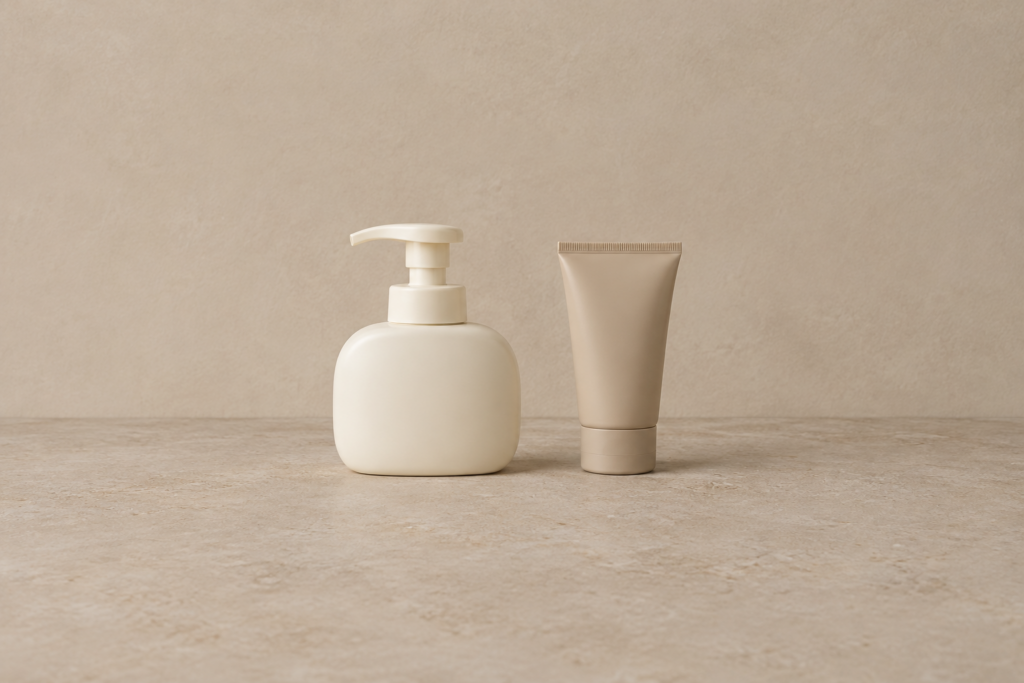
An ivory hand-wash pump bottle beside a capped taupe hand-cream tube on a textured beige counter.
Overview

What you’ll learn

Follow the formula from the mixing vessel to the package, then through the experience of spreading it and the experiments that study it.

  • How oil and water fit together in a cream
  • What a cream’s base contributes to an experiment
  • Which two readings describe water at the skin
  • Where the wash takes on its foamy form
  • What access to the contents has to do with opening design
  • What you can notice while putting on a cream
  • Where a hand-cream study took its readings

Tip: Picture the product at two moments, just as it leaves the container and just after you’ve spread it. The sections on dispensing and afterfeel follow those moments.

Vocabulary

Six terms for formula and design

Start with the terms for what’s in the package, what comes out and what a study can measure.

Vehicle

The base that carries the formula’s other components.

  • In a comparison: The study can test it alone.
  • A controlled change: In the forearm study, researchers added glycerol or petrolatum to the same base.
  • Extent of a disclosure: Naming the percentage of one component still leaves the rest of the vehicle to account for.

Emulsion

A mixture in which droplets of one liquid are spread through the other.

  • Internal phase: The dispersed part of the mixture. In an oil-in-water cream, those droplets contain oil.
  • Continuous phase: The liquid around the droplets. In an oil-in-water cream, it’s water-based.
  • Over time: The oil and water can separate.

Viscosity

How strongly a material resists flowing.

  • Consistency: Very thick formulas are at the high end of viscosity.
  • At the outlet: Dispenser hardware can be designed for particularly thick formulas.
  • In the hand: A bench measurement of spreading and a panel’s impression during rubbing are separate observations.

Afterfeel

The way a product feels on the skin once you’ve spread it.

  • When you notice it: It comes after picking up the product and rubbing it over the skin.
  • What you might notice: A sense of stickiness, greasiness or a coating left on the surface.
  • What it records: A panel’s impression of absorption describes how the product felt to participants.

Foaming dispenser

A head that dispenses wash as foam.

  • What goes in: It takes a liquid capable of foaming.
  • Inside the head: One design brings in air separately.
  • The refill: Method sells a liquid refill for its foaming hand-wash pump.

Transepidermal water loss

The rate at which water escapes through skin, abbreviated TEWL.

  • What the reading tracks: It tracks the outward movement of water.
  • A separate reading: A hydration reading estimates water in the skin’s outer layer.
  • Where it was taken: The site varies by study. One hand-cream experiment recorded readings on forearms.

Tip: Keep the vehicle, the outlet and the measurement in view as you move from the cream itself to the studies.

Formula structure

How a cream is put together

A list of materials tells you what went into a cream. Its structure is how those materials are arranged in the finished mixture.

  • Eucerin’s U.S. hand-cream page gives the percentage of one named ingredient, a single detail about the finished product.
  • For a cream made as an emulsion, the starting point is getting water and oil into one mixture that can hold together.
  • A model cream had oil droplets distributed throughout its watery base. The researchers used the droplets’ size and distribution to help describe the mixture.
  • In a separate cosmetic experiment, researchers changed which oils and emulsifiers they used while keeping the total amounts of each group the same.
  • How the cream was made mattered in the first experiment too. Conditions during a pause in cooling influenced how stable that model cream was.

Picture the cream in cross-section, with oil droplets throughout a water-based mixture. That arrangement is the design feature the ingredient names leave unseen.

Formula roles

How the base and its additions work together

A cream’s base is part of what goes on the skin. Testing that base by itself gives researchers a reference point for judging the finished cream.

  • In a 12-hour forearm study of 51 healthy volunteers with dry skin, petrolatum contributed to lower water loss and glycerol to greater hydration in the tested cream.
  • In another experiment, researchers covered treated forearm skin. The hydration readings varied with how available the mixture’s water was and whether it contained either of the two water-attracting ingredients tested.
  • The contents have to hold up in the package, too. The FDA identifies inadequate preservation within a cosmetic and inadequate protection from its packaging as separate ways contamination can occur.

That cream gives an example of how separate ingredients can contribute different effects within the same mixture.

Product delivery

The path from package to palm

Follow the contents as they leave a pump, then consider what it takes to reach the contents in a jar.

  • One foaming-pump patent shows a chamber where incoming liquid and air mix before the foam reaches the outlet.
  • When the contents are very thick, moving them through the pack is a design job in itself. Aptar describes one airless bottle-within-a-bottle system designed for high-viscosity formulas.
  • Getting cream out of a jar can involve touching the contents with your fingers, a way the FDA says microorganisms can get in. O’Keeffe’s U.S. hand-care range illustrates the format options with jar, tube and pumpable creams.

The form that lands in your palm and the way you reach the bulk are both part of how the package works.

The experience

From first contact to afterfeel

A panel applying creams to the back of the hand evaluated pickup, rubbing and afterfeel separately.

  • At pickup, the panel rated consistency. During rub-in, it judged ease of spreading.
  • In one study, the two kinds of model cream differed especially in afterfeel. The panel rated how sticky they felt and whether they seemed to leave a coating.
  • A separate study of 44 women included tests at the finger, forearm and cheek. Under the study conditions, measured hydration rose immediately. The researchers found no statistically significant change in touch perception.

The final rub leaves you judging the residual feel, a separate observation from pickup.

The finished product

What an experiment can show about the whole formula

The next question is what researchers can establish when they test the whole formula. Start with what they compared and what they could observe.

  • One comparison tested the complete cream, its base alone and the base with either of the two components.
  • In a separate washing experiment with and without a specific hand cream, researchers took the roughness and hydration readings on the forearms.
  • One study of experimental gels and gel-creams took cheek readings before application and after one and two hours in eight healthy women aged 20 to 25. The authors inferred that a film may have formed.

Keep the readings attached to those particular formulas and to the scheduled cheek checks in the first two hours.

In everyday terms

Two imagined encounters with hand care

Put the outlet and the feel on skin into familiar settings, one at a sink and one at a desk.

At a shared sink

Imagine two pumps at a shared sink. One dispenses foam. The other dispenses gel. Method lists examples of both forms of hand wash in pump packaging.

Picture the bubbles in the mound from a dispenser that mixes air into the wash. Some of that space is air. The size of the mound alone leaves the original liquid volume open.

Back at your desk

Imagine trying two creams before returning to your paperwork. Both are imagined to rub in easily. Afterward, one feels as though it leaves a coating and the other feels less noticeable.

If you described both creams as easy to spread, you’d still have two different descriptions of what they felt like afterward. In one study of experimental cosmetics, researchers recorded what participants said about hydration and absorption as impressions.

Shortcuts

Five shortcuts that miss part of the design

Put five quick assumptions about the formula, the package and the finished product to the test.

If two creams spotlight the same ingredient, are their formulas effectively the same?

Researchers held total oil and emulsifier amounts constant and varied the types they used. They found differences between the experimental creams in a beaker test of water lost by evaporation.

Does thicker cream keep skin hydrated for longer?

Thickness describes how a cream flows. Checking how hydration changes takes measurements at different times. In one gel and gel-cream experiment, researchers measured it before application and again after one and two hours.

Does a bigger mound of foam mean a more concentrated wash?

In a head that mixes air into the wash, the bubbles add volume. To know the concentration, you’d need information about the liquid that went in.

Does the package do all the work of protecting the contents?

The FDA lists inadequate packaging protection and inadequate preservation as two separate routes by which cosmetics can become contaminated. The contents and their container each have a part to play.

Why would a formulator add fragrance to a product meant to smell unscented?

The FDA says some cosmetics sold as unscented include fragrance ingredients to cover odors from other components.

Tip: When thinking through these examples, identify what the shortcut overlooks. It might be another ingredient, part of the dispenser or the timing of a measurement.

FAQ

Details about formulas, packs and tests

Use these answers to clarify a few specific terms and details that come up when discussing finished hand-care products.

Why might the tube and the brand’s website list different ingredients?

Eucerin says it updates product ingredients and that its U.S. website and packaging can occasionally differ. Its notice is a reminder that two descriptions may be for different versions.

Can U.S. ingredient order tell me a component’s exact percentage?

On U.S. retail cosmetics, ingredients generally appear by amount, from greatest to least. Color additives and ingredients present at 1% or less have ordering exceptions. That order alone doesn’t reveal an ingredient’s exact percentage.

Does a laboratory spreading measurement tell me how easily a cream will rub in?

In one comparison a bench test missed how the panel said the creams spread. In another, flow measurements helped predict some application sensations. The formulas and methods differed.

Is water activity the same as the percentage of water in a formula?

Water activity describes how available the water is in the mixture. The water percentage describes how much is there. The distinction mattered in one experiment when changing availability affected hydration.

Does studying a hand cream mean researchers took readings on the hands?

In a washing study, people washed both hands and forearms under regimens with and without the cream. Researchers took the roughness and hydration readings on the forearms.

What outcome does ‘clinically tested’ describe on its own?

The phrase doesn’t name an outcome for the formula. The U.S. FTC says that when an advertiser makes a specific claim about the evidence it has, it needs at least the level of support it claims.

What can a stability test show about how a cream holds together?

In one set of experimental gels and gel-creams, researchers checked for separation and changes in appearance under test conditions. They measured skin hydration separately.

Does a package’s evacuation figure give the amount from one press?

An evacuation figure refers to the share of the original fill the package can get out in total. Dose per press would describe a single actuation.

Tip: If you’re looking up a technical term, read it alongside the question it answers. The definitions above give you a starting point.

Bottom line

Start with the moment you’re trying to explain. For what comes out at the sink, look to the contents and the dispenser together. A foaming head is part of the reason you see foam.

Once a cream is on your skin, ask what you actually noticed. If you’re curious about the coating you feel before going back to your desk, you’re asking about afterfeel.

Further reading

Explore Hand Care

Continue with the Hand Care archives for lists, comparisons and buying guides.