
Emulsion Type
Arrangement of water and oil-related phases in a liquid foundation.
- Use: predict application and residue
- Variable: emulsifier and phase ratio
- Tradeoff: Category is often undisclosed
Foundation formulas matter because the same shade can behave differently depending on how pigment is dispersed and what remains after application. Water, oils, silicones, waxes, powders, volatile carriers, emulsifiers, and film formers control spread, opacity, dry-down, reflection, flexibility, and resistance to transfer.
A formula is more than an ingredient family printed near the top of a list. Pigment wetting, particle size, phase balance, preservation, packaging, and the interaction with sunscreen or primer shape real performance. The useful choice is the foundation that reaches the intended coverage and finish in a thin, stable layer while matching the user's skin response and removal tolerance.
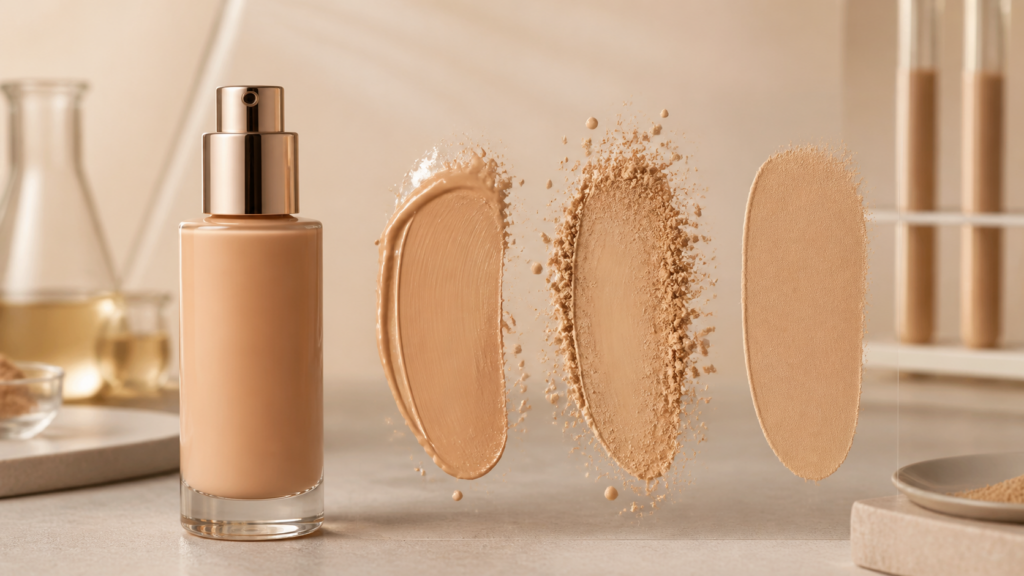
Show how emulsion type, pigment dispersion, powders, emollients, volatile carriers, film formers, shade system, preservation, packaging, and applied dose jointly determine coverage, finish, comfort, wear, and removal.
Tip: The final deposited film matters more than the wet swatch.
These foundation formulas concepts separate mechanism, application, limits, and purchasing consequences.
Arrangement of water and oil-related phases in a liquid foundation.
Separation and wetting of color particles throughout the vehicle.
Material left after water or volatile carriers evaporate.
Ingredient or blend reducing drag during spreading.
Particle taking up oil or changing light scatter.
How pump, dropper, bottle, tube, or compact protects and doses the product.
Tip: Use these terms to test foundation formulas instead of relying on a front-label promise.
Liquid, cream, stick, and powder names narrow the format but do not define the film. Look for shake instructions, coverage, finish, wear, and application directions as clues.
The final deposited film matters more than the wet swatch.
Patchiness often leads to unnecessary layering. Use suitable preparation, controlled sections, and a tool that spreads pigment without repeatedly lifting the base.
Evenness can outperform maximum pigment load.
Matte, natural, satin, and radiant results depend on light scatter and the residual surface. Sebum and skin care can move the finish after an hour, so judge more than fresh application.
Finish is a time-dependent optical result.
Sunscreen, moisturizer, primer, foundation, concealer, and powder create multiple films. Let earlier layers settle and reduce rubbing before replacing the foundation.
A failed stack does not prove a failed foundation.
Oxidation-like color shifts, pump control, contamination risk, fragrance, eye-area instructions, shade availability, and return policy can outweigh a beautiful initial swatch.
Foundation value is a successful full-face wear, not cost per milliliter alone.
Foundation architecture can improve application and wear; it cannot guarantee a perfect shade, porelessness, skin treatment, or universal compatibility.
Pigment stays evenly dispersed and builds without patchiness.
The residual film balances coverage, movement, comfort, and removal.
A long ingredient list does not reveal ratios, processing, or film structure.
High coverage and long wear may increase blending pressure or cleansing burden.
These claims flatten the variables that determine how foundation formulas performs in a real routine.
Oil-free is a labeling claim, not a complete phase map. Emollients, silicones, esters, waxes, and pigments can still influence slip and residue.
Finished products are complex mixtures. Amount, order, drying time, rubbing, polymer interaction, and surface condition determine pilling more reliably than one ingredient class.
Dispersion, opacity, particle placement, shade match, and applied thickness matter. Poorly dispersed high pigment can look patchier and heavier.
Apparent darkening can come from drying, oil wetting pigments, lighting, layer thickness, powder, or true chemical change. Compare controlled swatches over time.
Cosmetic foundations may contain familiar skin-care materials, but concentrations, dose, contact, and claims differ. Do not substitute makeup for a needed treatment or sunscreen routine.
Tip: Test the exact foundation formulas tool, setting, and routine before generalizing from its category.
The remaining decisions about foundation formulas concern technique, compatibility, safety, upkeep, and value.
Shake when the label directs it, especially for fluid systems that may settle or separate. Do not assume vigorous shaking suits airless or foam packaging.
Surface flakes, uneven skin care, absorbent powder, fast evaporation, and repeated buffing can concentrate pigment. Use gentle preparation and thinner placement.
Wear it over the normal routine and track first shine, separation, transfer, comfort, and touch-up behavior by zone rather than relying only on matte labeling.
No product label can guarantee every individual response. AAD recommends such labeling for acne-prone skin, plus gentle cleansing, complete removal, and clean tools.
A pump can reduce direct contact and improve dose control, but formula preservation, clean handling, cap use, and package integrity still matter.
Record shade in daylight, coverage, texture, set time, transfer, creasing, oil response, comfort, touch-ups, removal effort, and any irritation.
Foundation formulas matter because pigment dispersion and the residual film determine whether shade, coverage, finish, comfort, and wear remain coherent after application.
Choose the complete system: architecture, dose, skin-care stack, packaging, shade behavior, and removal. Test after dry-down and several hours rather than buying from a wet swatch or one ingredient label.
These Review Streets paths narrow the next foundation formulas decision by format, goal, and routine fit.
Browse face, eye, lip, brow, primer, and setting categories.
Compare liquid foundation coverage, finish, shade, and wear.
Choose a retailer
Prices checked regularly. We may earn a commission at no cost to you.