
Delivery Mechanism
The physical, chemical, or optical way a device acts on hair.
- Use: compare categories
- Variable: cut, pull, dissolve, or heat
- Tradeoff: Features cannot change the mechanism
Hair-removal technology matters because changing the tool changes what happens to the hair and surrounding skin. A razor manages a rapidly moving cutting edge; an epilator coordinates many mechanical grips; a depilatory controls reactive chemistry and contact time; IPL and laser devices manage light spectrum or wavelength, pulse duration, energy, spot size, cooling, skin contact, and lockouts.
Those engineering choices shape repeatability as much as the basic mechanism. A flexible shaving head may follow contours; an epilator's tweezer geometry affects capture; an IPL skin-tone sensor can limit unsuitable flashes; a clinic laser's wavelength and cooling can expand treatment options. Features should be tied to a real operating job rather than assumed to improve results.
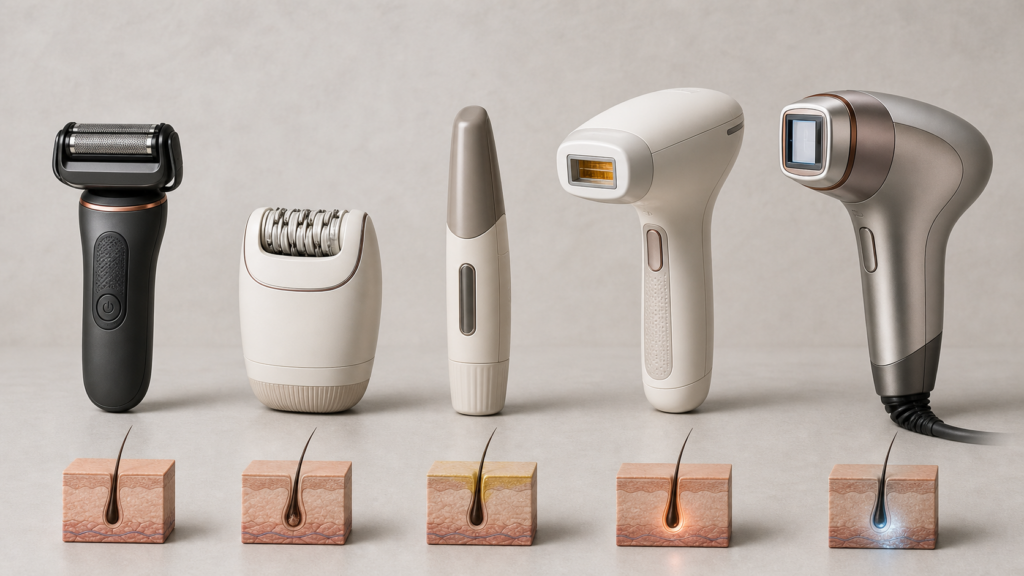
Explain why mechanism and delivery technology—not product category hype—determine depth, speed, regrowth, pain, compatibility, safety controls, treatment schedule, maintenance, and lifetime value across razors, epilators, depilatories, IPL, and laser.
Tip: A permanent-sounding name can conceal a maintenance routine.
These hair removal technology concepts separate mechanism, application, limits, and purchasing consequences.
The physical, chemical, or optical way a device acts on hair.
How reliably a tool engages hairs of varied length, angle, and diameter.
Length of an optical energy pulse.
Interlock that permits output only when the treatment window is properly placed.
Contact, air, or other cooling used to manage surface heat during energy treatment.
Purchase, consumables, electricity, appointments, maintenance, and replacement over use.
Tip: Use these terms to test hair removal technology instead of relying on a front-label promise.
Shaving, depilatories, and root extraction manage current hair; laser and IPL aim to reduce future growth over a course. The purchase category should match the desired endpoint.
A permanent-sounding name can conceal a maintenance routine.
Optical systems depend strongly on pigment and parameters, while mechanical systems depend on access, curl, length, and contour. No one technology fits every combination.
Biology sets limits that features cannot negotiate away.
Energy levels, sensors, timers, contact indicators, speed settings, pressure warnings, and cooling matter only when their purpose is clear and they work reliably.
Good controls reduce guesswork rather than add menus.
Window size, repetition rate, cord or battery limits, repositioning, charging, cleanup, and missed-area overlap determine whether a routine is sustainable.
A fast specification can become a slow session.
Price blades, foils, heads, cartridges, lamps where applicable, cleaning supplies, batteries, professional sessions, repairs, storage, and responsible disposal.
Technology value appears over years, not an unboxing.
Technology can improve delivery, feedback, and consistency; it cannot override incompatible hair pigment, unsafe skin conditions, poor technique, or biology.
The mechanism reaches the intended depth for the desired duration of smoothness.
Controls and safety interlocks match the operator's training and skin-hair characteristics.
Session time, pain, cleanup, consumables, and maintenance fit long-term use.
Claims distinguish temporary removal, hair reduction, and permanent reduction accurately.
These claims flatten the variables that determine how hair removal technology performs in a real routine.
A newer interface or sensor may improve use, but mechanism, delivered performance, evidence, and compatibility determine outcomes.
Flash count describes potential device life, not energy per pulse or suitability.
Sensors add a safeguard but cannot account for every condition, recent tanning, user error, medication, or device fault.
Battery aging, charge interruptions, waterproof restrictions, and travel rules can offset portability.
Parameter selection, placement, overlap, cooling, endpoints, and complication recognition remain operator-dependent.
Tip: Test the exact hair removal technology tool, setting, and routine before generalizing from its category.
The remaining decisions about hair removal technology concern technique, compatibility, safety, upkeep, and value.
Razors and depilatories can cover large areas quickly; actual time varies with preparation, contour, cleanup, and regrowth standard.
Appropriate professional laser and some IPL systems can produce long-term reduction over repeated sessions, with maintenance sometimes needed.
They differ in output, optical design, cooling, allowed skin tones, treatment window, controls, supervision, and treatment schedule.
Effective head width, tweezer geometry, speed control, contour contact, wet/dry permission, grip, noise, cleaning, and replacement support.
Hair follicles cycle, and light is most useful when target hair pigment and growth state are suitable; all follicles are not synchronized.
Follow its contraindications for skin tone, tanning, lesions, infection, medications, body areas, pregnancy, implants, or other conditions and seek advice when uncertain.
Hair-removal technology matters because it governs how a method cuts, grips, dissolves, or heats hair—and how consistently the operator can control that action. Sensors and features are valuable only when they solve a defined safety or usability problem.
Start with the required endpoint, then match mechanism to skin, pigment, hair, area, pain, session time, controls, cleanup, consumables, evidence, and maintenance. Biology and correct use still set the ceiling.
These Review Streets paths narrow the next hair removal technology decision by format, goal, and routine fit.
Browse shaving, epilation, and light-based hair-removal categories.
Compare at-home beauty devices, including light-based hair-removal systems.
Choose a retailer
Prices checked regularly. We may earn a commission at no cost to you.