
Weathering
Cumulative surface and structural change from washing, light, friction, heat, and chemicals.
- Use: identify older vulnerable lengths
- Variable: history and exposure
- Tradeoff: Damage is uneven
Hair repair treatments matter because bleaching, coloring, heat, ultraviolet exposure, grooming, and ordinary weathering can leave a fiber rougher, more porous, weaker, and easier to tangle or break. A suitable treatment may reduce friction, reinforce stressed areas, improve water management, or make damaged hair easier to handle.
Repair is not one mechanism. Conditioners coat and lubricate; proteins and polymers may form films or fill irregularities; certain bond-focused technologies target specific chemical interactions. None turns an emerged strand back into untouched hair. The useful question is which damage signal needs improvement, how the formula should be placed and repeated, and whether better feel translates into less breakage during the real routine.
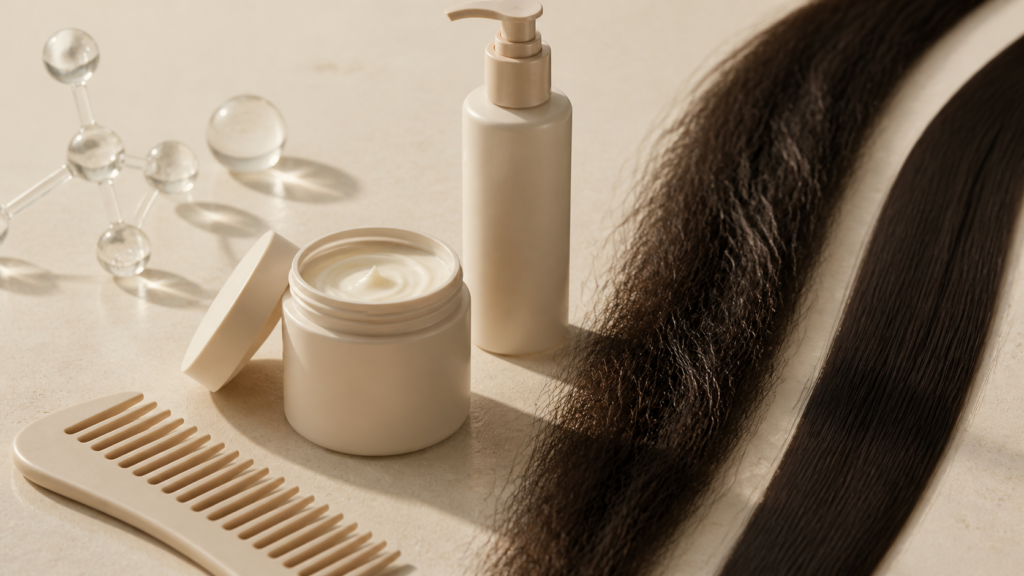
Define repair by the damage and measurable behavior addressed—friction, breakage during handling, porosity, or bond-related strength—without claiming that dead fiber is healed permanently.
Tip: A repair label is broad; the observed problem should be narrow.
These hair repair treatments concepts separate formula behavior, application choices, limits, and purchasing consequences before the mechanisms are compared.
Cumulative surface and structural change from washing, light, friction, heat, and chemicals.
Breakage when a stressed fiber cannot withstand applied force.
A deposited layer that changes smoothness, friction, and moisture exchange.
A formula using hydrolyzed proteins or amino-acid materials for conditioning or film effects.
A product designed around particular interactions associated with damaged hair structure.
The repeat schedule needed to sustain a useful cosmetic effect.
Tip: Use the terms to test hair repair treatments rather than relying on a front-label promise.
Roughness, tangling, snapping, mushy wet feel, faded color, dryness, and split ends do not all have the same cause. Identify the chemical and heat history, location of breakage, and whether the scalp is involved before selecting a format.
A repair label is broad; the observed problem should be narrow.
A rich mask may lower friction, a polymer may form a protective film, and a bond product may target a narrower structural interaction. Compare directions, evidence, and felt result rather than treating all repair words as interchangeable.
Different mechanisms can support the same routine without being identical.
Fine or lightly damaged hair may need a smaller amount or longer interval than porous, processed lengths. If hair becomes stiff, rough, coated, or difficult to style, reduce frequency and simplify before adding another treatment.
The maintenance dose is the least product that preserves the useful effect.
Lower friction, gentle detangling, heat control, and realistic chemical-service intervals determine whether a treatment's benefit survives. Repeated high heat or aggressive brushing can overwhelm a temporarily smoother surface.
Repair care cannot compensate for unlimited new damage.
Photograph consistent sections, note combing time, visible broken pieces, styling effort, and how long the benefit survives washing. A costly treatment earns its place only if it changes an important outcome without unacceptable weight or irritation.
Shine alone can hide whether the routine actually became gentler.
Repair can improve damaged hair's behavior and appearance for a useful interval, but it does not recreate living, virgin tissue.
Detangling requires less force and routine breakage decreases under comparable handling.
The fiber feels smoother or stronger without excessive rigidity, residue, or lost movement.
Split ends and severely fractured sections cannot be permanently fused into original structure.
New chemical, thermal, and mechanical damage continues unless the routine changes too.
These hair repair treatments claims collapse several variables into one rule and can lead to poor application or unnecessary purchases.
Most cosmetic effects diminish with washing and wear, even when they improve handling substantially. The emerged hair shaft is not living tissue, so repair should describe measurable temporary reinforcement, lubrication, or surface improvement.
Proteins are one broad ingredient family. Conditioning agents, polymers, silicones, oils, and bond-focused technologies can address different behaviors. The best option depends on formula delivery and the damage signal, not one label.
Bond terminology is used across different proprietary technologies and claims. Products can vary in target, evidence, concentration, placement, and conditioning support; compare the exact formula and directions rather than the category name alone.
High richness can improve slip but may flatten fine hair, leave residue, or obscure whether breakage changed. Match dose and format to strand diameter, damage location, and the routine's cleansing capacity.
Softness reflects surface lubrication and feel, not a complete structural assessment. Useful repair should also consider tangling, breakage under similar handling, elasticity-related behavior, styling control, and how the result survives washing.
Tip: Test the exact hair repair treatments product, dose, and routine before generalizing from a category label.
The remaining hair repair treatments decisions concern application, compatibility, frequency, safety, and value in an ordinary routine.
Follow the product directions, then adjust based on damage, strand response, wash frequency, and buildup. More frequent use is not inherently better; reduce use if hair becomes stiff, heavy, rough, or difficult to style.
They may coat and temporarily align a frayed area, improving appearance and snagging. They cannot restore the original continuous end permanently; trimming removes the split and helps prevent it from traveling farther.
Shed hairs often include the full strand and may show a club-shaped root; broken pieces are shorter and lack it. Sudden, patchy, painful, or substantial loss warrants professional assessment.
Only when directions permit and each serves a clear role. Introduce one at a time, watch for weight or stiffness, and avoid assuming that stacking repair claims multiplies benefit.
Bleached hair often needs lower-friction handling and conditioning, but protein preference varies by formula and fiber. Test a modest schedule and judge combing, flexibility, breakage, and feel instead of prescribing one ingredient universally.
Trim when ends remain split, snagging, transparent, or repeatedly breaking despite gentle care. Retaining severely weathered length can increase tangling and product use without delivering the appearance or control desired.
Hair repair treatments matter when they make damaged fibers easier to detangle, style, and retain with less breakage. Repair can involve lubrication, film formation, protein-related effects, or narrower bond technologies.
Choose by observed damage and measure a practical outcome across washes. The treatment must work alongside gentler handling and reduced new damage; permanent biological restoration is not a realistic cosmetic promise.
These Review Streets paths narrow the next hair repair treatments choice by format, goal, and routine fit.
Compare masks, oils, serums, and bond-focused formulas by goal and format.
Explore intensive conditioning options for slip, softness, damage, and moisture needs.
Choose a retailer
Prices checked regularly. We may earn a commission at no cost to you.