
Breakage
Failure along the hair shaft rather than release of a complete hair from the follicle.
- Use: set the correct target
- Variable: damage and force
- Tradeoff: It can resemble shedding
Hair strengthening treatments matter because damaged fibers can snap during detangling, drying, styling, and ordinary friction. A suitable formula may reduce combing force, form a reinforcing film, improve flexibility, or help a stressed strand tolerate handling more consistently.
Strengthening is not the same as growing more hair, making every strand permanently thicker, or reversing all chemical damage. Results depend on the mechanism, damage history, dose, frequency, conditioning balance, and the force applied afterward. The practical test is whether similar wash days produce fewer broken pieces and easier handling without stiffness, coating, lost movement, or scalp irritation.
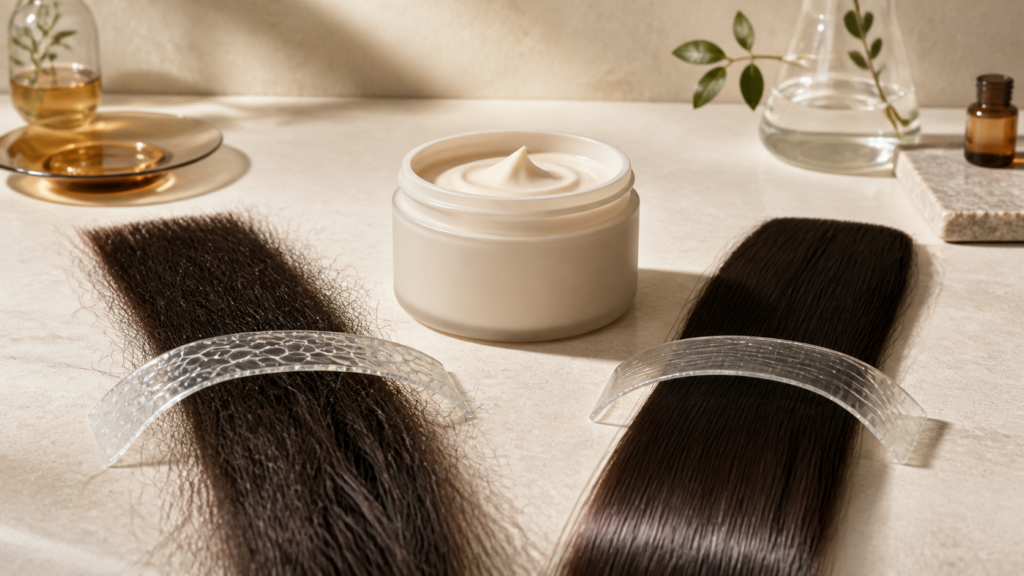
Define strengthening by reduced breakage under comparable handling, separating surface lubrication, film reinforcement, protein and bond-focused claims from growth, thickness and permanent repair.
Tip: The right category begins with the right failure mode.
These hair strengthening treatments concepts separate mechanism, application, limits, and purchasing consequences.
Failure along the hair shaft rather than release of a complete hair from the follicle.
How a fiber stretches and resists force before failing.
A deposited layer that changes friction and stress distribution.
Smaller protein-derived material used for conditioning or film effects.
Technology aimed at selected interactions in damaged hair structure.
Enough resistance with enough movement for routine handling.
Tip: Use these terms to test hair strengthening treatments instead of relying on a front-label promise.
Short snapped pieces, split ends, and breakage concentrated in processed zones suggest a fiber problem; complete hairs and sudden or patchy loss may involve the scalp or growth cycle. Do not treat every fallen hair with a strengthening mask.
The right category begins with the right failure mode.
Conditioning lowers friction; polymers and protein-derived materials can form films; bond-focused products make narrower structural claims. Several routes may reduce breakage, but they are not interchangeable and should be tested one at a time.
A strengthening label should name an outcome, not erase mechanism differences.
Begin with label guidance, then extend or shorten the interval using breakage, stiffness, residue, and styling response. Repeated intensive treatment can create weight or rigid feel without further benefit.
Maintenance frequency should be earned by repeatable response.
A smoother, reinforced fiber can still break under rough towels, tight styles, high heat, overlapping bleach, or aggressive brushing. Pair treatment with lower force and conservative tool settings.
Strengthening care cannot outrun unlimited new damage.
A film may make hair feel thicker immediately without changing long-term breakage. Photograph consistent sections and record broken pieces, detangling time, stiffness, movement, and effect duration before paying for repeated use.
The best evidence is less failure under the same routine.
It can improve damaged-fiber handling and resistance for a useful interval; it cannot change the follicle or recreate untouched hair.
Comparable detangling produces fewer snapped pieces with adequate flexibility.
The benefit survives a useful number of washes without excessive coating.
Hair becomes stiff, rough, heavy, or harder to style as treatments accumulate.
Sudden loss, scalp symptoms, or severe breakage needs qualified assessment rather than stronger cosmetics.
These claims flatten the variables that determine how hair strengthening treatments performs in a real routine.
Cosmetic treatments act mainly on emerged fibers and cannot promise faster follicular growth. They may improve retention by reducing breakage, which can make length easier to keep without changing the growth rate.
Protein-derived ingredients vary in size, dose, and formula context. Some hair responds well; other routines become stiff or coated. Test the finished product rather than diagnosing a universal protein deficiency.
Bond-focused products and protein-derived films may target different interactions and use conditions. Marketing language overlaps, so compare the exact technology, directions, conditioning support, and measured handling result.
Softness often reflects lubrication and surface feel. A very soft fiber can still stretch, snap, or suffer structural damage; evaluate breakage and flexibility alongside touch and shine.
Benefits may plateau while residue, stiffness, cost, and wash burden rise. Use the least frequent schedule that preserves easier handling and lower breakage under comparable conditions.
Tip: Test the exact hair strengthening treatments tool, setting, and routine before generalizing from its category.
The remaining decisions about hair strengthening treatments concern technique, compatibility, safety, upkeep, and value.
Follow its directions first, then adjust using breakage, flexibility, residue, and wash frequency. Reduce use if hair becomes stiff, rough, heavy, or difficult to style; more is not automatically stronger.
Films can temporarily smooth and align frayed ends, reducing snagging, but they cannot recreate the original continuous tip. Trimming removes the split and prevents reliance on repeated cosmetic concealment.
Yes when mechanical, environmental, or heat-related breakage is present, but healthy low-damage hair may need only ordinary conditioning and gentle handling. A treatment should solve an observed problem rather than prevent an imagined one.
They can when directions permit and their jobs differ, but introduce them separately. Overlapping rich films can hide which product helps and may increase stiffness, weight, or cleansing burden.
Broken fragments vary in length and lack a root; shed hairs are usually full length and may show a club-shaped end. Sudden, substantial, patchy, painful, or persistent loss warrants professional care.
It should reduce a meaningful handling problem at a repeatable dose without requiring extra corrective products. Include frequency, amount, dispenser waste, styling time, and effect duration when comparing value.
Hair strengthening treatments matter when they reduce fiber failure during a comparable routine. Their useful mechanisms include lower friction, reinforcing films, protein-related conditioning, and selected bond-focused technologies.
Choose by the observed breakage pattern, measure flexibility as well as resistance, and use the least frequent effective interval. Growth, permanent reconstruction, and universal protein rules fall outside a defensible cosmetic claim.
These Review Streets paths narrow the next hair strengthening treatments decision by format, goal, and routine fit.
Compare masks, oils, serums, and strengthening or bond-focused formats.
Compare intensive conditioning by damage, moisture, slip, and hair compatibility.
Choose a retailer
Prices checked regularly. We may earn a commission at no cost to you.