
Thermal Dose
Combined temperature, time, repetition, and contact.
- Use: compare routines
- Variable: tool and technique
- Tradeoff: Lower heat may take longer
Heat protection matters because dryers, irons, and curling tools transfer energy while tension and pressure act on the same fibers. Repeated or intense exposure can roughen the surface, alter keratin, change water-related behavior, and increase later breakage.
A suitable protectant may form an even film, improve slip, or reduce selected thermal effects, but performance depends on formula, coverage, drying state, temperature, contact time, and tool. Protection is incomplete, so lower workable settings, fewer passes, sound sectioning, and less frequent hot-tool use remain essential.
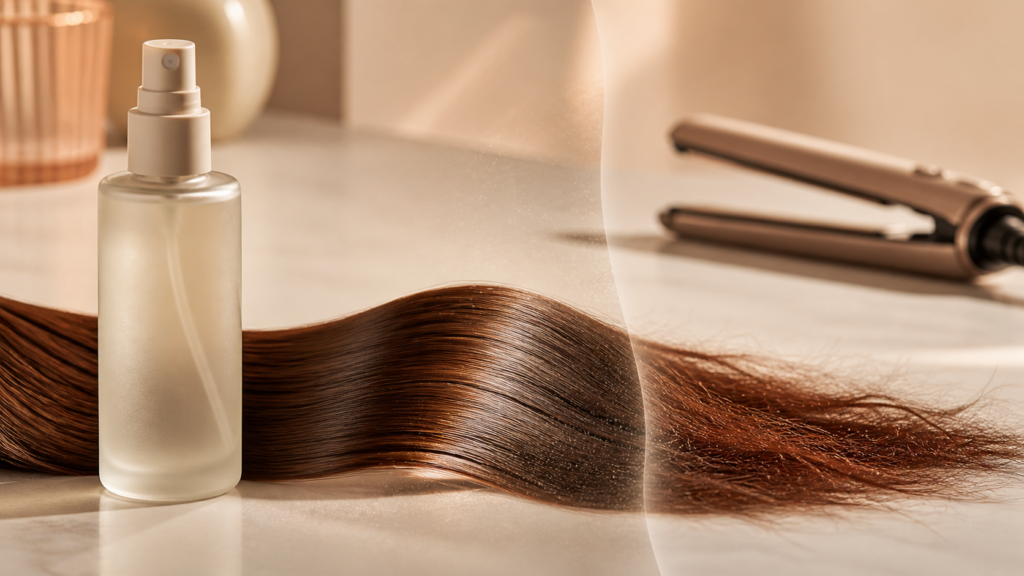
Explain protection as a partial, formula-specific reduction of thermal and mechanical stress within a lower-exposure routine—not permission for maximum heat or repeated passes.
Tip: Protection starts with a claim matching the actual process.
These hair heat protection concepts separate mechanism, application, limits, and purchasing consequences.
Combined temperature, time, repetition, and contact.
A layer intended to improve slip or reduce selected heat effects.
How evenly product reaches heated strands.
Stress associated with rapid water change under direct high heat.
Number of heated contacts on one section.
Stated tools and conditions supported by the product.
Tip: Use these terms to test hair heat protection instead of relying on a front-label promise.
A glossy serum or detangler is not automatically a thermal protectant. Choose explicit dryer or hot-tool directions, compatible application state, and usable amount guidance.
Protection starts with a claim matching the actual process.
Section hair and distribute as directed. Patchy use leaves gaps, while saturation may add residue or water before a heated surface.
Uniformity matters more than a dramatic amount.
Long dwell, repeated correction, high pressure, and frequent styling accumulate alongside temperature. Preparation should make one controlled sequence possible.
Protectant works inside an exposure budget.
Research shows wet heated styling can cause substantial structural damage. Fully dry sections before conventional irons unless a specialized tool explicitly directs otherwise.
Steam is not proof of safe activation.
Compare consistent sections using the same setting and passes. A useful formula supports styling without tack, smoke, stiffness, buildup, or increased heat.
A shield icon is weaker evidence than controlled results.
A product can support a lower-exposure system but cannot make extreme heat harmless.
Coverage is even and the intended style needs fewer controlled passes.
Hair retains better slip and handling under a conservative routine.
Wet ironing, maximum heat, and long dwell can overwhelm partial protection.
Smoke, scorching odor, burns, or rising breakage requires stopping.
These claims flatten the variables that determine how hair heat protection performs in a real routine.
Only some leave-ins carry relevant heat-use directions. Conditioning slip alone does not establish thermal performance; match the finished formula to the dryer, iron, wand, or other process.
No cosmetic film eliminates thermal risk. Extreme temperature, long contact, repeated passes, wet hair, and frequent use can still cause damage despite a protectant.
Excess can create wet patches, residue, stiffness, smoke, or uneven heating. Correct amount and distribution are more defensible than saturation.
Visible steam may signal water rapidly leaving hair or product. With conventional irons, fully dry the section and stop if behavior is unexpected.
Oils differ in spread, film, smoke behavior, and testing. Use an explicitly directed formula rather than assuming natural origin provides thermal protection.
Tip: Test the exact hair heat protection tool, setting, and routine before generalizing from its category.
The remaining decisions about hair heat protection concern technique, compatibility, safety, upkeep, and value.
Follow the exact label. Blow-dry formulas often go on damp hair; iron-directed products may require dry hair. Never assume freshly saturated hair is ready for a conventional hot iron.
Use the directed amount for length and density, section for coverage, and avoid dripping. Pump and spray outputs vary, so no universal count applies.
Follow directions and avoid automatic stacking. A dryer followed by an iron may need a compatible plan, but excess reapplication can add moisture or residue.
Lower thermal stress may support color care, but washing, ultraviolet exposure, dye chemistry, and damage also matter. No protectant freezes color.
Use the lowest workable level allowed by the tool and product. Bleach, existing breakage, fine strands, and frequent use justify added caution.
Stop for burns, smoke, scorching odor, popping, snagging, sudden roughness, or malfunction. Unplug safely and seek care for significant injury.
Heat protection matters as one layer in a lower-exposure system. Relevant formulas may improve film coverage, slip, and resistance to selected thermal effects, while temperature, time, moisture, and repetition still govern risk.
Match the claim to the tool, distribute evenly, dry appropriately, and limit passes and frequency. Protection is measured by efficient styling and better handling—not by how hot the routine becomes.
These Review Streets paths narrow the next hair heat protection decision by format, goal, and routine fit.
Compare dryers, irons, wands, multi-stylers, and their buying paths.
Explore airflow, heat control, attachments, ergonomics, and long-term versatility.
Choose a retailer
Prices checked regularly. We may earn a commission at no cost to you.