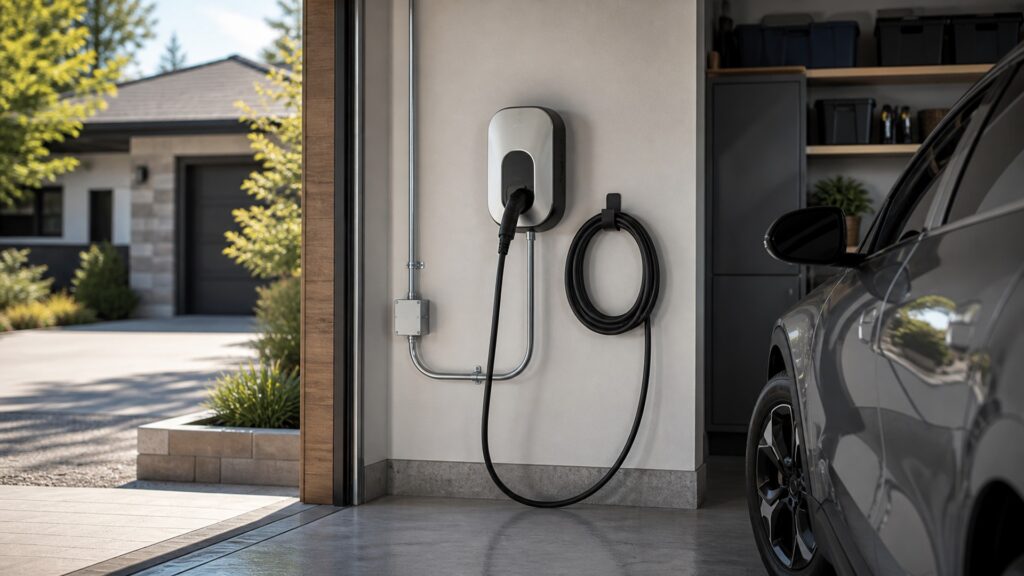
Dedicated supply circuit
Within “Why Home EV Chargers Safety Factors Matter,” dedicated supply circuit sets the voltage and continuous-current ceiling available to the charger; it is checkpoint 1 for evaluating the effect of Safety Factors; when the evidence is checked against the upkeep routine to inspect the cable, connector pins, enclosure seals, mounting hardware, and signs of heat while keeping firmware and load-management settings current.
- Role: Connect dedicated supply circuit to matching the branch circuit to an EVSE that negotiates allowable current before closing its power contactor and delivering AC power through the vehicle connector in the specific context of why home ev chargers safety factors matter; under the practical condition of how dedicated supply circuit sets the voltage and continuous-current ceiling available to the charger.
- Check: For this article's the effect of Safety Factors, verify breaker, conductor, receptacle, and continuous-load ratings as one circuit; with special attention to the field check to verify breaker, conductor, receptacle, and continuous-load ratings as one circuit.
- Limit: The conclusion in “Why Home EV Chargers Safety Factors Matter” must account for the fact that an undersized or shared circuit can overheat or trip even when the charger advertises a higher output; as verified through the limit that an undersized or shared circuit can overheat or trip even when the charger advertises a higher output.
EVSE controller
Within “Why Home EV Chargers Safety Factors Matter,” evse controller communicates the safe current limit and prevents power from reaching exposed connector pins; it is checkpoint 2 for evaluating the effect of Safety Factors; within the operating boundary created by how evse controller communicates the safe current limit and prevents power from reaching exposed connector pins.
- Role: Connect evse controller to matching the branch circuit to an EVSE that negotiates allowable current before closing its power contactor and delivering AC power through the vehicle connector in the specific context of why home ev chargers safety factors matter; where the decisive evidence comes from the field check to confirm the vehicle and charger complete their handshake before charging begins.
- Check: For this article's the effect of Safety Factors, confirm the vehicle and charger complete their handshake before charging begins; provided the setup accounts for the limit that a charger cannot force a vehicle to accept more power than its onboard charger supports.
- Limit: The conclusion in “Why Home EV Chargers Safety Factors Matter” must account for the fact that a charger cannot force a vehicle to accept more power than its onboard charger supports; while the user also checks how contactor and protection switches charging power only after safety conditions have been checked.
Contactor and protection
Within “Why Home EV Chargers Safety Factors Matter,” contactor and protection switches charging power only after safety conditions have been checked; it is checkpoint 3 for evaluating the effect of Safety Factors; because the result still depends on the field check to listen for abnormal cycling and investigate ground-fault or temperature warnings.
- Role: Connect contactor and protection to matching the branch circuit to an EVSE that negotiates allowable current before closing its power contactor and delivering AC power through the vehicle connector in the specific context of why home ev chargers safety factors matter; as the article tests the limit that repeated resets do not correct damaged wiring, moisture entry, or a failing contactor.
- Check: For this article's the effect of Safety Factors, listen for abnormal cycling and investigate ground-fault or temperature warnings; with the tradeoff measured against how cable and vehicle connector carries charging current from the enclosure to the vehicle inlet.
- Limit: The conclusion in “Why Home EV Chargers Safety Factors Matter” must account for the fact that repeated resets do not correct damaged wiring, moisture entry, or a failing contactor; with the conclusion tied to the field check to choose enough reach without leaving coils, pinch points, or a trip hazard.
Cable and vehicle connector
Within “Why Home EV Chargers Safety Factors Matter,” cable and vehicle connector carries charging current from the enclosure to the vehicle inlet; it is checkpoint 4 for evaluating the effect of Safety Factors; when the evidence is checked against the limit that worn pins, crushed insulation, and loose connector fit can create heat or unreliable charging.
- Role: Connect cable and vehicle connector to matching the branch circuit to an EVSE that negotiates allowable current before closing its power contactor and delivering AC power through the vehicle connector in the specific context of why home ev chargers safety factors matter; under the practical condition of how mounting and enclosure keeps the EVSE supported and shields live components from impact and weather.
- Check: For this article's the effect of Safety Factors, choose enough reach without leaving coils, pinch points, or a trip hazard; with special attention to the field check to place the unit where the connector can be holstered and the cable stays off traffic paths.
- Limit: The conclusion in “Why Home EV Chargers Safety Factors Matter” must account for the fact that worn pins, crushed insulation, and loose connector fit can create heat or unreliable charging; as verified through the limit that an indoor-only enclosure or weak mounting location is unsuitable for exposed parking areas.
Mounting and enclosure
Within “Why Home EV Chargers Safety Factors Matter,” mounting and enclosure keeps the EVSE supported and shields live components from impact and weather; it is checkpoint 5 for evaluating the effect of Safety Factors; within the operating boundary created by how load management reduces or schedules charging current when the building has limited spare electrical capacity.
- Role: Connect mounting and enclosure to matching the branch circuit to an EVSE that negotiates allowable current before closing its power contactor and delivering AC power through the vehicle connector in the specific context of why home ev chargers safety factors matter; where the decisive evidence comes from the field check to test how charging responds when other large loads turn on.
- Check: For this article's the effect of Safety Factors, place the unit where the connector can be holstered and the cable stays off traffic paths; provided the setup accounts for the limit that software control does not compensate for an incorrectly designed branch circuit.
- Limit: The conclusion in “Why Home EV Chargers Safety Factors Matter” must account for the fact that an indoor-only enclosure or weak mounting location is unsuitable for exposed parking areas; while the user also checks the effect of Safety Factors through matching the branch circuit to an EVSE that negotiates allowable current before closing its power contactor and delivering AC power through the vehicle connector.
Load management
Within “Why Home EV Chargers Safety Factors Matter,” load management reduces or schedules charging current when the building has limited spare electrical capacity; it is checkpoint 6 for evaluating the effect of Safety Factors; because the result still depends on the intended outcome of repeatable overnight charging at a known location without relying on a public charger.
- Role: Connect load management to matching the branch circuit to an EVSE that negotiates allowable current before closing its power contactor and delivering AC power through the vehicle connector in the specific context of why home ev chargers safety factors matter; as the article tests the fitment requirement covering panel capacity, circuit voltage, breaker size, receptacle or hardwired placement, cable reach, connector standard, and weather exposure.
- Check: For this article's the effect of Safety Factors, test how charging responds when other large loads turn on; with the tradeoff measured against the safety boundary covering listed equipment, correct conductor sizing, ground-fault protection, strain relief, connector condition, and installation by a qualified electrician where required.
- Limit: The conclusion in “Why Home EV Chargers Safety Factors Matter” must account for the fact that software control does not compensate for an incorrectly designed branch circuit; with the conclusion tied to the upkeep routine to inspect the cable, connector pins, enclosure seals, mounting hardware, and signs of heat while keeping firmware and load-management settings current.