Why Home Gym Systems Safety Factors Matters

Safety factors matter in home gym systems because several moving parts, stations, cables, pads, pins, and resistance sources share one frame. A system can feel controlled, but safe use still depends on stable setup, clear movement space, secure adjustments, and equipment condition.

A good home gym system makes loading, movement paths, and transitions predictable. A poor setup can create loose pins, worn cables, unstable stations, cramped movement, or awkward body positions that make ordinary workouts riskier than they need to be.

By: Review Streets Research Lab
Updated: September 25, 2026
Explainer · 8-12 min read
home gym systems safety factors explainer hero image for Review Streets
What You'll Learn

How Safety Factors Affect Home Gym Systems

A practical look at frame stability, cables, pins, stations, clearance, and controlled use.

  • Why frame stability comes first
  • How pins, cables, pulleys, and fasteners affect safety
  • Where station fit can reduce or increase risk
  • Why clearance matters around all-in-one systems
  • What to inspect before repeating a workout

Tip: Start with the workouts the system must support every week. The right equipment choice follows the repeated movements, not the longest feature list.

Definitions

Key Concepts Behind Home Gym Systems Safety Factors Matters

These concepts clarify how home gym systems fit real home strength training decisions.

Frame Stability

Frame stability is how well the system stays planted and aligned during loaded movements.

  • Example: a multi-gym that does not rock during rows
  • Check: test stability at realistic loads
  • Limit: uneven floors or poor assembly can reduce stability

Adjustment Security

Adjustment security is whether pins, locks, seats, pads, and attachments are fully seated before use.

  • Example: a selector pin inserted completely into the weight stack
  • Check: confirm each adjustment before the set
  • Limit: rushed transitions increase mistakes

Cable And Pulley Condition

Cable and pulley condition is the state of cables, coating, pulleys, guide rods, and travel paths.

  • Example: checking for fraying or rough movement
  • Check: inspect wear and smoothness regularly
  • Limit: damaged parts need service, not workaround use

Station Clearance

Station clearance is the space needed around each exercise area.

  • Example: room for a pulldown bar, leg station, and seated row setup
  • Check: measure the full movement path
  • Limit: crowded rooms can change technique

Load Control

Load control is how smoothly the resistance moves and returns.

  • Example: lowering a stack without slamming it
  • Check: use controlled tempo and watch the stack
  • Limit: fast reps can create bounce or slack

User Fit

User fit is whether the station positions suit the user's body and movement.

  • Example: seat height aligning with press handles
  • Check: adjust before loading heavily
  • Limit: fixed positions may not fit every user

Tip: A home gym system is strongest when its stations, resistance, and setup match the user's actual routine.

Stability

The Frame Has To Stay Predictable

A home gym system combines several stations on one structure. The frame must stay stable as forces change from presses, pulls, leg work, and cable movements.

  • Assemble and level the frame carefully.
  • Check bolts and contact points.
  • Stop if the system shifts or rocks.

Stable equipment is the base for safer training.

Adjustments

Pins And Locks Need Attention

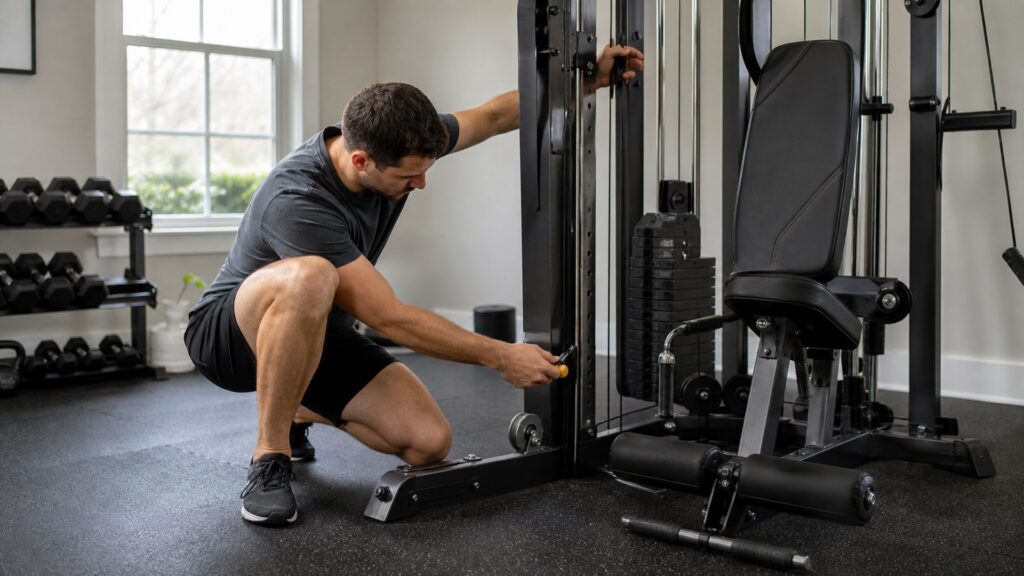
Selector pins, seat adjustments, arm settings, and attachments are small parts with large consequences. They should be fully engaged before each set.

  • Check pins before loading.
  • Avoid rushed station changes.
  • Replace damaged handles or straps.

Secure adjustments keep the station predictable.

Wear

Moving Parts Need Inspection

Cables, pulleys, guide rods, and fasteners wear over time. Rough travel, frayed cable, bent pins, or loose hardware should be treated as stop signs.

  • Inspect visible cable wear.
  • Listen for grinding or scraping.
  • Follow maintenance guidance for lubrication and service.

Maintenance is part of safe home training.

Clearance

Every Station Needs Working Space

All-in-one systems can make a room feel efficient, but each station still needs movement clearance. Crowded setups can alter body position and cable path.

  • Measure each station's movement path.
  • Keep storage away from handles and cables.
  • Leave room to enter and exit safely.

A compact frame still needs a usable training area.

Technique

Controlled Reps Keep The System Smooth

Home gym systems work best with controlled movement. Jerky reps can bounce stacks, strain attachments, or pull the user out of alignment.

  • Start with manageable loads.
  • Control the return phase.
  • Adjust the station before adding intensity.

Safe use depends on both equipment condition and user control.

Quick Reality Check

Where Safety Checks Help And Where They Have Limits

Safety checks reduce avoidable problems before they interrupt training.

Where They Help

They catch loose adjustments, worn cables, unstable frames, and poor clearance.

They keep repeated workouts predictable.

Where They Fall Short

They cannot make damaged equipment safe.

They cannot make every station fit every user or exercise.

Common Myths

Misconceptions About Home Gym System Safety

Guided equipment still needs setup and inspection.

All-in-one systems are automatically safe

They reduce some setup decisions, but still have moving parts and adjustments.

If the stack moves, the system is fine

A moving stack does not rule out cable wear or loose hardware.

Compact systems need less clearance

Each station still needs room for the full movement.

Guided stations remove technique concerns

Controlled reps and proper fit still matter.

Tip: A feature is useful only when it improves setup, progression, comfort, or consistency.

FAQ

Frequently Asked Questions About Home Gym System Safety

Short answers for comparing home gym systems with other strength equipment.

What should I check before using a home gym system?

Check frame stability, pins, cables, pulleys, attachments, station clearance, and load selection.

When should I stop using the system?

Stop if cables fray, pulleys stick, pins loosen, the frame shifts, or a station feels unstable.

Do home gym systems need maintenance?

Yes. Cables, guide rods, pulleys, bolts, pads, and attachments should be inspected regularly.

Are home gym systems safer than free weights?

They can reduce some risks, but they create their own setup and maintenance checks.

What is the practical takeaway?

Use a home gym system only when it is stable, adjusted, maintained, and clear enough for the exercise.

Bottom Line

Safety factors matter because a home gym system depends on a connected frame, stations, resistance source, adjustments, and user position.

The safest setup is stable, inspected, uncluttered, and used with controlled movement through stations that fit the user.

Next Steps

Go Deeper or Compare Your Options

Use these Review Streets paths to compare related categories and practical next decisions.

Cable Machines

Compare cable-focused equipment with broader home gym systems.