
Offset Load
An offset load places the weight away from the hand, changing balance and timing.
- Example: a bell hanging below the handle during a swing
- Check: use it when the offset helps the exercise
- Limit: it can make some lifts harder to learn
Safety factors matter with kettlebells because the weight can swing, rotate, rack, and travel around the body. That movement freedom is useful, but it also makes grip, timing, space, and load choice more important than they may look at first.
A safer kettlebell session starts with a movement the user can control. The bell should match the exercise, the available space, and the user's current skill before speed or heavier loading are added.
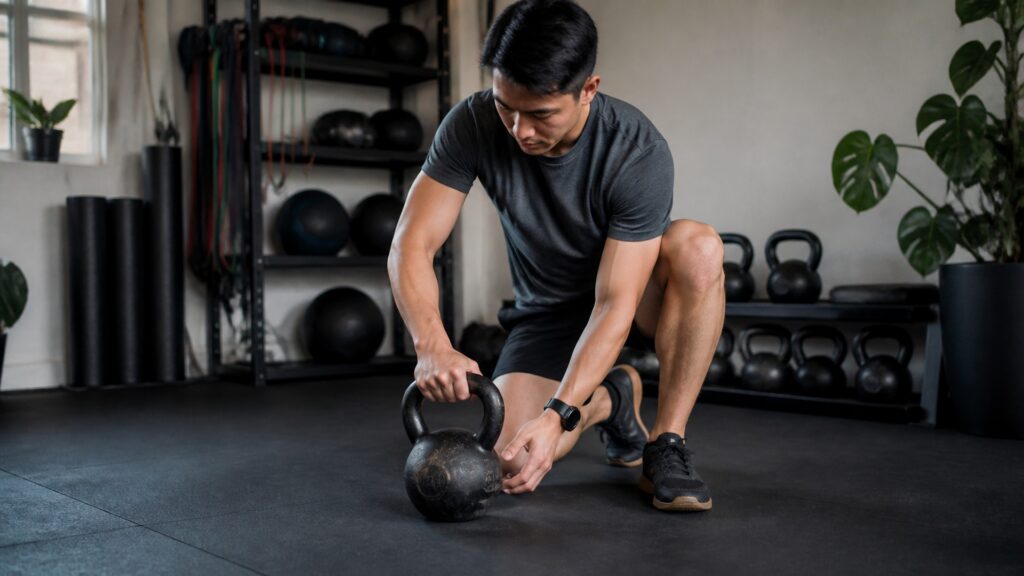
A practical look at grip, space, technique, load jumps, and safe set endings with kettlebells.
Tip: If the bell path is not predictable, the load is too heavy or the movement is too advanced.
These concepts help readers understand why kettlebells need specific setup and technique checks.
An offset load places the weight away from the hand, changing balance and timing.
A ballistic movement uses controlled momentum instead of only slow lifting.
Grip security is how reliably the hand controls the handle during work.
Rack position holds the bell near the forearm and torso for squats, presses, and carries.
Load jump is the increase between available kettlebell weights.
Training role is the job the kettlebell has in the workout.
Tip: The right training tool is the one whose resistance and setup match the exercise goal.
Kettlebell safety starts with knowing where the bell will travel. Swings, cleans, snatches, carries, and rack work all need different paths.
A predictable bell path keeps effort productive.
The handle is the connection point for every rep. If grip fades, the bell can drift, rotate, or land poorly.
Grip is a safety factor, not a minor detail.
Kettlebells move around the body and sometimes through space. The training area has to allow the movement and the finish.
The room is part of the safety setup.
Kettlebells often increase in bigger jumps than dumbbells. A jump that looks small on paper can change timing and posture.
Progress should preserve the pattern.
Cleans, snatches, and fast complexes can be useful, but they should not be learned in a rushed circuit.
Skill work is safest when quality comes before intensity.
Good safety checks support training, but they do not remove the need for judgment.
They keep grip, path, space, and load aligned with the movement.
They make progression safer and more repeatable.
They cannot replace coaching for advanced skills.
They cannot make pain, poor recovery, or careless loading safe.
Kettlebells are compact, but compact does not mean risk-free.
Poor timing or a bad path can make even lighter bells awkward.
Swings depend on hinge timing and hip drive.
Grip failure can become a control problem.
Fatigue can make technical movements worse.
Tip: Treat control as part of the workout, not as a warning after the fact.
Short answers for practical training and equipment decisions.
Control of the bell path is the biggest factor.
They can be when beginners start with simple movements and suitable loads.
Many users should learn the hinge and deadlift pattern before fast swings.
Enough room for the bell path, body movement, and safe set-downs.
Use kettlebells with a load, path, and pace the user can control.
Kettlebell safety factors matter because the bell moves freely around the hand and body.
Good grip, clear space, realistic loading, and skill-appropriate exercises keep kettlebell training useful.
Use these Review Streets paths to compare related categories and practical next decisions.
Review the core kettlebell design and training setup.
Explore the kettlebells category.
Compare related strength-training tools.
Choose a retailer
Prices checked regularly. We may earn a commission at no cost to you.