
Offset Load
An offset load places the weight away from the hand, changing balance and timing.
- Example: a bell hanging below the handle during a swing
- Check: use it when the offset helps the exercise
- Limit: it can make some lifts harder to learn
Workout role matters with kettlebells because the same bell can be used for power, strength, conditioning, carries, skill work, or warmups. Those roles require different exercise choices, loading, pace, and expectations.
A kettlebell used for a heavy goblet squat should not be judged like a bell used for swing intervals or loaded carries. The role determines whether the set needs control, speed, endurance, or technical practice.
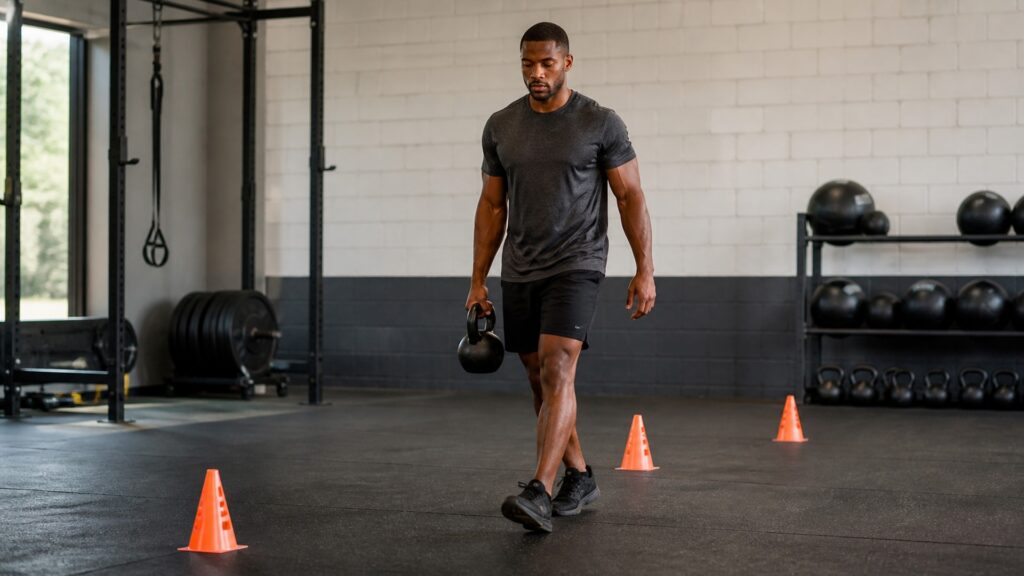
A practical guide to using kettlebells for strength, power, carries, conditioning, and skill practice.
Tip: Name the role before choosing the exercise. Kettlebell training gets messy when every set is treated the same.
These concepts show how the same tool can serve different training purposes.
An offset load places the weight away from the hand, changing balance and timing.
A ballistic movement uses controlled momentum instead of only slow lifting.
Grip security is how reliably the hand controls the handle during work.
Rack position holds the bell near the forearm and torso for squats, presses, and carries.
Load jump is the increase between available kettlebell weights.
Training role is the job the kettlebell has in the workout.
Tip: The right training tool is the one whose resistance and setup match the exercise goal.
Goblet squats, presses, rows, deadlifts, and split squats can make kettlebells useful strength tools when the available weight fits.
Strength work needs control more than speed.
Swings and related hinge patterns use hip drive and timing. They are not the same job as slow lifting.
Power work depends on quality reps.
Suitcase, farmer's, rack, and overhead carries give kettlebells a practical role beyond ordinary lifting.
Carries are one of the tool's strongest roles.
Kettlebells can make short circuits demanding, but fatigue should not turn technical lifts into sloppy reps.
Conditioning should challenge without erasing control.
Cleans, snatches, and transitions may need focused practice before they belong in fast workouts.
Skill work deserves patience.
A clear role makes the tool easier to use well.
They separate strength, power, carry, conditioning, and skill goals.
They guide load, pace, reps, and rest.
A role cannot fix poor technique or unsuitable weight.
Some goals still need other equipment.
Versatility does not mean every use is equally strong.
Some sessions should focus on strength or skill.
Swings are useful, but they do not replace every squat or lunge need.
Different roles may need different loads.
Effort matters, but it has to serve the goal.
Tip: Use the role to decide what kind of effort matters.
Short answers for practical training and equipment decisions.
Yes, if the user's goals and available weights match the program.
They are strong for swings, carries, compact strength work, and conditioning.
They can be, especially when load and volume are appropriate.
They may fall short for very heavy strength progression or highly specific machine work.
Choose load, reps, and movement based on the kettlebell's role in the session.
Kettlebell workout role matters because one tool can serve several different training jobs.
The best results come when strength, power, carry, conditioning, and skill work are programmed differently.
Use these Review Streets paths to compare related categories and practical next decisions.
Review the core kettlebell design and training setup.
Explore the kettlebells category.
Compare related strength-training tools.
Choose a retailer
Prices checked regularly. We may earn a commission at no cost to you.