Why Landscape Utility Trailers Fitment Matters

Fitment on a landscape utility trailer means matching the complete rig to the equipment and work: the tow vehicle must support the loaded trailer, the loading path must suit the mower, and racks and restraints must fit without obstructing one another. It is a compatibility problem across several parts, not simply a question of whether the mower fits on the floor.

A trailer can have enough nominal deck space yet fail the practical test. The mower may catch at the ramp transition, a toolbox may block an attachment point, or the loaded trailer may exceed a limit of the truck or hitch. Checking these connections before purchase prevents an apparently suitable trailer from becoming an awkward or unusable setup.

By: Review Streets Research Lab
Updated: October 7, 2026
Explainer · 8-12 min read
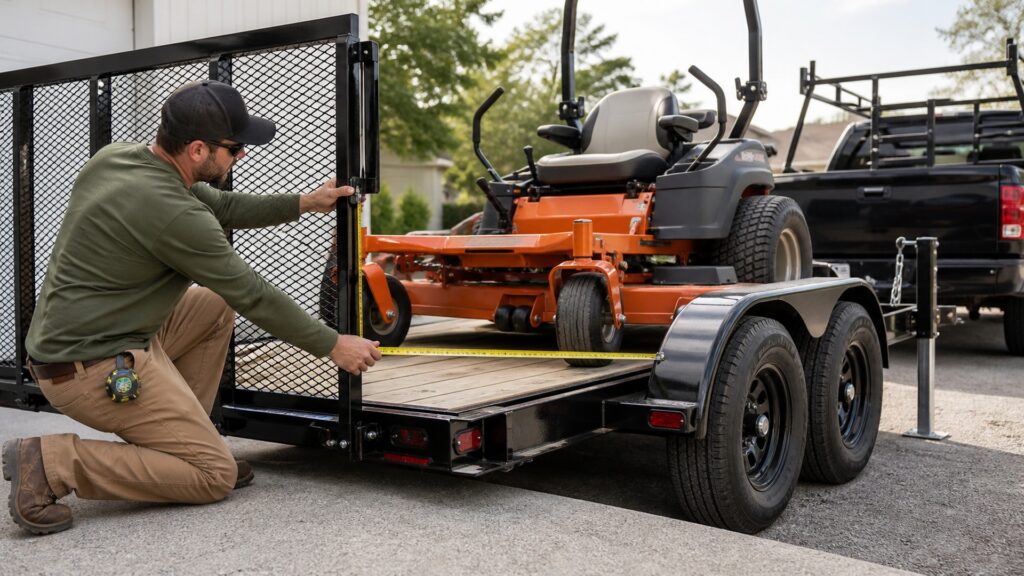
landscape utility trailers explainer hero image for Review Streets
What You'll Learn

Match the Trailer, Mower, Accessories, and Tow Vehicle

Work from the actual equipment outward to the complete towing combination.

  • Measure equipment in its transport configuration
  • Check access onto the deck as well as the parked footprint
  • Match the loaded trailer to the vehicle and hitch requirements
  • Leave working room for restraints, lids, and locks
  • Recheck compatibility whenever the equipment arrangement changes

Tip: Recheck compatibility whenever the equipment arrangement changes

Definitions

Six Dimensions of Landscape-Trailer Fitment

Use these terms when checking the actual trailer and equipment.

Equipment envelope

The equipment envelope is the space occupied by the complete machine in its intended transport configuration.

  • Example: a mower measured with its attached catcher or other transported equipment
  • Check: the widest and longest relevant points
  • Limit: a nominal cutting width is not the full transport width

Clear loading path

A clear loading path provides suitable room and support from the ground to the transport position.

  • Example: a mower crossing the ramp-to-deck transition
  • Check: ramp width, capacity, traction, and machine clearance
  • Limit: a machine can fit on the deck but fail to reach it safely

Hitch compatibility

Hitch compatibility joins the specified trailer connection to suitable vehicle-mounted towing equipment.

  • Example: matching a coupler with the required ball and rated mounting equipment
  • Check: component instructions, sizes, ratings, and installed arrangement
  • Limit: a connection that physically joins is not automatically suitable

Loaded-combination fit

Loaded-combination fit means the actual vehicle and trailer loads meet all applicable limits together.

  • Example: accounting for workers and tools in the truck as well as trailer tongue load
  • Check: vehicle, trailer, axle, tire, and hitch requirements
  • Limit: a large trailer rating does not increase vehicle capacity

Accessory clearance

Accessory clearance is the space an installed rack, box, or other attachment needs in every supported position.

  • Example: a toolbox lid opening with the mower aboard
  • Check: mounting compatibility, moving parts, and retained equipment
  • Limit: empty-trailer clearance can disappear after loading

Securement access

Securement access is the room needed to attach and inspect the required restraints.

  • Example: reaching a machine tie-down point beside the deck rail
  • Check: the completed load with restraints in place
  • Limit: a suitable anchor is not useful if cargo makes it inaccessible

Tip: Read the ratings and instructions for the exact equipment you will use.

Measurements

Measure the Machine You Will Actually Carry

Start with the equipment as it will travel. Attachments, handles, collection equipment, and other projections can matter more than a model’s shorthand size. Compare that envelope with the usable space between rails, boxes, and other obstructions. Also leave whatever access the transport instructions require.

  • Use the full transport dimensions.
  • Include installed trailer accessories.
  • Check whether equipment changes position during loading.

For example, two mowers with the same cutting width may occupy different transport envelopes. A deck selected from cutting width alone can overlook a protruding chute or collection attachment.

Loading

Check the Transition Before Accepting the Final Fit

A machine must reach its planned position without an unsuitable loading angle, obstruction, or overloaded ramp. The ramp and the trailer have separate requirements. Compare the machine’s loading instructions with the trailer arrangement, and have the manufacturer or dealer resolve uncertain clearance or loading capacity.

  • Check the narrowest part of the route.
  • Verify ramp suitability for the machine.
  • Use only the prescribed loading arrangement.

A mower that sits neatly on the deck may still contact the transition on the way up. A successful drawing of the parked layout does not settle that problem.

Reference: Carry-On utility-trailer owner instructions.

Towing connection

Match the Truck and Hitch to the Loaded Trailer

Assess the combination in working condition. The truck may carry people and equipment while also supporting trailer tongue load. Use the ratings and instructions for the actual vehicle and every relevant connection component; do not select solely from a headline towing figure.

  • Account for the vehicle’s own load.
  • Verify connection and electrical requirements.
  • Use measured or otherwise reliable weights.

A larger replacement trailer can solve a deck-space problem while creating a vehicle-load problem. Check both before committing to the change.

Reference: Carry-On trailer and tow-vehicle load limits.

Accessories

Check the Layout with Doors, Gates, and Tools Moving

A compatible accessory needs more than a place to bolt on. It must clear the equipment, allow intended movement, and attach in an approved way. Check box lids, rack retention devices, gate operation, and the space needed to remove long tools. Include the accessory’s mass and contents in the load assessment.

  • Try the layout with the normal equipment aboard.
  • Keep lights and required access clear.
  • Follow both trailer and accessory instructions.

A rack can hold a trimmer securely but place its handle where the mower must pass. Moving the rack is only a solution if the new mounting and complete load arrangement remain suitable.

Final check

Validate the Arrangement After Every Meaningful Change

Treat fitment as a property of the finished rig. Replacing a mower, adding a box, or changing the tow vehicle can invalidate an earlier assessment. Recheck the affected dimensions, weights, access, and instructions rather than assuming that one compatible part makes the whole setup compatible.

  • Record the normal equipment arrangement.
  • Reassess after additions or replacements.
  • Resolve conflicts before loading or towing.

A practical acceptance check follows the complete sequence: connect, load, restrain, close, inspect, and unload. Each step should work within the equipment’s instructions, without forced clearances or improvised attachments.

Quick Reality Check

Physical Fit Is Only the First Check

Compatibility includes movement, loading, and the towing combination.

A good fit provides

A usable loading path and room for the secured equipment.

Compatible connections and access to routine checks.

A close fit can still fail

The mower fits but the ramp is unsuitable.

The deck has room but the loaded vehicle or hitch limit is exceeded.

Common Myths

Misconceptions About Landscape-Trailer Fitment

The right dimensions do not settle every compatibility question.

Cutting width tells me the mower transport width

Measure the complete machine in its transport configuration.

If the coupler connects, the rig is compatible

Size, rating, installation, and operating requirements also matter.

A toolbox only uses floor space

It adds mass and may obstruct movement or restraints.

Fitment is finished after the first purchase

New equipment or a different vehicle can change the result.

Tip: Ask for the specific specification or operating instruction behind a broad claim.

FAQ

Questions About Matching a Landscape Trailer

Practical answers for the next loading or buying decision.

What should I measure first?

Measure the actual machine and attachments as transported, then the loading path and usable deck space.

Can a trailer be too large for my vehicle even when nearly empty?

Yes. Check the actual combination and all relevant limits; size and load cannot be judged from appearance alone.

How much spare clearance do I need?

Use the equipment and loading instructions rather than a universal allowance. Include access for required restraints and moving parts.

Can I drill new rack mounts wherever they fit?

Confirm an approved mounting method with the trailer and accessory manufacturer before modifying anything.

What information should I take to the dealer?

Bring equipment dimensions and weights, proposed accessories, and the tow vehicle and hitch details.

Bottom Line

Landscape-trailer fitment succeeds when the entire rig works together, from hitch connection to mower loading and tool access.

Check the fully equipped arrangement and repeat the assessment when a meaningful part changes.

Next Steps

Check Specifications and Operating Instructions

Use these manufacturer and safety resources to check the requirements for the actual equipment.