
Long-Term Reduction
Stable decrease in regrowing hairs measured after a treatment course and follow-up.
- Use: set the correct endpoint
- Variable: device and biology
- Tradeoff: Not identical to permanent removal
Long-term hair reduction matters when the recurring burden of shaving, waxing, epilation, depilatories, bumps, appointments, or visible regrowth outweighs the cost and commitment of a light-based treatment course. Laser and IPL aim to heat pigment in suitable hairs and impair future growth. Because follicles cycle independently, repeated sessions are needed to reach responsive hairs over time.
The outcome is reduction, not a guarantee that every hair disappears forever. Treated areas may show fewer hairs, slower return, finer regrowth, and easier maintenance. New growth can occur with hormonal change, aging, medicines, or previously inactive follicles. White and gray hair and many very light hairs lack enough target pigment for reliable optical treatment.
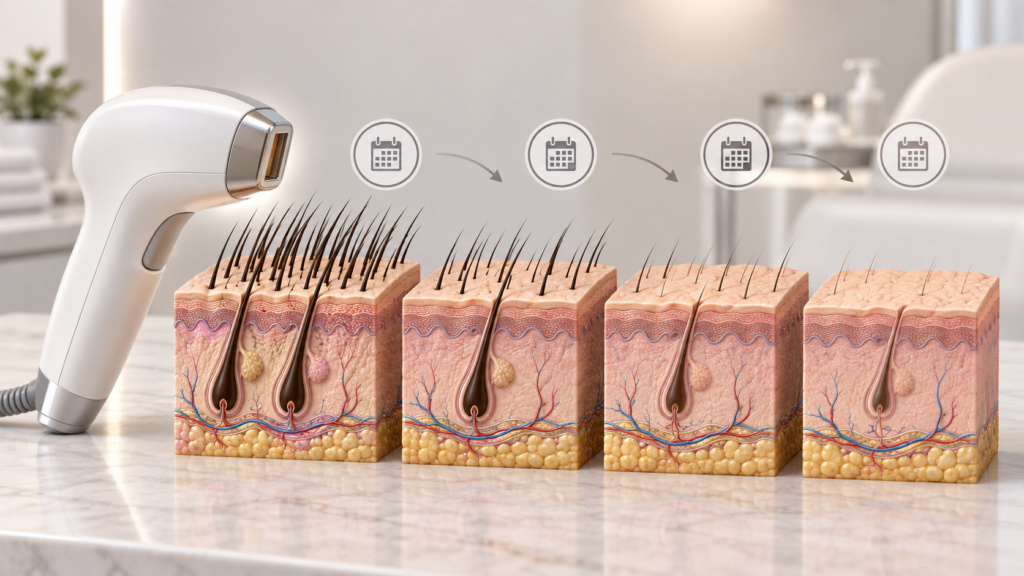
Explain the practical value of reducing regrowth over time through appropriate laser or IPL courses, including hair-cycle biology, candidacy, time savings, bumps, maintenance, limits, safety, cost, and comparison with repeat removal—without promising permanent elimination.
Tip: Reduction matters only relative to the burden it replaces.
These long-term hair reduction concepts separate mechanism, application, limits, and purchasing consequences.
Stable decrease in regrowing hairs measured after a treatment course and follow-up.
Active growth phase in which pigmented hair is connected to structures targeted by light.
Melanin-containing hair structure intended to absorb treatment energy.
Planned series of sessions plus assessment and recovery intervals.
Later treatment used when meaningful regrowth appears after the initial course.
Combined time, irritation, cost, and inconvenience of managing recurring hair.
Tip: Use these terms to test long-term hair reduction instead of relying on a front-label promise.
Estimate shaving or waxing frequency, minutes, products, appointments, travel, discomfort, bumps, dark marks, and how much reduction would materially improve the routine.
Reduction matters only relative to the burden it replaces.
Dark coarse hair often provides a clearer optical target than white, gray, or very light hair. Skin tone and tanning affect parameters and safety; exact devices differ.
A technology category cannot determine candidacy by itself.
Appointments are repeated because all follicles are not in the same phase. Evaluate comparable photos and regrowth, not just immediate post-shave smoothness.
The calendar is part of the mechanism.
Test spots, contact, cooling, overlap, eye safety, endpoint recognition, and aftercare help manage heat in epidermis and hair structures.
Faster escalation is not smarter treatment.
Include consultation, sessions, travel, time off, home-device time, maintenance, treatment-area limits, remaining hair, and complication access.
The economic case depends on actual reduction and adherence.
Long-term reduction can lower recurring grooming load; it cannot create permanent universal hairlessness or treat every hair-skin combination equally.
The exact device, provider, skin tone, current tan, hair color, diameter, and body area are assessed together.
Sessions are spaced for biology rather than compressed to sell a package.
Maintenance and remaining hair are included in the expected endpoint.
Burns, pigment change, paradoxical growth, eye risk, pain, and incomplete response are discussed before purchase.
These claims flatten the variables that determine how long-term hair reduction performs in a real routine.
Most responsible claims describe sustained reduction; some hair remains or returns and maintenance may be needed.
Early shedding covers only treated responsive hairs; several cycles and follow-up are required to assess reduction.
Skin pigment, tanning, hair depth and diameter, device, pulse, cooling, and provider judgment constrain safe parameters.
Wrong candidacy, inadequate delivery, hormonal factors, fine hair, missed areas, or device limits may require reassessment rather than endless sessions.
Even partial reduction can shorten routines and reduce irritation, but value is personal and should be defined beforehand.
Tip: Test the exact long-term hair reduction tool, setting, and routine before generalizing from its category.
The remaining decisions about long-term hair reduction concern technique, compatibility, safety, upkeep, and value.
Many people experience lasting reduction after a course, with occasional maintenance; duration and degree vary by person, area, and system.
Reducing coarse regrowth may help some people whose bumps are triggered by shaving, but active inflammation and scarring still need appropriate care.
Root extraction removes the pigmented target the light treatment needs; shaving is commonly used instead when directed.
Eligible home devices can reduce regrowth with consistent use, but output, schedule, controls, and evidence differ from clinic systems.
Optical systems generally lack a melanin target; electrolysis or temporary removal may be discussed instead.
Reassess after burns, pigment change, paradoxical growth, repeated severe pain, poor objective response, changing health factors, or unclear device records.
Long-term hair reduction matters when fewer, slower, or finer hairs materially reduce years of shaving, waxing, irritation, cost, or time. Laser and IPL pursue that outcome across repeated hair-growth cycles rather than removing every hair at once.
Define the acceptable endpoint, verify candidacy and the exact device, compare the full course with ongoing removal, and retain realistic maintenance. Treat lack of response or adverse effects as a reason to reassess—not simply to add energy or sessions.
These Review Streets paths narrow the next long-term hair reduction decision by format, goal, and routine fit.
Browse shaving, epilation, and light-based hair-removal categories.
Compare at-home beauty devices, including light-based hair-removal systems.
Choose a retailer
Prices checked regularly. We may earn a commission at no cost to you.