
Why Meditation Headbands Meditation Headbands Health Function Matters

What does a tone tied to your own brain activity add? In a two-week trial, perceived stress scores improved more among adherent completers with wearer-linked tones than with randomly timed tones. The adults enrolled had stress with depressive symptoms or sleep difficulties.

By: Review Streets Research Lab
Updated: November 25, 2026
Explainer · 8–10 min read
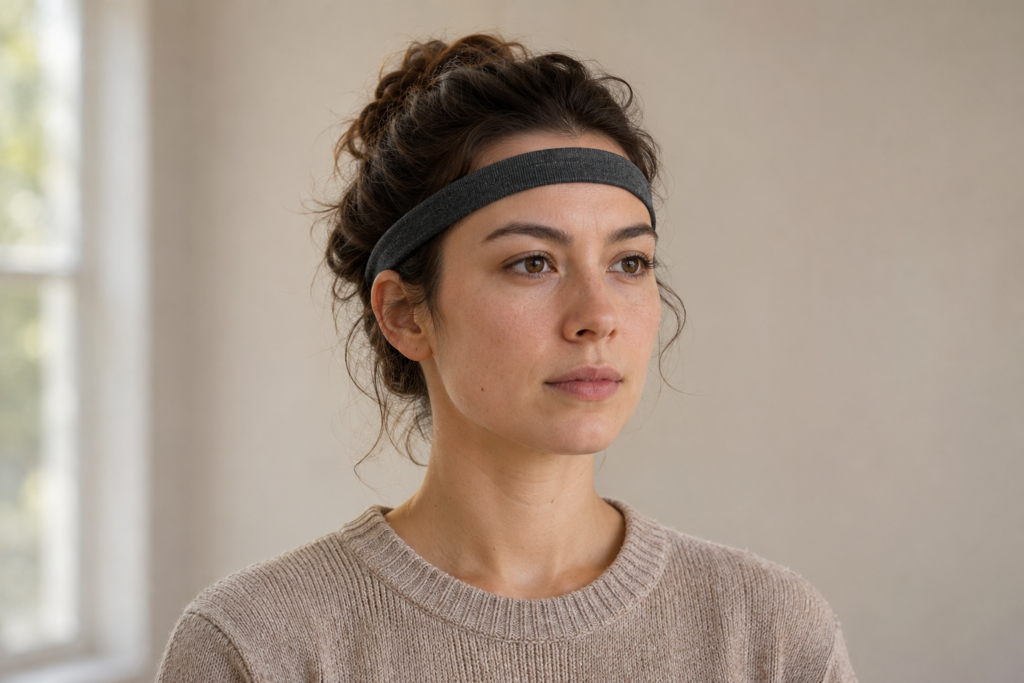
An adult wearing a charcoal fabric headband across the forehead in a softly lit room.
In this explainer

Reading the headband trial

Start with the first example, then return to the trial result.

  • Recognize a tone triggered by the wearer’s signal.
  • Find out what each group received.
  • Check whether participants could tell their assignment.
  • Identify the evidence needed to link a result to brain changes.
  • Read the description of the programs people were assigned.
  • Find out whose data went into the result.
  • Read the visit schedule.

Tip: Keep your place in the trial’s methods section when you turn to its results.

Research terms

Terms for the tone comparison

The terms below come up in the studies and examples.

Intervention

The program a study assigns, including its activities and equipment.

  • Equipment: At the exhibition, the program used a tablet and a headband.
  • Guidance: An instructor’s briefing can be part of the program.
  • Added parts: Training to use the headband can be part of the assigned package.

Comparator

A condition used as the reference for a result.

  • Shared equipment: Two study groups can wear the same equipment.
  • Contingency: Here, contingency means a cue depends on the wearer’s own signal.
  • Alternative activity: The early Muse study used online math as its comparison activity.

Endpoint

The outcome a study analyzes, with a specified tool and time for assessing it.

  • Symptom scale: A symptom scale can record anxiety.
  • Performance task: Another trial timed responses to colored words.
  • Time window: The endpoint specifies when the measurements occur.

Self-report

Information participants provide directly about their experience.

  • Perception: An answer can describe a feeling only the participant observes.
  • Symptoms: The answer can record a symptom in the participant’s own words.
  • Interview: An interview lets participants describe their experience of managing a symptom.

Follow-up

An assessment scheduled after a point in the study, such as surgery.

  • Reference point: A starting score gives the study a point from which to measure change.
  • Last assessment: Some changes are measured at the end of training.
  • Later visit: Three months after surgery identifies the operation as the point the study counts from.

Applicability

How directly a result answers the question at hand.

  • People: Check whom a study enrolled before applying its finding to another group.
  • Software: Researchers can pair a retail headband with a custom tablet app.
  • Claim: Ask how closely the studied program fits the one in the claim.

Tip: Keep the name of each group beside its assigned activity as you read.

The intervention

What came with the headband?

Check the methods section for each study’s intervention description.

  • In the Beijing nursing-student study, FocusZen was the headband and OxyZen was its companion app.
  • The Salamanca program began with guided mindfulness and moved to independent practice with audio feedback. An instructor introduced each session.
  • In the OCD program, the app supplied the daily guided practice.
  • At an exhibition in Bern, a feasibility study paired Muse 2 hardware with a custom tablet app for a two-minute visual feedback task.
  • In the migraine trial, each group wore an EEG headband and received its own audio assignment.

Look beyond the headband name to identify the software participants used.

The study schedule

What did people in each group do?

Read both assignments before looking at the results.

  • The early Muse trial analyzed 26 healthy adults after six weeks of daily practice. The comparison group did online math.
  • In the OCD trial, participants received the guided Muse program or waited eight weeks. The waiting group did without the assigned practice and its feedback during that period.
  • A Korean workplace trial assigned 92 employees to four weeks of mindfulness with the app and device, mindfulness with the app alone, or paper stress education.

For the added-device question, compare the two app arms.

The outcome

What did the outcome capture?

Look at how each study collected its results.

  • A study around breast-cancer surgery tracked completion and use for feasibility. Nine of the ten migraine program completers interviewed felt better able to manage symptoms.
  • Response times on a laboratory color-word task improved more with Muse than with math practice. The workplace trial separately used data from 67 employees for its analysis of heart and brain activity.
  • The migraine trial abstract reports 101 participants and 61 completers. Among completers, headache management confidence favored the mindfulness group at program end. The comparisons for disability and severity were inconclusive. A related report interviewed people who finished the mindfulness program.

The confidence result concerns how able participants felt to manage headaches. The disability comparison remains inconclusive.

The comparison

When does the comparison test the link?

Look at what people actually heard in each study.

  • The migraine study changed both the audio content and access to feedback. Both groups wore headbands.
  • Both mindfulness arms took the same six-week course. One also received the headband, app, training and session reports. Students knew their assignments. Anxiety and depression scores improved more with the added package at program end.
  • MAVE randomized wearer-linked versus random tones with the same guidance. Group differences in depressive mood, sleep and stress physiology were unclear.

Actual sound exposure and sham credibility remain open in MAVE.

The limits

How much does the result tell us?

Read the limits the authors describe alongside each result.

  • At three months, the added Muse program in Salamanca showed no clear anxiety advantage over the shared workshop. The estimate was 0.1 points, with a 95% confidence interval from −1.6 to 1.9. The interval leaves effects in either direction possible.
  • MAVE analyzed 38 adherent completers out of 49 assigned. The two-week result had no later follow-up.
  • A synthesis of consumer feedback-assisted meditation studies found a small average improvement in psychological distress. Broader mindfulness evidence includes programs with discussion or psychological treatment.

Read the pooled distress finding as evidence about the programs combined in that review.

Two hypothetical studies

What would count as a fair test of the tones?

Both examples are hypothetical. Picture what people would hear in each group.

Testing the whole guided session

Imagine assigning a guided session with responsive sounds or a reading about tides. Both groups would answer the same questionnaire.

A difference would still reflect the bundled assignment.

Testing when the same sounds play

Imagine a separate trial. Give both groups the same guide, headset and matched tone count, pitch, volume and duration. Tie the timing to the wearer’s signal in just one group. Play the other group’s tones independently.

Ask participants to guess their group. Expectations could affect their answers.

Common assumptions

What a result can leave open

Try each of these claims against what the study actually observed.

Does a higher app score show a meaningful health improvement?

A symptom or daily-function claim calls for a measure of that outcome and a change large enough to matter.

Does this explain how the cue worked?

Test whether the relevant brain activity changed and account for other explanations before attributing the result to that pathway.

Can any headband claim a benefit found in mindfulness research?

A group discussion in a mindfulness course can be part of the studied treatment. Evidence on that course does not establish a benefit from timing a headband cue.

Does a benefit from the full program settle what the sound contributes?

When guidance and feedback both change, their separate contributions remain open.

Does an inconclusive result settle whether a headband can help?

An uncertain estimate can leave room for improvement and for little or no difference under the conditions tested.

Tip: Read the full sentence around any claim that a study found a benefit.

Questions about the research

Questions that come up in the trial reports

Use these questions when you return to a trial report.

How should I read anxiety outcomes at different follow-up visits?

In the Beijing nursing-student trial, anxiety scores at one month favored the headband package over conventional mindfulness. The comparison with mental health education was unclear then. At three months, scores favored the package over both alternatives.

Does a newer Muse model inherit research on an earlier one?

The 2016 Muse trial used an iPod app. The manufacturer lists Muse 2 and Muse S Athena separately. To apply the older result, check whether the program and feedback under study match the new setup.

Whom did MAVE aim to keep unaware of assignment?

MAVE reported blinding participants and investigators.

How large does a symptom-score change have to be to matter?

Look for the change that people using that scale would notice in the symptom or activity under study.

Who took part in the Salamanca trial?

The Salamanca trial enrolled young adults at one center. Most participants were women. That leaves the result’s fit for children and older adults open.

Were people diagnosed, or did they report symptoms on a scale?

In the OCD trial, a structured diagnostic interview established who qualified. A later analysis reused the same trial data. In Salamanca, researchers used an anxiety questionnaire to assess symptoms.

Why are there different totals for people who started and people in the analysis?

At the exhibition, 110 visitors started a session and 79 finished with a usable recording. The 52 who met the criteria for analysis formed the group covered by the usability ratings.

What about trial registration?

The MAVE registry entry came after the trial. It does not document advance registration.

Tip: Keep the methods section open while you read the trial’s tables.

The takeaway

Start with the sound. To test the cue’s link to the wearer, change its trigger.

Check sound exposure and whether people could tell their assignment.

Related reading

Explore meditation headbands

Visit the category hubs for lists, comparisons and buying guides.