
Percussive Motion
Percussive motion is the rapid back-and-forth movement of the massage head.
- Example: a massage gun pulsing against the quadriceps
- Check: look for controllable speed and smooth feel
- Limit: faster motion is not automatically better
Movement pattern matters for percussion massagers because the device has to move across the body in a controlled way. The user controls placement, glide path, pressure, angle, and how long the massage head stays on one area.
A good movement pattern keeps the device from digging, bouncing, or lingering too long on sensitive spots. It also helps the user match attachments and speed settings to the target area.
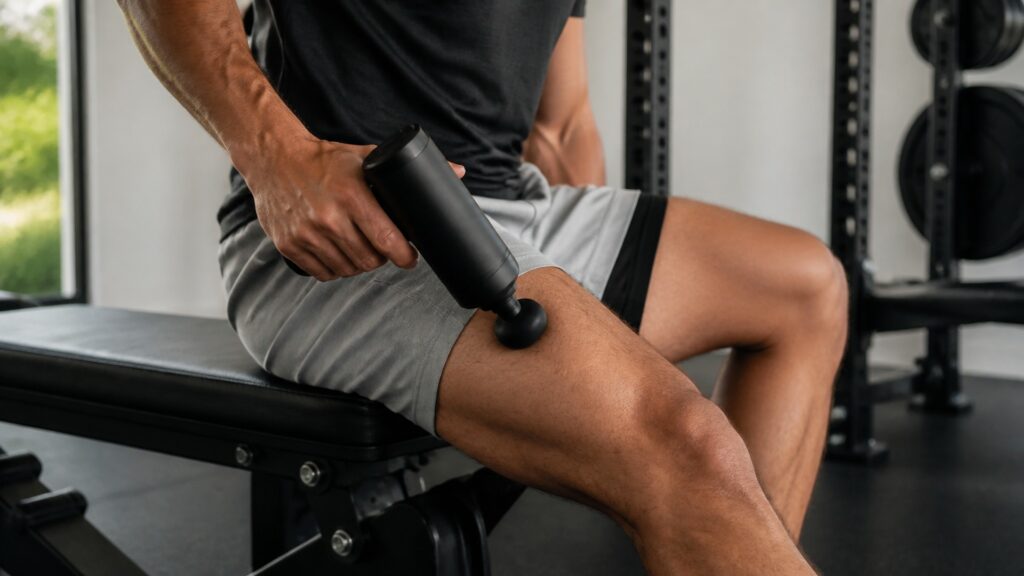
A practical guide to placement, glide path, pressure, and target areas.
Tip: Keep the device moving slowly and lightly before increasing speed, force, or time on one area.
These concepts explain how percussion massagers create rapid pressure and why control matters.
Percussive motion is the rapid back-and-forth movement of the massage head.
Amplitude is how far the massage head travels with each stroke.
Stall force is how much pressure the motor can resist before slowing or stopping.
Attachment shape changes how force spreads across the body.
Pressure control is the user's ability to keep force tolerable and targeted.
Recovery role is how the device supports warmup, cooldown, or comfort around training.
Tip: A percussion massager should feel controlled and useful, not like a test of pain tolerance.
The massager should begin on a broad, appropriate muscle area with light pressure. Starting too aggressively can make the body tense before the device has a chance to help.
Good placement makes the rest of the motion easier.
A steady glide helps distribute pressure and reduces the urge to dig into one spot. The path should follow the target muscle rather than jump around randomly.
Controlled movement keeps percussion from becoming irritation.
Holding the device straight into the body can feel stronger than using a lighter angle. Angle, attachment shape, and pressure work together.
The user should control the device, not fight it.
Broad heads move differently than small, focused heads. Softer attachments can feel more forgiving, while pointed attachments need caution and precision.
Attachment choice shapes the movement path.
A useful movement pattern should leave the user feeling more comfortable or ready to move, not bruised or irritated.
Movement pattern turns power into controlled use.
Movement control improves percussion use, but it does not make every area appropriate.
It keeps pressure distributed and easier to tolerate.
It helps attachments and speed settings work more predictably.
It cannot make sharp pain safe to treat.
Some areas are not good targets for percussion.
How the device moves matters as much as how strong it is.
Lingering too long on one spot can irritate tissue.
Pressure can make bad placement worse.
Shape changes how force spreads and how carefully the device should move.
Slower movement is often easier to control.
Tip: Use motion to control pressure instead of using pressure to force results.
Short answers about placement, glide, angle, and attachments.
It controls where force lands, how long it stays there, and whether the sensation remains tolerable.
Usually yes. Slow controlled movement is safer than digging into one spot.
Yes. Angle changes force and comfort, especially around curved or sensitive areas.
A broad or softer attachment is usually the easiest starting point.
Move the device slowly, lightly, and deliberately before increasing intensity.
Percussion massager movement pattern matters because placement, glide, angle, and pressure control how force reaches the body.
A useful pattern keeps the device moving with control, matches the attachment to the area, and stops before pressure becomes irritation.
Use these Review Streets paths to compare related fitness categories and practical buying decisions.
Explore massage-gun features, attachments, and recovery use cases.
Compare related recovery and muscle-therapy tools.
Compare another recovery-tool category before deciding.
Choose a retailer
Prices checked regularly. We may earn a commission at no cost to you.