
Percussive Motion
Percussive motion is the rapid back-and-forth movement of the massage head.
- Example: a massage gun pulsing against the quadriceps
- Check: look for controllable speed and smooth feel
- Limit: faster motion is not automatically better
Safety factors matter for percussion massagers because the device applies rapid pressure directly to the body. Speed, force, attachment shape, and target area can change a helpful recovery aid into irritation if they are poorly controlled.
Safer use starts with light pressure, appropriate attachments, short sessions, and clear stop signs. The device should support comfort and movement, not push through sharp pain or uncertain symptoms.
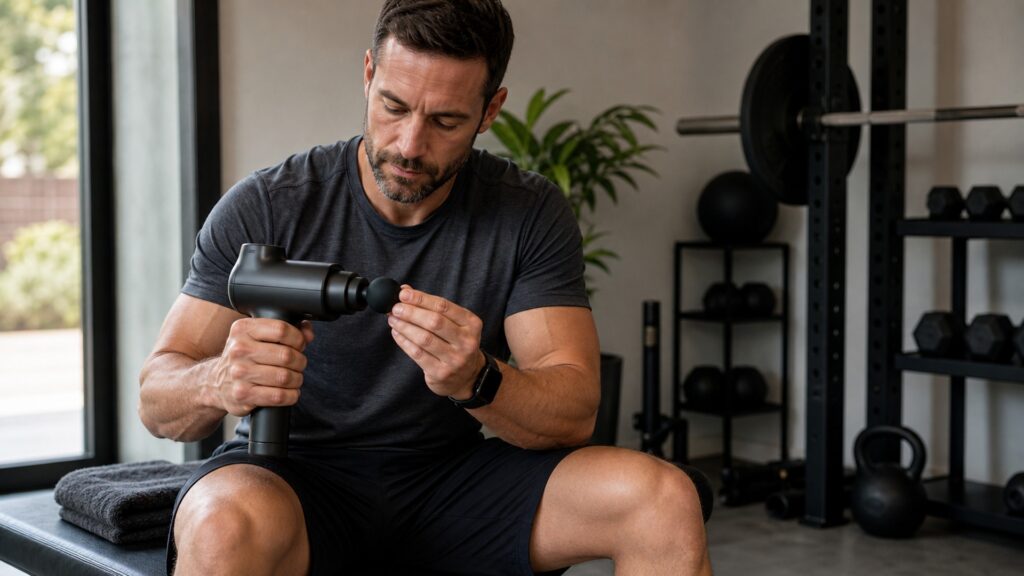
A practical guide to pressure, attachments, target areas, and warning signs.
Tip: Start lower than you think you need, then increase only if the pressure stays comfortable and controlled.
These concepts explain how massage guns apply rapid pressure and why control matters.
Percussive motion is the rapid back-and-forth movement of the massage head.
Amplitude is how far the massage head travels with each stroke.
Attachment shape changes how force spreads across the body.
Pressure control is the user's ability to keep force tolerable and targeted.
Target area is the muscle group or region being addressed.
Recovery role is how the device supports warmup, cooldown, or comfort around training.
Tip: A percussion massager should feel controlled and useful, not like a test of pain tolerance.
A safer percussion routine lets the user back off quickly. If the device feels useful only when pressed hard, the setting or attachment may be wrong.
Control is the first safety feature.
Large muscles are usually more appropriate than joints, bones, the front of the neck, acute injuries, or areas with unexplained symptoms.
The target area matters as much as the device.
Narrow heads focus force into a smaller point. That can feel intense quickly, especially at higher speeds or with deep amplitude.
Attachments are safety choices, not just accessories.
Long or repeated passes can irritate tissue, especially when the user keeps returning to one sore spot. Short, specific use is easier to judge.
A brief controlled session is better than chasing intensity.
Sharp pain, numbness, tingling, bruising, swelling, or symptoms that persist are reasons to stop and reassess.
Safety means knowing when not to use the tool.
Safety checks help keep percussion useful without overstating what it can do.
They keep pressure, attachment choice, and target areas appropriate.
They reduce the chance of turning recovery work into irritation.
They cannot diagnose injuries.
They do not make aggressive pressure automatically productive.
A powerful device still needs careful use.
More force can make irritation more likely and is not automatically more useful.
They can focus pressure too sharply if used carelessly.
Some sore spots need rest, lighter care, or professional assessment.
Even brief use can be too aggressive if placement or pressure is wrong.
Tip: Use comfort and control as safety signals.
Short answers about pressure, attachments, and stop signs.
Use light to moderate pressure that stays tolerable.
Avoid joints, bones, acute injuries, and areas with unexplained symptoms.
They can be used carefully, but they concentrate force and should not be the starting point.
Stop for sharp pain, numbness, tingling, swelling, bruising, or worsening symptoms.
Use percussion with controllable pressure, appropriate targets, and clear stop signs.
Percussion massager safety factors matter because rapid pressure can help or irritate depending on force, target area, and control.
A safer routine starts light, uses suitable attachments, avoids warning signs, and treats the device as support rather than treatment for every problem.
Use these Review Streets paths to compare related fitness categories and practical buying decisions.
Explore the category before comparing specific tools.
Compare related recovery and mobility tools.
Review the related category before deciding.
Choose a retailer
Prices checked regularly. We may earn a commission at no cost to you.