
Percussive Motion
Percussive motion is the rapid back-and-forth movement of the massage head.
- Example: a massage gun pulsing against the quadriceps
- Check: look for controllable speed and smooth feel
- Limit: faster motion is not automatically better
Training function matters for percussion massagers because the device should support a real warmup, cooldown, or recovery moment. A powerful massage gun that does not fit the routine is easy to overuse or ignore.
The useful question is whether the device helps the user reach the right areas, control pressure, adjust intensity, and return to movement without adding irritation.
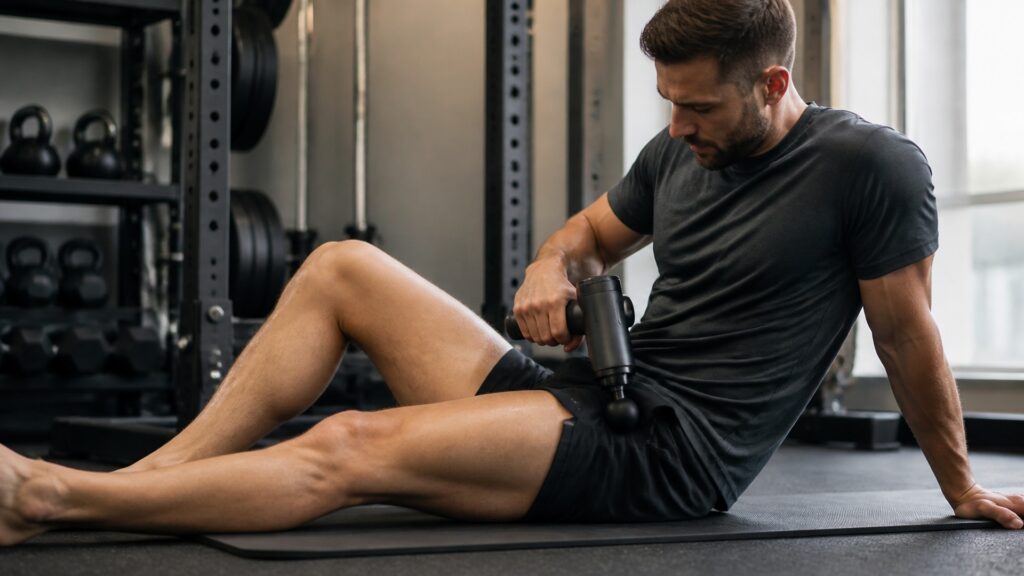
A practical guide to matching device features with workout routines.
Tip: Pick the device that helps the routine most often, not the one with the most aggressive setting.
These concepts explain how percussion massagers create rapid pressure and why control matters.
Percussive motion is the rapid back-and-forth movement of the massage head.
Amplitude is how far the massage head travels with each stroke.
Stall force is how much pressure the motor can resist before slowing or stopping.
Attachment shape changes how force spreads across the body.
Pressure control is the user's ability to keep force tolerable and targeted.
Recovery role is how the device supports warmup, cooldown, or comfort around training.
Tip: A percussion massager should feel controlled and useful, not like a test of pain tolerance.
Percussion can fit before training, after training, or between sessions, but each role asks for different intensity and timing.
Function improves when the device has a defined job.
High stall force and speed can sound impressive, but the user still needs to control pressure. Too much force can make the body tense up.
A controllable device is easier to use well.
A device that is hard to hold or aim may miss the areas it is meant to help. Attachments and handle angle change how well the user can reach larger muscles or awkward spots.
Training function depends on reaching the right area comfortably.
The device may help an area feel better, but recovery still depends on training load, rest, sleep, nutrition, hydration, and time.
The device supports recovery habits; it does not override them.
The best device is usually the one that feels manageable, reaches common target areas, has clear controls, and does not encourage unnecessary force.
Training function turns the device into a routine-fit decision.
Function matters when the device supports a real training need.
It matches speed, attachment, and pressure to warmup, cooldown, or recovery support.
It keeps use focused on specific target areas.
It cannot compensate for poor training load or injury.
More force can make the device harder to use well.
The strongest setting is not always the most useful one.
It helps only if pressure remains controlled and appropriate.
It can support preparation, but movement still matters.
Some soreness needs rest, lighter use, or professional assessment.
Attachment shape changes pressure and target access.
Tip: Training function is about useful support, not maximum impact.
Short answers about timing, attachments, speed, and routine fit.
Control usually matters most: speed, pressure, attachment choice, and comfortable handling.
Both can make sense if use is brief, targeted, and tolerable.
It can be enough if it reaches the target areas and provides controllable pressure.
It may help manage how an area feels, but it cannot guarantee prevention.
Choose a device that fits your routine and lets you control pressure well.
Percussion massager training function matters because the device should fit warmup, cooldown, and recovery habits.
A useful percussion massager reaches the right areas, allows controlled pressure, adjusts easily, and supports training without encouraging overuse.
Use these Review Streets paths to compare related fitness categories and practical buying decisions.
Explore massage-gun features, attachments, and recovery use cases.
Compare related recovery and muscle-therapy tools.
Compare another recovery-tool category before deciding.
Choose a retailer
Prices checked regularly. We may earn a commission at no cost to you.