
Spring resistance
Load created by stretching springs through a moving range.
- Changes by attachment
- Feels different across range
- Needs setup control
Pilates equipment matters because it changes how resistance, support, and alignment cues enter a movement. A reformer can guide a carriage path through springs and straps, while rings, barrels, and smaller props give feedback or assistance.
That does not mean equipment is automatically better than mat practice. Apparatus changes the conditions. It may support, challenge, or clarify a pattern depending on setup, instruction, and the user's control.
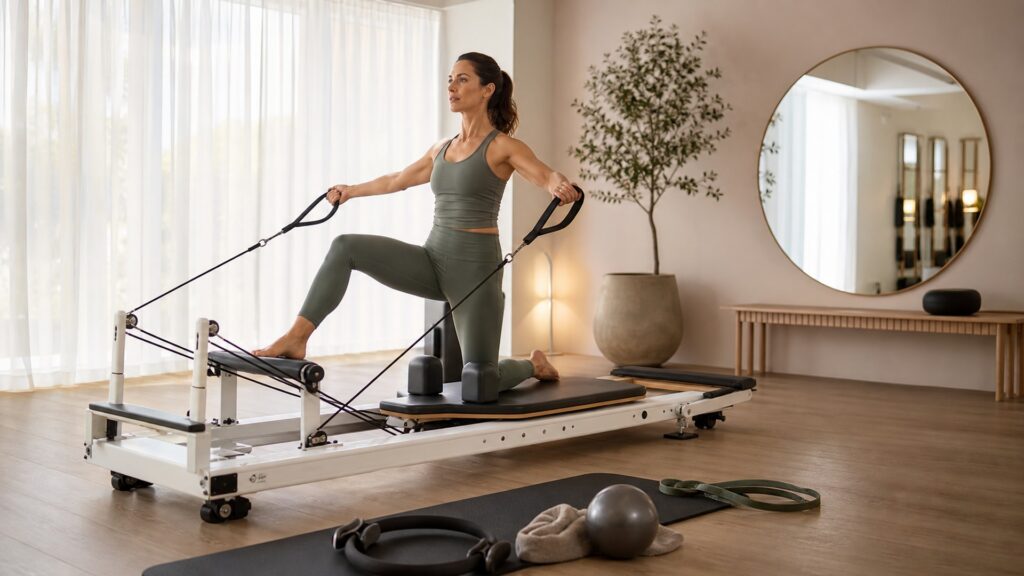
A focused explanation of the signals, movement constraints, tradeoffs, and limits behind Pilates Equipment.
Tip: For Pilates Equipment, compare the behavior first; the product or practice label comes second.
These definitions connect the main idea to the variables, limits, and practical signals readers need to compare options.
Load created by stretching springs through a moving range.
The reformer's sliding platform movement.
Resistance and direction created through straps or ropes.
A reformer support point for feet or hands.
A flexible ring used for compression and position cues.
The change from bodyweight mat work to guided equipment work.
Tip: If the explanation skips spring resistance and carriage travel, it is probably too generic.
Pilates apparatus can guide how load enters the movement. Springs, straps, pulleys, bars, and moving surfaces create resistance that changes with position, not just with listed weight.
The equipment matters because it shapes both resistance and path.
Rings, balls, barrels, and boxes can give tactile feedback. They show where pressure is applied, whether a position is drifting, or how a movement feels when support changes.
A prop is often a cue, not just an accessory.
Straps, springs, and support surfaces can help a user access a movement while still requiring control. Assistance and challenge can exist in the same setup.
Pilates equipment matters because support can be adjustable rather than passive.
Changing spring count, footbar position, headrest, strap length, or body placement can turn one exercise into a different demand. That makes instruction and setup especially important.
The apparatus is precise only when its setup is precise.
The useful question is not whether Pilates equipment is advanced. It is whether the tool clarifies the lesson: control, coordination, range, resistance, or feedback.
Pilates equipment matters when it makes the intended movement easier to understand.
A useful explanation should clarify the decision without pretending one rule covers every product, body, app, surface, or practice.
It clarifies how springs, straps, support surfaces, and props change movement demands.
It gives readers a practical vocabulary for comparing claims without leaning on vague fitness language.
It does not prove apparatus is superior to mat work or appropriate for every person without qualified instruction.
The right interpretation can change with fit, setup, instruction, surface, activity type, and the exact product.
Common shortcuts and misunderstandings can make the topic seem simpler than it is.
Equipment can increase challenge, but it can also assist range and provide feedback when set up appropriately.
More springs can increase resistance in some movements, but they can assist or stabilize others depending on direction and setup.
A reformer changes feedback and load, but mat work still teaches bodyweight control with minimal equipment.
Rings, balls, and blocks can change pressure, alignment cues, and attention even when the load is modest.
Apparatus can guide movement, but instruction, setup, and individual control still determine execution.
Tip: Treat strong claims as starting points for comparison, not final answers.
Concise answers to common questions readers may have after the main explanation.
Springs create adjustable resistance that changes through the range as the carriage, straps, or limbs move.
Not automatically. Equipment adds guidance and resistance; mat work reduces setup and emphasizes bodyweight control.
Spring count, strap length, footbar position, and body placement all change leverage and resistance.
It adds compression resistance and tactile feedback, often between the hands, thighs, ankles, or arms.
No guarantee. Pain or rehabilitation questions need qualified individual guidance.
Pilates equipment matters because it changes resistance, support, feedback, and the path of movement.
A reformer, ring, strap, spring, or barrel is useful when its setup serves the lesson rather than just making the exercise look more complex.
Use these Review Streets paths to connect the explainer to related categories, comparisons, and next decisions.
Use this hub to compare mats, props, reformers, rings, and balance tools across the broader Yoga and Pilates equipment space.
Use this path when surface grip, cushioning, sweat handling, and floor feel are the next equipment questions.
Use this path when springs, straps, rings, reformers, and resistance-assisted positioning are the next comparison point.
Choose a retailer
Prices checked regularly. We may earn a commission at no cost to you.