
Workout Role
Workout role is the job the rack performs in the training plan.
- Example: main station for squats, bench, and pull-ups
- Check: name the lifts the rack must support
- Limit: one rack does not cover every training need
Workout role matters in power racks and squat racks because a rack can be the center of a strength program, a support station for barbell work, or one part of a larger home gym. Its value depends on the job it needs to do.
A rack is strongest when the user's routine depends on barbell lifts, pull-ups, safeties, and adjustable setup points. It is less useful when the routine mostly needs guided stations, cable angles, or cardio-style training.
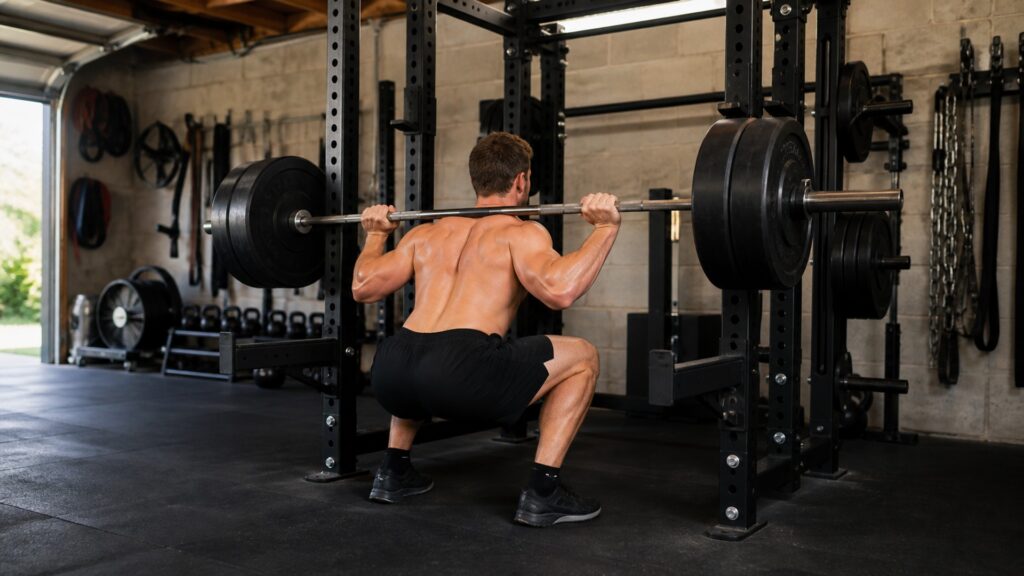
A practical look at racks as main stations, support tools, and long-term home gym anchors.
Tip: Judge the rack by the lifts it supports safely and repeatedly, not by the largest number on the spec sheet.
These concepts clarify how rack design affects barbell training in a home gym.
Workout role is the job the rack performs in the training plan.
A main strength station handles the central exercises in a program.
A support station fills a specific role around other equipment.
Progression base means the rack supports gradual loading over time.
Accessory compatibility is the rack's ability to accept attachments that expand training options.
Long-term fit is whether the rack can keep serving the user as training changes.
Tip: A rack is most useful when its frame, safeties, spacing, and room fit match the user's main lifts.
A rack should be chosen for a specific role. It may anchor the whole home gym, support a few barbell lifts, or complement other equipment.
A clear role keeps the purchase practical.
When barbell lifts define the program, the rack becomes the main station. It supports setup, safeties, and repeatable loading for the biggest lifts.
The rack is the natural center for barbell-based training.
Not every rack has to be the whole gym. A compact squat rack may simply add barbell capability to a setup that already has dumbbells, cables, or machines.
Support roles work best when they solve a clear problem.
Rack attachments can expand training, but they should serve repeated exercises. A dip bar, landmine, or cable attachment is useful only when it fits the plan and space.
Expansion should make the rack more useful, not more crowded.
A rack can last through years of strength training if it has enough capacity, spacing, and attachment support for likely future goals.
The best rack role can grow with the user.
Role-based evaluation keeps rack choices tied to actual training.
It clarifies whether the rack should anchor the gym or fill a narrow gap.
It prevents overbuying attachments and features.
It cannot predict every future goal.
Some routines still need benches, plates, cable stations, or machines.
A rack is valuable when its job is clear.
The right rack depends on the role, room, and lifts.
It matters for anyone whose routine uses barbell setup and safeties.
They are worth adding only when they support repeated training.
A smaller rack can be serious when it fits the intended lifts safely.
Tip: Treat rack claims as setup questions: what lift, what height, what safety, and what room?
Short answers for choosing and using rack-based home strength equipment.
Yes, when barbell lifts are central to the program.
It is support equipment when it adds barbell capability around other primary tools.
Buy attachments only for exercises you know you will repeat.
Yes, if its capacity, spacing, dimensions, and compatibility fit current and future training.
Define the rack's role before choosing size, safeties, and accessories.
Workout role matters because a rack is most useful when it has a clear job in the strength plan.
It can anchor barbell training, support a broader setup, or grow with future goals, but the value depends on repeated use.
Use these Review Streets paths to compare related categories and practical next decisions.
Explore rack-based strength equipment and setup tradeoffs.
Compare rack-based training with broader all-in-one stations.
Review cable-focused equipment for accessory and angle-based work.
Choose a retailer
Prices checked regularly. We may earn a commission at no cost to you.