
Reference Line
Chosen boundary for cheek, neck, sideburn, brow, or body-hair design.
- Use: preserve shape
- Variable: anatomy and style
- Tradeoff: Natural sides are not identical
Precision grooming matters because detail areas combine visible boundaries with awkward contours, changing hair direction, delicate skin, and nearby structures that should not be touched. The goal is not maximum closeness. It is to remove the intended hair, preserve the intended line or length, and repeat the result without unnecessary passes.
Tool geometry controls access. A narrow trimmer exposes less cutting width at an edge; a small foil can clean beneath a line; guards hold a repeatable length; rounded nose or ear heads shield internal blades; good lighting and mirrors expose asymmetry before it is overcorrected. Stable grip and sequence matter as much as attachments.
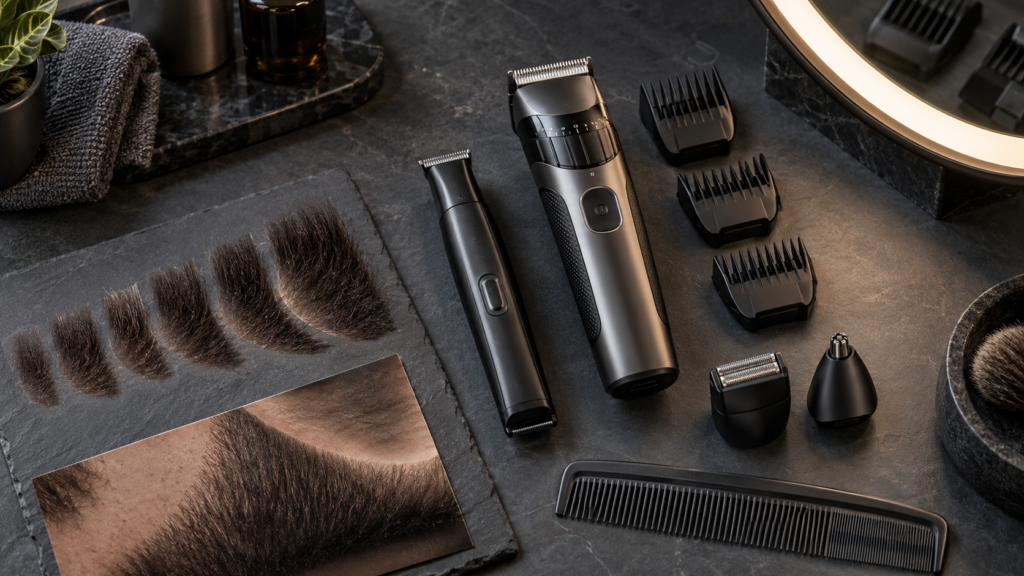
Explain precision as controlled boundaries, length transitions, access, visibility, tool geometry, hand stability, symmetry, and skin preservation for beards, brows, sideburns, nose, ears, neckline, bikini lines, and detail work—not perfectionism or cutting closer everywhere.
Tip: A line is easier to refine than to regrow.
These precision grooming concepts separate mechanism, application, limits, and purchasing consequences.
Chosen boundary for cheek, neck, sideburn, brow, or body-hair design.
Span of hair engaged by a blade or trimmer in one pass.
Spacer controlling approximate hair left above skin.
View that reveals edge, contour, and tool approach.
Stable hand or tool contact used to control movement.
Progressive removal while trying to make two sides perfectly identical.
Tip: Use these terms to test precision grooming instead of relying on a front-label promise.
Decide neckline, cheek line, arch, sideburn height, body boundary, and length transition while enough hair remains to judge proportion.
A line is easier to refine than to regrow.
Start above the intended length, move with controlled overlapping passes, and step down gradually in transition zones rather than beginning bare.
Length can be removed later but not restored.
Turn a corner trimmer or narrow head toward the line, use short movements, and clean outside the boundary without pressing into skin.
Detail tools reduce the amount at risk in one movement.
Nose, ear, brow, genital, and other detail areas need exact attachment and area approval. Do not insert tools farther than directed or cut unseen skin folds.
Access does not authorize depth.
Step back, change lighting, let hair settle, and accept normal asymmetry. Correct only a specific visible issue rather than chasing mirror-image perfection.
Precision includes knowing when to stop.
Precision improves repeatability and skin control; it cannot make perfect facial symmetry or eliminate all irritation.
The finished boundary is planned before bulk hair is removed.
Large tools establish overall length; smaller tools refine only the remaining edge.
Skin is supported without excessive stretching, pressure, or repeated correction.
Sensitive openings, lesions, moles, lashes, and mucosal tissue are treated as exclusion zones.
These claims flatten the variables that determine how precision grooming performs in a real routine.
A crisp result can retain stubble or graduated length; the target is controlled contrast, not universal skin closeness.
Faces and brows are naturally asymmetric. Balanced proportion usually looks more natural than aggressive correction.
Very close blade alignment can increase nicks and irritation if skin enters the cutting path.
Close magnification can hide overall proportion and encourage correction creep; alternate close and normal views.
Attachments have area, cleaning, and insertion limits; delicate sites need purpose-built guards and instructions.
Tip: Test the exact precision grooming tool, setting, and routine before generalizing from its category.
The remaining decisions about precision grooming concern technique, compatibility, safety, upkeep, and value.
A full trimmer sets bulk and length; a narrow detail trimmer or small foil can refine the outside edge if skin tolerates it.
Use natural landmarks and the intended style, leave a margin, and refine gradually rather than cutting high on the first pass.
Trimming visible hair is generally safer than plucking deeply; nasal hair and tissue serve protective functions and are infection-prone when traumatized.
Record guards, lever positions, direction, and zones; establish the longest length first and blend with intermediate settings.
Do not run a blade across a raised or changing lesion. Groom around it and seek assessment for concerning changes.
Remove hair, clean or rinse only as instructed, dry completely, avoid sharing, and store protected from contamination.
Precision grooming is controlled removal: plan the boundary, establish bulk and length first, refine with a smaller head, maintain visibility and a stable hand, protect sensitive structures, and stop before correction creep changes the design.
Shop for useful head width, guards, visibility, grip, low-speed control, area approval, cleaning, and replacement support. A precise tool is valuable only when it reduces what one mistake can remove.
These Review Streets paths narrow the next precision grooming decision by format, goal, and routine fit.
Browse shaving, epilation, and light-based hair-removal categories.
Compare at-home beauty devices, including light-based hair-removal systems.
Choose a retailer
Prices checked regularly. We may earn a commission at no cost to you.