
Scope of Practice
Services a professional may legally perform under applicable rules.
- Use: check provider fit
- Variable: license and location
- Tradeoff: Titles vary by jurisdiction
Professional beauty services matter when the outcome depends on more than access to a product or machine. A capable provider translates a broad goal into a suitable service, screens contraindications, adjusts the protocol to the starting condition, controls timing and placement, maintains sanitation, recognizes an endpoint, documents what happened, and gives usable aftercare.
That value grows with the invasiveness, chemistry, heat, light, needles, tissue injury, allergy potential, or correction difficulty involved. It is smaller for simple low-risk maintenance that a consumer can perform reliably. A polished space or well-known device does not establish competence; licensing scope, training, experience, evidence, and an adverse-event plan must be evaluated directly.
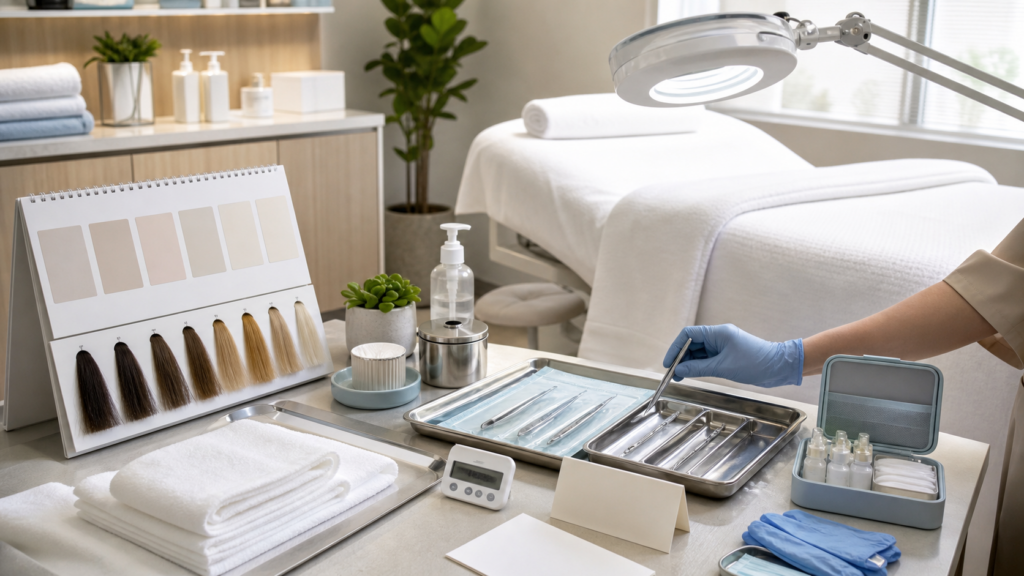
Explain professional beauty services as a chain of consultation, selection, controlled execution, sanitation, monitoring, documentation, aftercare, and complication response, while helping readers evaluate provider fit, evidence, total cost, and when home care is sufficient.
Tip: Technology should follow assessment, not lead it.
These professional beauty services concepts separate mechanism, application, limits, and purchasing consequences.
Services a professional may legally perform under applicable rules.
Condition or circumstance that makes a procedure unsuitable or requires modification.
Decision process covering purpose, alternatives, material risks, recovery, and questions.
Documentation of assessment, products, lots, settings, timing, response, and advice.
Observed sign or protocol limit used to finish or adjust treatment.
Plan for recognizing, responding to, and escalating an adverse event.
Tip: Use these terms to test professional beauty services instead of relying on a front-label promise.
Pigment, texture, hair damage, nail condition, unwanted hair, and sensitivity can require different modalities. The provider should explain why the selected service fits.
Technology should follow assessment, not lead it.
Confirm applicable license, service-specific training, experience with comparable skin or hair, sanitation, authentic supplies, maintenance, supervision, and emergency access.
A brand logo cannot credential an operator.
A professional service controls placement, exposure, symmetry, tissue response, comfort, equipment behavior, and termination throughout the appointment.
Attention during the service is part of what you buy.
Home instructions should name cleansing, moisture, sun, heat, exercise, water, product restrictions, expected changes, and exactly whom to contact.
Aftercare converts a procedure into a managed recovery.
Include consultation, test sessions, add-ons, gratuity, travel, time off, home products, repeat visits, correction, cancellation terms, and complication management.
The menu price is not the total decision.
Professional service adds judgment, controlled process, and accountability; it cannot promise a specific result or eliminate biological risk.
Consultation identifies the target, baseline, alternatives, limits, and reasons to defer.
Provider, product, device, settings, lot, timing, and response are recorded when relevant.
Informed consent includes likely benefits, common tradeoffs, important risks, downtime, cost, and maintenance.
Follow-up remains reachable after the client leaves the room.
These claims flatten the variables that determine how professional beauty services performs in a real routine.
Licenses establish a scope and baseline, while service-specific training and experience still vary.
Routine low-risk maintenance may be more practical at home; professional value rises with complexity and consequence.
Screening can reveal reasons to postpone, modify, refer, or decline a service.
Consent should inform a decision; it does not replace competent practice, sanitation, or legal duties.
Even gentle services can cause irritation, allergy, bruising, infection, pigment change, or an unwanted result.
Tip: Test the exact professional beauty services tool, setting, and routine before generalizing from its category.
The remaining decisions about professional beauty services concern technique, compatibility, safety, upkeep, and value.
The exact service, operator, credentials, expected result, alternatives, risks, preparation, downtime, aftercare, total cost, and complication contact.
Use the relevant state or local licensing board and confirm both the credential and whether it covers the planned service.
They help only when lighting, angle, timing, treatment course, and client characteristics are comparable and unedited.
When diagnosis, prescription treatment, deeper injury, injections, significant energy delivery, suspicious lesions, or medical complications are involved.
Guaranteed outcomes, pressure packages, evasive credential answers, unlabeled products, poor hygiene, no consent, and no follow-up route.
Breathing difficulty, eye injury, rapidly spreading swelling, severe burns, or other acute systemic symptoms require urgent evaluation.
Professional beauty services matter because they organize assessment, controlled technique, sanitation, monitoring, documentation, aftercare, and recourse around a result. Those safeguards become more valuable as treatment complexity and potential harm rise.
Choose the provider before the product or machine. Verify scope, relevant experience, exact protocol, realistic outcome, total course cost, downtime, sanitation, records, and a credible complication pathway.
These Review Streets paths narrow the next professional beauty services decision by format, goal, and routine fit.
Browse professional products, equipment, and salon-focused beauty categories.
Compare skincare and hair-removal device technologies.
Choose a retailer
Prices checked regularly. We may earn a commission at no cost to you.