
Starting Level
Relative lightness or darkness before coloring.
- Use: predict lift and deposit
- Variable: natural and artificial pigment
- Tradeoff: Scales vary by brand
Professional hair color matters when the result depends on interpreting a complex starting canvas and controlling several chemical variables. A colorist assesses natural level, undertone, gray distribution, porosity, condition, prior permanent or direct dye, lightener, relaxer, and heat history before selecting color family, developer, placement, and processing sequence.
The advantage is not that every professional tube is inherently safer or stronger. It is the ability to mix shades, vary formulas by zone, isolate sections, monitor lift, neutralize exposed undertones, protect compromised areas, and plan correction over multiple visits. Hair dye can still cause irritation or allergy; FDA advises following warnings, gloves, timing, scalp precautions, and a skin test every time as directed.
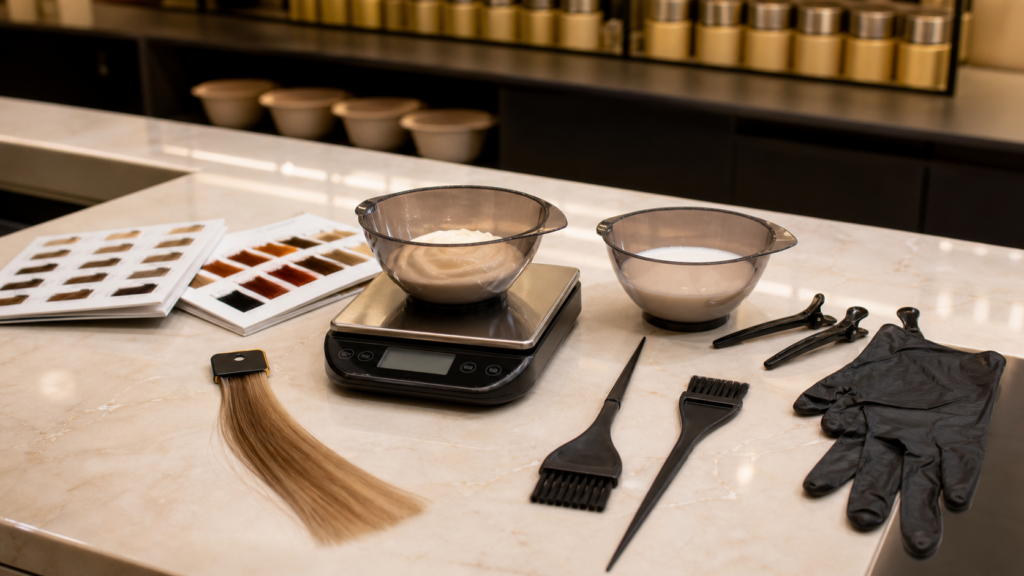
Explain professional hair color as diagnosis plus controllable chemistry: starting level, undertone, porosity, gray percentage, prior oxidative and direct dyes, lightening background, developer choice, sectioning, timing, strand and allergy testing, correction, and maintenance.
Tip: What is already in the hair controls what can safely happen next.
These professional hair color concepts separate mechanism, application, limits, and purchasing consequences.
Relative lightness or darkness before coloring.
Warm color exposed as natural pigment is lightened.
Oxidizing component used with certain color or lightener systems.
Variation in how hair absorbs and releases water and color.
Small controlled application used to preview processing and condition.
Planned service addressing unwanted or accumulated artificial color.
Tip: Use these terms to test professional hair color instead of relying on a front-label promise.
List box dye, salon color, direct pigments, henna or metallic salts, bleach, smoothing, relaxers, and reactions. Photos help but do not replace inspection.
What is already in the hair controls what can safely happen next.
The skin test addresses potential reaction according to product directions; a strand test previews lift, tone, timing, and fiber behavior. Neither guarantees the other.
Two uncertainties require two different tests.
Heat, porosity, previous color, and gray percentage can require different ratios, shades, placement, or timing rather than one mixture dragged through all hair.
Precision often means using less chemistry where less is needed.
Sectioning and saturation affect evenness. Stop at the safest achievable stage when elasticity, breakage, scalp response, or protocol limits demand it.
A target shade is never worth ignoring the substrate.
Include root frequency, toning, fade, color-safe cleansing, heat and sun exposure, home pigment, future removal, and the cost of correcting banding.
The real purchase is a color lifecycle, not one appointment.
Professional color expands diagnostic and formulation control; it cannot guarantee an exact swatch, undamaged lightening, or freedom from allergy.
The formula accounts for roots, lengths, ends, and prior color separately.
The service has strand, allergy, timing, and scalp stop rules.
More lift increases structural stress and maintenance burden.
Correction price and timeline are discussed before irreversible steps.
These claims flatten the variables that determine how professional hair color performs in a real routine.
Professional oxidative dyes can contain sensitizing ingredients. FDA advises a skin test every time as directed and stopping after reaction.
Developer choice depends on formula, starting point, scalp use, and desired lift or deposit. Excess strength can increase damage and unpredictability.
Oxidative color generally does not reliably lift accumulated artificial pigment; correction may require removal, lightening, neutralization, or compromise.
It reduces uncertainty but cannot reproduce every zone, section thickness, heat pattern, or color-history difference.
Hair integrity, prior pigment, starting level, and maintenance tolerance may require a staged plan or a different target.
Tip: Test the exact professional hair color tool, setting, and routine before generalizing from its category.
The remaining decisions about professional hair color concern technique, compatibility, safety, upkeep, and value.
Recent color and chemical history, product names when known, reaction history, clear photos, maintenance budget, and the parts of the goal that matter most.
Scalp heat, natural regrowth, gray coverage, and absence of previous color can change processing compared with porous lengths.
Permanent color can provide durable coverage, but new gray grows in and pigment still fades; coverage and maintenance vary.
Defer after scalp irritation, sunburn, unexplained hair loss, significant breakage, failed testing, or incompatible recent chemistry until assessed.
Lightening exposes underlying warm pigment; toner adjusts the visible balance but fades and does not repair structural damage.
It may require testing, multiple formulas, careful sectioning, pigment removal, staged lightening, conditioning, and several appointments.
Professional hair color matters because diagnosis, zone-specific formulation, controlled processing, and correction planning can manage variables that a single standard box cannot. The expertise is in reading both pigment and fiber condition.
Expect a complete history, testing, measured formulas, section control, stop rules, and a maintenance plan. Professional color still carries allergy and damage risks, and an achievable healthy result may require compromise or multiple visits.
These Review Streets paths narrow the next professional hair color decision by format, goal, and routine fit.
Browse professional products, equipment, and salon-focused beauty categories.
Compare professional-inspired skincare and beauty device technologies.
Choose a retailer
Prices checked regularly. We may earn a commission at no cost to you.