
Periodontal Probe
Marked instrument used to measure spaces and tissue conditions around teeth.
- Use: quantify gum findings
- Variable: technique and inflammation
- Tradeoff: Not a treatment tool
Professional oral-care tools matter because they extend what a trained clinician can see, measure, document, and treat. Mirrors, lighting, periodontal probes, radiographs, scalers, polishers, suction, and isolation systems each have a defined job within an examination or procedure, supported by infection-control and maintenance protocols.
Their value does not come from being sharper or more powerful. It comes from calibrated use, anatomical knowledge, diagnosis, controlled force or energy, sterile processing, and the ability to respond to complications. Consumer tools that resemble scalers or polishers do not reproduce that system and can damage enamel, roots, gums, or restorations.
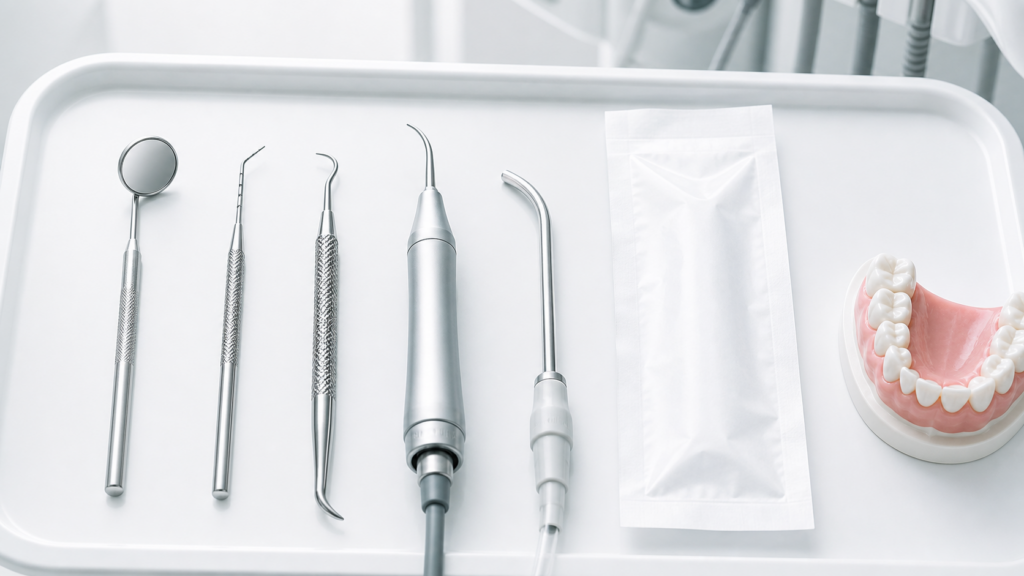
Explain why diagnostic and treatment instruments matter through visibility, measurement, controlled energy, sterilization, training, documentation, and maintenance; distinguish professional scalers, polishers, radiography, suction, mirrors, and probes from consumer look-alikes.
Tip: The instrument supports judgment; it does not create the diagnosis.
These professional oral care tools concepts separate mechanism, application, limits, and purchasing consequences.
Marked instrument used to measure spaces and tissue conditions around teeth.
Powered instrument using vibration and water for professional deposit removal.
Shaped metal instrument for controlled deposit removal.
Image showing structures not fully visible in a surface exam.
Validated processing that cleans, packages, sterilizes, and stores reusable instruments.
Methods that control moisture, soft tissues, and field access.
Tip: Use these terms to test professional oral care tools instead of relying on a front-label promise.
A professional combines history, visual exam, probing, tests, and selected imaging to decide what problem exists and whether treatment is indicated.
The instrument supports judgment; it does not create the diagnosis.
Scalers and polishers require correct angulation, power, water, pressure, and knowledge of enamel, roots, implants, and restorations.
Professional control is more important than raw power.
Reusable critical and semicritical items need the appropriate validated processing, while barriers, single-use items, hand hygiene, and waterline practices address other transmission routes.
Appearance cannot verify sterilization.
Patients can ask what a measurement or image will change, what discomfort is expected, what alternatives exist, and what follow-up is needed.
Professional care should remain understandable.
Retail scrapers and polishing devices can gouge roots, alter restorations, push deposits, or injure gums. Home care should focus on plaque disruption.
A professional-looking tool is not a professional service.
Professional tools increase diagnostic and procedural control; they do not make every treatment necessary or eliminate informed consent.
The tool matches a documented clinical question or treatment step.
Calibration, sterilization, barriers, and maintenance are visible parts of quality.
More scraping, polishing, or imaging is not automatically better care.
A patient should understand the purpose, alternatives, limits, and aftercare.
These claims flatten the variables that determine how professional oral care tools performs in a real routine.
Sharpness without angulation, diagnosis, and tactile control increases injury risk. Tool condition is only one part of safe use.
Correctly selected and used instruments are standard professional tools; risks depend on technique, surface, settings, and patient factors.
Polishing addresses selected surface deposits after assessment; it does not substitute for calculus removal or treat intrinsic color.
Imaging should be selected to answer clinical questions based on history, age, risk, and findings—not taken indiscriminately.
Home kits cannot measure pockets, diagnose disease, protect root surfaces, or provide sterile controlled treatment.
Tip: Test the exact professional oral care tools tool, setting, and routine before generalizing from its category.
The remaining decisions about professional oral care tools concern technique, compatibility, safety, upkeep, and value.
They provide different access, feedback, and deposit-removal options; selection varies by surface and patient needs.
Appropriate reusable instruments undergo validated cleaning and sterilization; single-use items are discarded. Ask the practice about infection control if concerned.
Probing helps document pocket depth, bleeding, recession, and changes that guide periodontal assessment.
Material, paste abrasivity, pressure, and technique matter, so professionals choose the system for the surface.
Sensation varies with inflammation, deposits, sensitivity, and procedure. Tell the clinician so technique or comfort measures can be adjusted.
A soft toothbrush, fluoride toothpaste, suitable interdental cleaner, and any professionally recommended aids—not sharp scaling instruments.
Professional oral-care tools matter because they combine visibility, measurement, controlled treatment, and infection control within trained clinical judgment. The value is the system around the instrument, not merely its power or shape.
Ask what each tool is meant to establish or change, and expect appropriate sterilization, maintenance, consent, and aftercare. Keep home care focused on removable plaque rather than DIY scaling or polishing.
These Review Streets paths narrow the next professional oral care tools decision by format, goal, and routine fit.
Browse toothbrushes, interdental cleaners, whitening, and daily oral-care categories.
Compare manual, electric, sonic, and specialty toothbrush formats.
Choose a retailer
Prices checked regularly. We may earn a commission at no cost to you.