
Duty Cycle
How long and how often equipment can operate within safe limits.
- Use: match workload
- Variable: motor, cooling, and service volume
- Tradeoff: Not the same as peak power
Salon-grade equipment matters because a working salon asks tools to deliver repeatable output across many clients while tolerating frequent cleaning, long duty cycles, repositioning, and service. A dependable dryer, steamer, treatment bed, extractor, disinfection unit, or powered handpiece must support not only a result but also safe workflow, sanitation, ergonomics, maintenance, and documentation.
The label salon-grade is not a single enforced specification. Buyers still need to examine temperature or energy control, load rating, electrical listing, cleanable surfaces, consumable supply, calibration needs, ventilation, warranty, parts, training, and local rules. A high-output unit can magnify mistakes when used outside its intended setting.
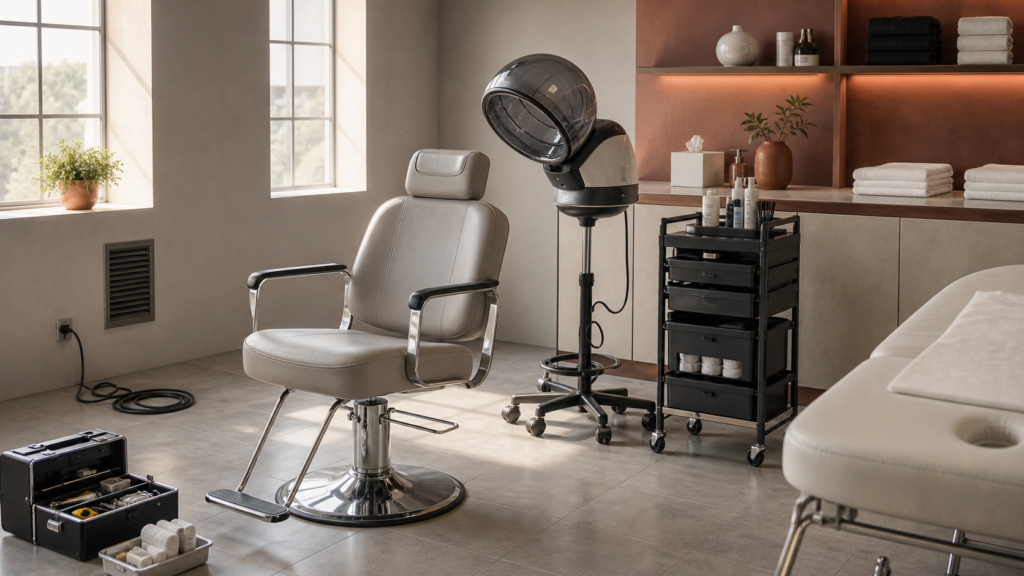
Explain salon-grade equipment as infrastructure designed for repeated service, controllable output, sanitation, ergonomics, ventilation, electrical safety, maintenance, documentation, and repairability—while making clear that commercial duty and professional operation do not automatically make a device suitable or superior for home use.
Tip: The room is part of the equipment system.
These salon-grade equipment concepts separate mechanism, application, limits, and purchasing consequences.
How long and how often equipment can operate within safe limits.
Ability to set and reproduce heat, speed, suction, pressure, or energy.
Design that permits effective cleaning between uses.
Independent certification to applicable electrical safety standards.
Scheduled inspection, cleaning, replacement, and calibration before failure.
Availability of parts, technicians, manuals, and repair routes.
Tip: Use these terms to test salon-grade equipment instead of relying on a front-label promise.
Count clients, operating minutes, room circuits, water, drainage, ventilation, floor space, noise, storage, and turnover time before comparing headline specifications.
The room is part of the equipment system.
Useful equipment delivers the intended setting consistently and gives the operator meaningful feedback. Maximum heat or suction is rarely the safest buying target.
Control creates professional value more reliably than raw output.
Smooth nonporous surfaces, removable contact parts, validated reprocessing instructions, single-use items, storage, and turnaround time determine whether sanitation is workable.
Equipment that cannot be safely turned over does not fit the service.
Adjustable furniture, balanced handpieces, cord management, local exhaust, hearing considerations, and accessible controls reduce strain and exposure across a full day.
Professional performance includes the worker using the machine.
Ask who installs, trains, services, updates, and removes the unit; how fast parts arrive; which consumables are proprietary; and what happens when support ends.
Purchase price is only the opening cost.
Commercial equipment can improve repeatability and throughput; it cannot replace operator judgment, infection control, or facility safeguards.
Controls are readable, stable, and matched to the service protocol.
Client-contact parts can be cleaned, disinfected, sterilized, or replaced as required.
Downtime, noise, heat, fumes, cord routing, and worker posture are included in the purchase decision.
A cheaper tool with local parts and service may create more uptime than an impressive orphaned machine.
These claims flatten the variables that determine how salon-grade equipment performs in a real routine.
The phrase is used broadly. Verify concrete safety, performance, sanitation, and support documentation.
Power draw alone does not reveal output stability, airflow, heat distribution, efficiency, noise, or durability.
Commercial equipment may assume training, facility controls, electrical capacity, PPE, or supervision not present at home.
Covers do not replace proper cleaning and reprocessing of all exposed or contaminated parts.
Preventive maintenance is intended to find wear, contamination, drift, and damaged cords before failure.
Tip: Test the exact salon-grade equipment tool, setting, and routine before generalizing from its category.
The remaining decisions about salon-grade equipment concern technique, compatibility, safety, upkeep, and value.
Space, access, flooring, electrical service, water and drainage, ventilation, anchoring, clearances, network needs, and local requirements.
No. Device status relates to specific intended uses and substantial-equivalence or approval pathways, not every marketing statement.
Confirm identity, ownership, service history, recalls, calibration, remaining support, software access, accessories, decontamination, and manufacturer transfer rules.
Manufacturer reprocessing instructions, product contact times, compatibility limits, logs, and applicable licensing or public-health rules.
After damaged cords, leaks, unusual heat or noise, unstable output, failed self-tests, contamination that cannot be reprocessed, or overdue required maintenance.
No. Exclusions, labor, shipping, response time, loaners, parts availability, and authorized local service determine practical value.
Salon-grade equipment matters when it turns a procedure into a repeatable, supportable service: controlled output, workable sanitation, appropriate duty cycle, safer ergonomics, documented maintenance, and access to parts and training.
Buy the operating system, not the badge. Validate the room, electrical and ventilation needs, operator workflow, consumables, reprocessing, service response, downtime cost, and eventual replacement before committing.
These Review Streets paths narrow the next salon-grade equipment decision by format, goal, and routine fit.
Browse professional products, equipment, and salon-focused beauty categories.
Compare skincare and hair-removal device technologies.
Choose a retailer
Prices checked regularly. We may earn a commission at no cost to you.