
Performance Consistency
Similarity of output across sections and repeated sessions.
- Use: reduce correction
- Variable: control and construction
- Tradeoff: Consistency can preserve a poor setting
Styling tool quality matters because hair and hands depend on the tool behaving predictably. Even heat, smooth contact surfaces, stable airflow, secure attachments, usable controls, balanced weight, and intact electrical components can reduce snags, redos, fatigue, and unexpected exposure.
Quality is not synonymous with price, professional branding, titanium, ceramic, or a long feature list. It appears in repeatable output, sensible safeguards, durable stress points, cleanable parts, clear instructions, warranty support, and a design suited to the user's routine. A modest tool that performs one job consistently may be a better purchase than a premium system with poor fit or unavailable parts.
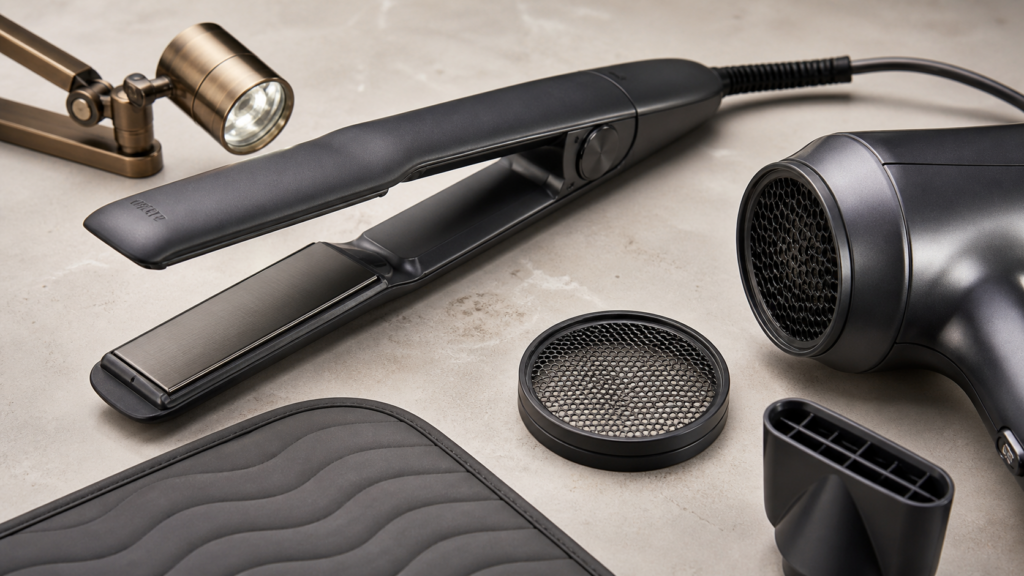
Define quality as predictable performance and safer ownership across heat delivery, surfaces, mechanics, controls, ergonomics, electrical construction, serviceability, warranty, and useful life—not luxury branding.
Tip: Consistency reduces guesswork but does not justify excess heat.
These styling tool quality concepts separate mechanism, application, limits, and purchasing consequences.
Similarity of output across sections and repeated sessions.
Smooth, intact condition of plates, barrels, brush pins, and edges.
Controlled fit and movement of hinges, clamps, buttons, and attachments.
Sound condition of cord, plug, housing, insulation, and protective components.
Ability to clean, replace parts, obtain support, or repair appropriately.
Purchase and upkeep cost divided by sessions that meet the goal.
Tip: Use these terms to test styling tool quality instead of relying on a front-label promise.
A quality tool should not require the user to chase hot spots, pressure gaps, or fading airflow. Test comparable sections at conservative settings and note redos.
Consistency reduces guesswork but does not justify excess heat.
Plate alignment, barrel finish, brush seams, nozzle edges, and attachment locks affect snagging and pressure. Small defects can become repeated mechanical stress.
The hair experiences the finish, not the marketing material.
Settings should be legible, reachable, and resistant to accidental changes. Auto shutoff is useful, while stands, cool tips, gloves, and heat mats may be equally important for the format.
A safeguard works only when its behavior is understood.
High-flex areas and airflow paths often reveal ownership quality. Warranty length matters less when exclusions, shipping, parts, or support make service impractical.
Useful life depends on maintenance and support as well as materials.
Weight, grip size, dominant-hand access, hair length, storage, voltage, noise, and task frequency determine whether good engineering becomes good ownership.
Quality is performance that remains usable in context.
Quality supports predictable styling and ownership; it cannot make aggressive settings or careless technique harmless.
The tool reaches the intended result with stable output and few redos.
Contact, controls, cord, and attachments remain reliable over normal use.
Price and branding do not prove calibration, durability, or suitability.
Any tool becomes unsafe when damaged, contaminated, or used against directions.
These claims flatten the variables that determine how styling tool quality performs in a real routine.
Price may reflect design, marketing, accessories, or distribution. Verify output, finish, controls, warranty, support, fit, and measured routine performance.
Professional tools may prioritize high output, continuous duty, or long cords. Home users may need lighter weight, gentler settings, simpler controls, and easier storage.
Material terms describe selected components and are used inconsistently. Heating uniformity, surface integrity, calibration, mechanics, and service life determine the complete tool.
Auto shutoff is a backup whose timing and behavior vary. Place tools on a heat-safe surface, keep them away from combustibles and water, and unplug after use.
Cord wear, loose parts, hot spots, cracked housings, clogged filters, and damaged coatings can create risk before complete failure. Inspect routinely and retire unsafe equipment.
Tip: Test the exact styling tool quality tool, setting, and routine before generalizing from its category.
The remaining decisions about styling tool quality concern technique, compatibility, safety, upkeep, and value.
Read the manual and warranty, inspect controls and parts, check safety listings appropriate to the market, assess weight and grip, and buy with a practical return policy.
Use normal sections and products at conservative settings. Record time, passes, snags, temperature stability, attachment security, fatigue, noise, storage, and final result.
It is useful only with credible coverage, accessible service, reasonable exclusions, and available parts. Warranty terms complement rather than replace construction evidence.
Damaged cords, loose plugs, cracked housings, sparking, burning odors, unstable heat, peeling coatings, rough edges, weak clamps, and insecure attachments require stopping use.
Use authorized service when the maker supports it. Do not improvise repairs to mains-powered heated appliances; compare repair cost, remaining life, safety, and parts availability.
Include price, frequently used functions, session time, failed styles, consumable parts, maintenance, warranty, expected life, and whether the tool replaces anything already owned.
Styling tool quality matters because predictable output, intact surfaces, sound mechanics, clear controls, and electrical integrity reduce guesswork and avoidable redos. Quality is observable behavior across the ownership cycle.
Choose the simplest tool that performs the real task reliably and fits the user's hair, hands, space, and schedule. Inspect, clean, store, and retire it according to safety—not prestige or sunk cost.
These Review Streets paths narrow the next styling tool quality decision by format, goal, and routine fit.
Compare dryers, irons, wands, multi-stylers, and their buying paths.
Explore airflow, heat control, attachments, ergonomics, and long-term versatility.
Choose a retailer
Prices checked regularly. We may earn a commission at no cost to you.