Why Track Saws Accuracy Matters

Track saw accuracy is often reduced to a simple idea of cutting straight, but it is governed by a combination of mechanical alignment, track interaction, and controlled movement. The relationship between the saw base, guide rail, and blade path determines how precisely the tool follows its intended line. Small variations in fit, stability, or setup can influence the final cut, making accuracy a system-level characteristic rather than a single feature.

This explainer outlines how track saw accuracy is established and maintained, including rail design, anti-play adjustments, plunge mechanics, and blade tracking. It clarifies how these elements work together to guide the saw consistently along a fixed path and what factors affect repeatability across multiple cuts.

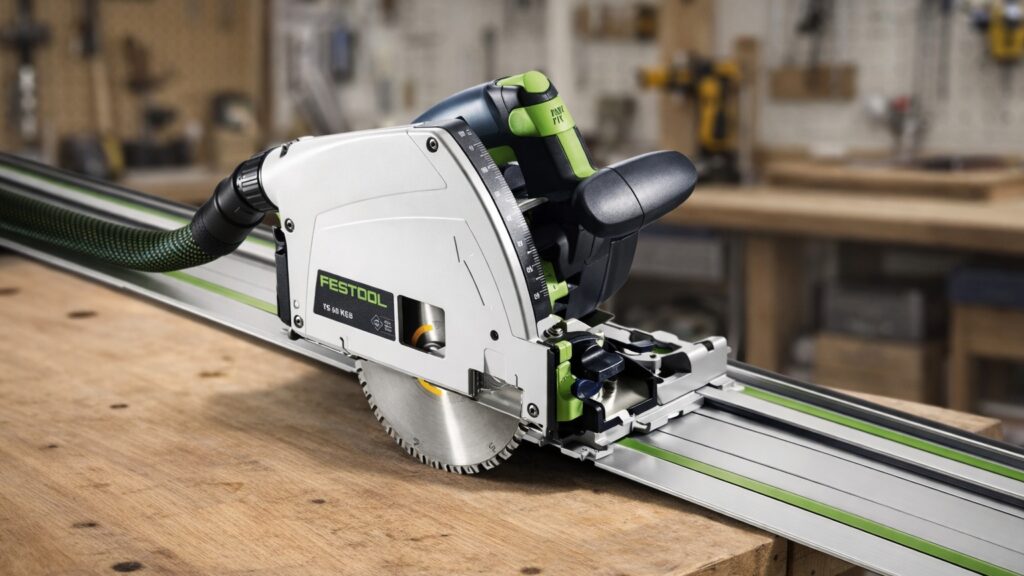
By: Review Streets Research Lab
Updated: April 19, 2026
Explainer · 8–12 min read
Festool TS 60 KEB-F-Plus track saw
What You’ll Learn

How Track Saw Accuracy Is Created

A focused breakdown of how track alignment, base stability, and blade tracking interact to control cut precision, repeatability, and consistency across different materials and setups.

  • How the guide rail establishes a fixed reference line for cutting
  • What anti-play adjustments do to eliminate lateral movement during operation
  • How base plate geometry influences stability and tracking along the rail
  • Why plunge mechanisms must align precisely with the intended blade path
  • What causes deflection, drift, or deviation from the reference line
  • How blade alignment and arbor stability affect cut accuracy over distance
  • Why consistent feed pressure helps maintain alignment throughout the entire cut
  • How rail condition and setup influence repeatable, predictable cutting performance

Tip: Accuracy depends on maintaining a single reference line from rail to blade, with every component aligned and stable throughout the cut.

Definitions

Key Components That Control Track Saw Accuracy

Understanding accuracy requires looking at how the system’s components interact, where alignment is established, and how small variations influence the final cutting path.

Guide Rail

The fixed reference surface that defines the intended cut line. Its straightness and stability determine how accurately the saw can follow a consistent path.

  • Reference edge: Establishes the exact line the blade should follow
  • Rigidity: Prevents flex that can introduce deviation along the cut
  • Surface grip: Helps keep the rail from shifting during operation

Anti-Play Adjustment

A mechanism that removes lateral movement between the saw base and rail. It ensures the saw tracks tightly without side-to-side looseness.

  • Fit tolerance: Reduces gaps between base and rail edges
  • Stability: Limits unwanted movement during forward motion
  • Consistency: Maintains alignment across repeated passes

Base Plate

The platform that rides along the rail and supports the saw. Its flatness and geometry control how smoothly and evenly the tool moves.

  • Flatness: Ensures even contact across the rail surface
  • Contact area: Distributes pressure to avoid tipping or rocking
  • Alignment: Keeps the saw oriented correctly during the cut

Plunge Mechanism

The system that lowers the blade into the material along a guided path. It must align precisely with the rail to maintain a consistent cutting line.

  • Vertical path: Controls how the blade enters the material
  • Pivot alignment: Keeps the blade tracking in the intended plane
  • Repeatability: Ensures consistent entry position across multiple cuts

Blade Alignment

The relationship between the blade and the guide system determines whether the cut stays true. Misalignment can cause drift away from the reference line.

  • Parallel tracking: Keeps the blade aligned with the rail direction
  • Runout: Small deviations that affect cut straightness over distance
  • Mounting stability: Prevents shifting during operation under load

Feed Pressure

The force applied while pushing the saw forward influences how the system maintains alignment. Uneven pressure can introduce subtle deviations.

  • Forward force: Drives the saw along the rail path
  • Balance: Even pressure helps maintain consistent contact
  • Control: Smooth input reduces the chance of wandering cuts

Tip: Accuracy is maintained when the rail, base, and blade stay aligned as a single system throughout the entire cut path.

Power Path

How Accuracy Moves Through a Track Saw System

Track saw accuracy is not created by the blade alone. It is carried through a sequence of aligned components that establish, support, and maintain the cutting path from start to finish.

  • The guide rail sets the fixed reference line the saw is meant to follow
  • The base plate rides that reference and keeps the saw stable in motion
  • The anti-play mechanism reduces side-to-side looseness between saw and rail
  • The plunge assembly lowers the blade into the material along a controlled path
  • The blade then cuts on the line established by the rail and maintained by the saw body

When any part of this path shifts, flexes, or loses alignment, the cut line changes with it.

Motors

Blade Alignment Determines Whether the Saw Stays True

Accuracy depends on the blade remaining in the same plane as the guide system throughout the cut. Even minor misalignment between blade, arbor, and base can introduce drift over distance.

  • Parallel alignment keeps the blade tracking in the same direction as the rail
  • Arbor stability limits unwanted movement at the point where the blade rotates
  • Blade runout can create a wider or less predictable cutting path

In real cutting, straight results depend on the rotating blade staying mechanically true to the rail-defined path.

Gearing

Why Rail-to-Base Fit Matters More Than a Straight Edge Alone

A straight rail only establishes potential accuracy. The saw must also fit and travel on that rail in a controlled way, without rocking, binding, or lateral movement.

  • A close fit keeps the saw body oriented consistently along the rail
  • Excess clearance allows small sideways shifts that change blade position
  • Uneven contact can cause the base to tilt or track inconsistently
  • Smooth movement helps maintain the same cutting line over the full length of the pass

Accuracy is preserved when the rail and base function as one guided interface rather than as separate parts.

Heat Management

Material Resistance and Feed Pressure Influence Cut Deviation

Cutting accuracy is affected not only by static alignment, but also by how the system behaves under load. As the blade meets resistance, force travels back through the saw body and guide interface.

  • Dense or inconsistent material can increase the tendency for the blade to deflect
  • Uneven forward pressure can disturb how the base rides the rail
  • Side loading during the cut can push the saw away from its intended path

Under real load, accuracy depends on the system resisting deviation while the blade continues moving through the material.

User Control

Controlled Movement Keeps the Reference Line Intact

Once the rail establishes the cut line, the saw must move along it without disturbing the relationship between rail, base, and blade. Accuracy depends on maintaining that alignment throughout the full motion of the cut.

  • Steady feed motion helps the saw track consistently from entry to exit
  • Balanced pressure keeps the base fully engaged with the rail surfaces
  • Clean plunge and exit motions reduce disturbance at the beginning and end of the cut

The more consistently the saw moves as a guided system, the more closely the finished cut matches the intended line.

Quick Reality Check

Where Track Saw Accuracy Holds — and Where It Can Shift

A practical contrast between the conditions that support precise tracking and the factors that can quietly introduce deviation.

When Accuracy Stays Stable

Track saw accuracy remains stable when the rail is straight, the base fits tightly, and the blade stays aligned with the guided cutting path.

In that condition, the saw follows a fixed reference line, so the cut reflects the rail position rather than small variations in hand guidance.

When Deviation Starts Appearing

Accuracy can shift when looseness, deflection, or uneven feed pressure changes the relationship between the rail, the saw body, and the blade.

That change may be small at the start, but over a long pass it can move the blade away from the intended reference line.

Common Myths

Misconceptions About Track Saw Accuracy

Track saw accuracy is often misunderstood as a single feature, when it is actually the result of alignment, fit, and controlled movement.

A track guarantees a perfect cut

The track provides a fixed reference, but the cut still depends on how the saw base fits the rail and how the blade stays aligned during motion. Accuracy comes from the whole guided system, not from the rail alone.

Straight rails eliminate all cutting error

A straight rail only defines the intended path. Looseness in the guide interface, blade runout, or deflection under load can still shift the cut away from that line.

Accuracy only depends on blade sharpness

Blade condition matters, but it is only one part of the system. The relationship between the rail, base plate, plunge path, and blade alignment has just as much influence on where the cut actually goes.

Hand pressure does not affect tracking

Uneven forward or sideways pressure can change how the saw rides the rail, especially over longer cuts. Even small disturbances in contact or balance can alter the blade’s path through the material.

Any inaccuracy means the rail moved

Rail movement is only one possible cause of error. Deviation can also come from poor rail-to-base fit, saw body flex, plunge misalignment, or resistance in the material changing the blade’s path.

Tip: Track saw accuracy is best understood as a chain of alignment, where each connected part must preserve the same reference line.

FAQ

Frequently Asked Questions About Track Saw Accuracy

Clear explanations of how alignment, rail interaction, and cutting forces influence precision, helping clarify what actually controls consistent, repeatable results.

What actually determines how accurate a track saw cut is?

Accuracy comes from how well the guide rail, saw base, and blade remain aligned as a single system. The rail defines the path, while base fit, anti-play adjustment, and blade tracking determine whether the saw follows that path without deviation.

Does the guide rail alone guarantee a straight cut every time?

No. The rail provides a straight reference, but the saw must maintain consistent contact and alignment along it. Any looseness, tilt, or uneven movement between the base and rail can shift the blade away from the intended line.

Why can cuts drift slightly over longer distances?

Small alignment changes can accumulate as the saw travels. Blade deflection, minor play in the guide system, or uneven feed pressure can gradually move the cutting path away from the original reference line over the length of the cut.

How does blade alignment affect overall cutting accuracy?

The blade must remain parallel to the rail-defined path. If the arbor or mounting allows slight misalignment or runout, the blade can cut wider or wander, even if the rail and base are positioned correctly.

Does feed pressure change how accurately the saw tracks?

Yes. Uneven or excessive pressure can alter how the base rides the rail, introducing slight lateral movement. Consistent forward motion helps maintain stable contact between the saw and rail, preserving alignment during the cut.

What role does the plunge mechanism play in accuracy?

The plunge mechanism controls how the blade enters the material along a guided path. If the plunge path is not aligned with the rail, the blade can start slightly off-line, affecting the entire cut from entry to exit.

Why can identical setups produce slightly different results?

Variations in material resistance, surface stability, or how force is applied can change how the system behaves under load. Even with the same setup, small differences in interaction can influence the final cutting path.

Is accuracy mostly about setup or about movement during the cut?

Both contribute equally. Setup establishes the reference and alignment, while movement determines whether that alignment is preserved. A precise setup can still produce deviation if the system shifts while cutting.

Tip: When accuracy changes, trace the path from rail to blade and identify where alignment or stability is no longer being maintained.

Bottom Line

Track saw accuracy comes from alignment, stability, and controlled movement across the full system. The rail, base, plunge path, and blade must remain in the same reference relationship or the cut begins to drift from its intended line.

Once that system-level relationship is clear, it becomes easier to interpret where precision is created, where it can break down, and why repeatability matters.

Next Steps

Go Further Into Reviews, Comparisons, and Buying Guidance

With the core accuracy system explained, these pages extend that understanding into broader category research and decision-focused reference material.

Track Saw Lists

A curated overview of track saw pages organized to help readers narrow the field through broader category-level editorial coverage.

Track Saw Comparisons

Focused comparison pages that examine how different track saw designs, features, and systems change cutting behavior and practical use.

Track Saw Buying Guides

Reference-style buying guides that explain which specifications and design details matter when interpreting how track saw systems actually work.