
Why Track Saws Guide Rails Matters

Guide rails are often treated as simple accessories, yet they define how a track saw interacts with the workpiece. The rail is not just a straightedge; it establishes alignment, constrains movement, and stabilizes the saw throughout the cut. Misunderstanding this relationship leads to confusion about accuracy, edge quality, and consistency, since the rail governs these outcomes more directly than the saw itself.

This explainer breaks down how guide rails control the cutting path, manage friction and stability, and influence splinter reduction along the edge. It also clarifies how rail design, setup, and contact with the material affect performance. By the end, the underlying system of rail-guided cutting becomes clear and predictable.

By: Review Streets Research Lab
Updated: April 19, 2026
Explainer · 8–12 min read
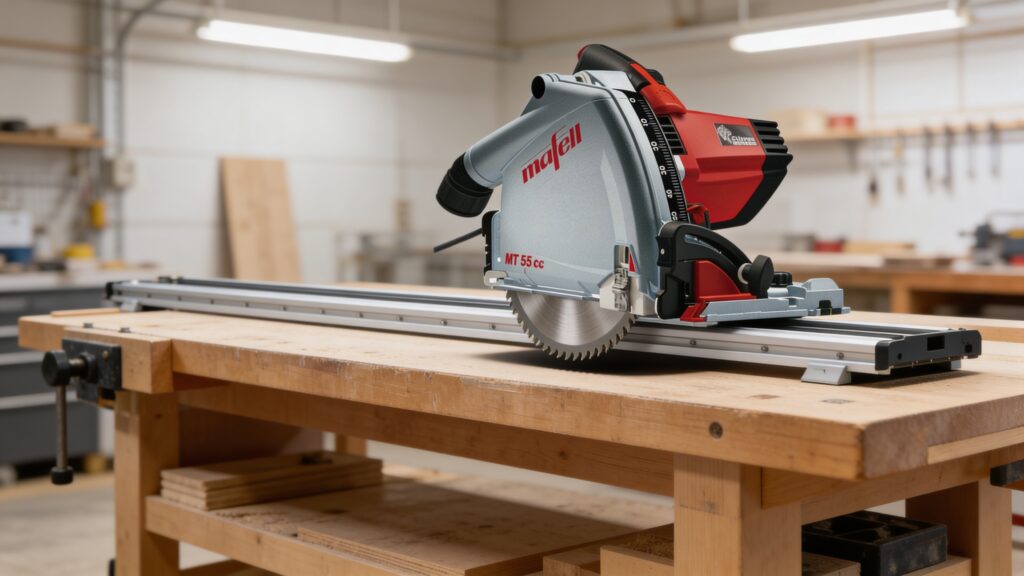
Mafell MT 55 cc track saw
What You’ll Learn

How Track Saw Guide Rails Control the Cut

A focused breakdown of how the rail defines alignment, stabilizes movement, and governs the interaction between saw and material during guided cutting.

  • How the rail establishes a fixed reference line for every cut
  • Why saw-to-rail contact limits lateral movement and keeps alignment consistent
  • How friction strips create grip without excessive downward force during operation
  • Why edge splinter control depends on rail-supported material along the cut line
  • How rail rigidity affects straightness across long panels and sheet goods
  • What role rail connectors play in maintaining alignment over extended lengths
  • How surface contact and debris influence tracking accuracy during movement
  • Why setup precision directly determines repeatability and final cut consistency

Tip: Treat the guide rail as the true cutting path, with the saw simply following its constraints.

Definitions

Key Parts That Make a Track Saw Rail System Work

Before the cutting system makes sense, it helps to understand how the rail, saw interface, and support features work together to control movement.

Guide Rail

The guide rail is the fixed reference that defines the saw’s path across the material. Its straightness and surface contact determine how reliably the cut line is maintained from start to finish.

  • Reference: Establishes the line the saw follows throughout the cut
  • Straightness: Keeps the cutting path consistent over long distances
  • Contact: Transfers alignment only when it sits flat on the workpiece

Saw-to-Rail Interface

This is the connection between the saw base and the rail profile. It constrains side-to-side movement so the saw advances forward without wandering away from the intended path.

  • Fit: Determines how tightly the saw tracks along the rail
  • Guidance: Limits lateral drift during motion across the material
  • Consistency: Maintains the same relationship through the entire pass

Splinter Guard

The splinter guard is the edge strip that marks the true cut line while supporting surface fibers. It helps the material break more cleanly at the edge as the blade passes.

  • Cut line: Shows where the blade will actually remove material
  • Support: Helps hold fibers in place near the edge
  • Clarity: Aligns layout marks with the rail’s working edge

Anti-Slip Strips

These strips increase friction between the rail and the work surface. Their role is to resist unwanted shifting so the rail remains stable while the saw moves along it.

  • Friction: Reduces rail movement during setup and cutting
  • Stability: Helps the system stay positioned under forward force
  • Surface effect: Grip changes with dust, texture, and material finish

Rail Connectors

Rail connectors join separate rail sections into one longer guide. Their alignment matters because even small deviations at the joint can transfer directly into the cutting path.

  • Joining: Extends the guide path for longer sheet or panel cuts
  • Alignment: Keeps adjacent rail sections on the same line
  • Continuity: Prevents the saw from encountering a directional change mid-cut

Workpiece Support

The workpiece support is the surface beneath both the material and the rail system. It affects how evenly the rail sits, how the sheet remains supported, and how stable the cut remains.

  • Flatness: Allows the rail to transfer a true straight reference
  • Support: Prevents sagging that can alter blade movement
  • Stability: Reduces shifting, vibration, and uneven contact during cutting

Tip: A rail-guided cut is a system where alignment, support, and constrained movement all shape the final edge.

Cut Path Control

How the Guide Rail Defines the Cutting Path

A track saw does not determine its own path; the rail establishes it before cutting begins. This fixed reference controls alignment, direction, and the saw’s allowable movement.

  • The rail creates a straight reference line independent of the saw itself
  • The saw base engages the rail to constrain side-to-side movement
  • Forward motion is guided along the rail’s edge without deviation
  • Any irregularity in the rail transfers directly into the cut path

The rail functions as the governing structure that defines where and how the cut occurs.

Tracking Interface

How the Saw Maintains Alignment on the Rail

The connection between the saw base and the rail ensures consistent tracking. This interface limits unwanted movement while allowing smooth forward travel.

  • A precise fit reduces lateral play between the saw and rail
  • Contact surfaces guide motion while minimizing resistance during cutting
  • Stable engagement prevents drift when cutting long or dense materials

Accurate tracking depends on a controlled relationship between the saw base and the rail profile.

Rail Continuity

Why Rail Alignment Matters Across the Entire Cut

The rail must remain straight and continuous for the entire length of the cut. Any misalignment or inconsistency changes the direction the saw follows.

  • Joined rails must align perfectly to avoid directional shifts mid-cut
  • Small gaps or offsets create visible deviations along the edge
  • Rail rigidity prevents bending or flexing over longer spans

Continuous alignment ensures the cutting path remains consistent from start to finish.

Surface Interaction

How Rail Contact and Friction Influence Stability

The rail relies on consistent contact with the work surface to maintain position. Friction and surface conditions determine how well the rail resists movement.

  • Anti-slip strips increase friction to reduce unintended rail shifting
  • Dust or debris between rail and surface disrupts stable contact
  • Uneven surfaces create gaps that reduce effective support

Stable contact between rail and material is essential for maintaining accurate positioning during the cut.

Edge Formation

How the Rail Influences Cut Quality at the Edge

The rail not only guides direction but also affects how the material behaves at the cut edge. Support along the cut line influences how fibers separate during cutting.

  • Edge strips support surface fibers to reduce tear-out during cutting
  • Consistent alignment helps maintain a clean, straight edge profile
  • Variations in support lead to uneven or rough edge finishes

Edge quality is directly shaped by how the rail supports and guides the material during cutting.

Quick Reality Check

What Guide Rails Control — and What They Don’t

A quick balance of what guide rails genuinely govern during a cut, and where their role ends within the larger system.

What Guide Rails Govern

Guide rails create the saw’s reference path, limit side movement, and stabilize travel so the cut follows a fixed line rather than operator steering alone.

When the rail sits flat and remains aligned, long sheet cuts stay directionally consistent because the saw is mechanically constrained throughout the pass.

Where Their Role Ends

Guide rails do not correct every variable, because cut quality still depends on surface support, rail condition, debris, blade behavior, and overall system setup.

A straight rail on an unstable panel can still produce inconsistent results, since movement beneath the material changes how the saw and rail interact.

Common Myths

Misconceptions About How Guide Rails Affect Track Saw Performance

Guide rails are often misunderstood as simple accessories, when they actually shape alignment, support, and movement across the entire cut.

The rail is just a straightedge

A guide rail does more than mark a line. It also constrains the saw’s path, stabilizes movement, and supports the cut edge, which is why it affects both direction and cut behavior.

A straight rail guarantees a perfect cut

Rail straightness is only one part of the system. Surface support, debris, saw-to-rail fit, and material movement all influence whether that straight reference becomes a clean, consistent edge.

Guide rails remove the need for setup

The rail controls the path only after it is positioned correctly. If the rail is misaligned, poorly supported, or unstable on the surface, the saw will faithfully follow that incorrect setup.

Rail connectors never affect cut accuracy

Joined sections can change the cutting path if their alignment is even slightly off. A small offset at the connection point can carry forward as the saw continues along the rail.

Anti-slip strips make movement impossible

Anti-slip strips increase friction, but they do not create absolute lock. Dust, smooth finishes, uneven pressure, and surface texture still affect how securely the rail stays in place.

Tip: A guide rail works best when viewed as one part of a larger alignment and support system, not as an isolated accessory.

FAQ

Frequently Asked Questions About How Guide Rails Affect Track Saw Cutting

Clear answers to the most common questions about how guide rails influence alignment, stability, edge behavior, and overall cut consistency.

What does a guide rail actually do during a cut?

A guide rail establishes the saw’s reference path and constrains side-to-side movement as the cut progresses. Instead of relying on freehand steering, the saw follows a fixed line determined by the rail’s position and straightness.

Why does rail straightness matter so much?

The saw can only follow the path the rail provides. If the rail is bowed, misaligned, or joined unevenly, that error becomes part of the cut because the saw tracks the rail rather than correcting it.

Do guide rails improve edge quality or just alignment?

They influence both. The rail controls direction, while the splinter guard and supported cut line help manage how surface fibers break at the edge, which affects how clean and consistent the final edge appears.

Why can a rail-guided cut still turn out inconsistent?

A stable rail does not eliminate every variable. Debris under the rail, poor workpiece support, material movement, or looseness in the saw-to-rail interface can all change how the system behaves during the cut.

How do rail connectors affect long cuts?

Rail connectors extend the reference path by joining separate sections into one longer guide. If the sections are not aligned precisely, the saw encounters a directional change at the joint and carries that deviation forward.

What role do anti-slip strips play on the rail?

Anti-slip strips increase friction between the rail and the work surface, helping resist unwanted movement during setup and cutting. Their effectiveness still depends on surface texture, dust, pressure, and how evenly the rail is supported.

Does the rail matter if the saw already tracks well?

Yes, because good saw tracking depends on the rail as the controlling reference. The saw’s ability to move smoothly only matters when the rail itself is straight, stable, and properly positioned on the material.

What matters more for accuracy: the rail or the setup?

They are inseparable parts of the same system. A well-made rail cannot produce an accurate cut if it is positioned incorrectly, and careful setup cannot compensate for a reference path that shifts or loses alignment.

Tip: When a rail-guided cut goes off line, trace the problem through reference, contact, support, and tracking rather than treating it as a single-point failure.

Bottom Line

Guide rails define the cut path, not the saw itself. Alignment, stability, and surface contact determine how accurately the saw follows the rail, making the rail system the primary driver of direction and consistency.

Once this relationship is clear, it becomes easier to interpret cut behavior and understand how setup, support, and rail condition influence the final result.

Next Steps

Go Further Into Reviews, Comparisons, and Buying Guidance

With the guide rail system explained, these pages extend that understanding into broader category research and decision-focused reading.

Track Saw Lists

A curated overview of track saw pages organized to help readers narrow the field through broader category-level editorial coverage.

Track Saw Comparisons

Focused comparison pages that examine how different track saw designs, features, and systems change cutting behavior and practical use.

Track Saw Buying Guides

Reference-style buying guides that explain which specifications and design details matter when interpreting how track saw systems actually work.

Quick Summary

Why Guide Rails Matter

  • Guide rails establish the saw’s reference path before cutting even begins
  • Saw-to-rail contact limits lateral drift and stabilizes forward movement
  • Rail straightness directly affects alignment, repeatability, and final edge quality
  • Surface support and debris change how accurately the rail performs
  • Clean cuts depend on the full rail system, not blade motion alone