
Rated capacity
The maker's reported volume for the storage its test counts.
- Units: Liters and cubic inches both express volume.
- Test boundary: The procedure specifies which pockets count.
- Setup: A test can use the bag with its straps slack.
Size matters when you're filling a bag or finding space for the bag itself. An expansion compartment's name tells you where the added room is. Its rating tells you how much. A roll-top duffel can have two listed heights, one with the top rolled shut. Stowed dimensions give you the size of a backpack's folded bundle.
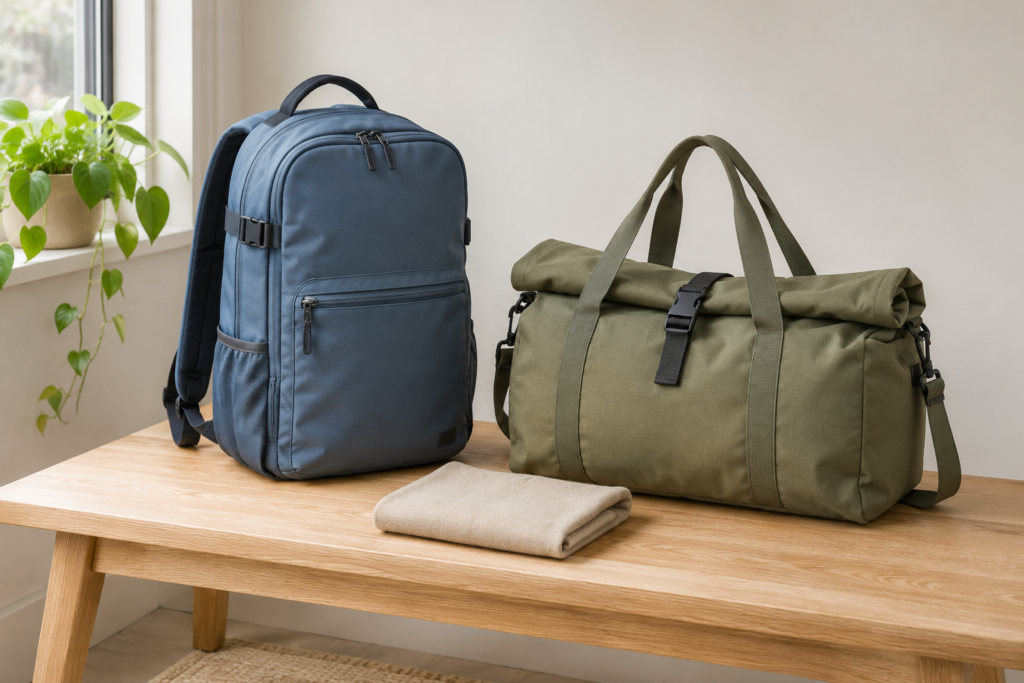
Start with the kind of answer you need. Liters describe volume. The words beside the number help you read the result.
Tip: Copy the full line into your notes. Keep closed beside DryTide's approximate 30 cm height.
The words around a measurement often do more work than the units. Base length is a useful example.
The maker's reported volume for the storage its test counts.
Small pieces used to fill the bag for a volume test.
A section that opens out for more space.
The free fabric above the load used for the folds.
A built-in pocket that houses the folded backpack.
A volume rating for the bag system as specified.
Tip: Read the noun beside the number. A pocket label identifies part of the bag.
In Knack's method, deciding which pockets contribute comes before the volume tally.
Two labels can use liters with different pocket rules. The useful follow-up here is what went into each total.
An expanded total leaves a question about location. Knack's Series 2 Medium answers it with a zip-open compartment.
Keep Knack's 11 L with the suitcase compartment it describes.
DryTide's roll-top folds need free material above the load, clear of any bulky item that would obstruct the fold.
The height on paper depends on whether the top is extended or closed.
An empty self-stowing backpack becomes its own cargo when the bag body folds into a pocket built into that same pack. The pocket and the pack inside it are the bundle you put away.
A published pocket size measures the housing. A published stowed size measures the bundle as a whole.
The arithmetic starts with the labels. Separate and connected capacities can differ.
Keep each figure with its arrangement.
Try reading a listing for a specific object, such as a backpack folded into its own pocket.
Imagine leaving an empty backpack on a shallow shelf in a shared locker. You're sketching what goes on that shelf before you bring anything. The 20 L Stowaway listing sizes the pocket. The 30 L listing gives the folded pack's size, so that figure can go on the sketch.
There's room on the drawing for a question mark. Put one beside any figure you still need. For the 20 L pack, that's the outside of the folded bundle. If the 30 L figure just matches the shelf, the listing gives no tolerance to settle the fit.
Imagine a friend dropping off a bag you're borrowing for a trip. It's the main bag from a Farpoint 55. Osprey lists it as the 40 L main pack, so that's the item to write on the loan note.
Suppose there's a second drop-off the next morning. If it's the Farpoint daypack, give that separate bag its own line on the loan note. When you return the loan, the note tells you which pieces actually came through the door.
A number can be right while the assumption that goes with it is wrong. Unrolled height, for example, needs both words.
A box calculation includes space outside a rounded shell. Imagine marking the rounded outline on a drawing of that box. The corners beyond the outline still contribute to the calculation.
Knack's rule leaves open exterior pockets out. A usable pocket can be absent from that figure.
Knack assigns the increase to its suitcase compartment. Check which section grew.
An item below the lip can still block DryTide's folds if it sits where the fabric must turn.
The 2-in-1 has a lower connected rating. The Farpoint's total equals the sum of its component ratings.
Tip: If a number appears on its own, go back to the words next to it in the spec. Look for a qualifier like fully extended.
The questions below start where a headline figure leaves off. Even a capacity table can tell you how the top was closed during measurement.
Knack pools fill from enclosed spaces. That total gives no individual share. For an answer about one space, look for its name beside a separate number.
CabinZero's example tracks a known volume per scoop. Osprey collects the fill to read its volume afterward. Both record the quantity of fill.
The Le Pliage Original Extensible listing gives the bag's outside width and its minimum and maximum capacities. Those are figures for the bag as a whole. The inside width of the added area remains unspecified.
On SealLine's roll-top dry packs and duffles, the reference is three folds secured in place. For a separate example, DryTide describes additional rolls when enough material is available. It says backpack parts such as shoulder straps can limit the extra turns on its roll-top backpacks. Neither statement supplies a height for a fourth roll.
Sea to Summit specifies that state for its 2023 Evac Compression Dry Bag. For the 2022 eVent Compression Dry Sack, it says rolling down reduces the volume. The comparison lists 20 L in the large row for both, so the matching number alone leaves the closure convention unclear. The 2022 entry gives the direction of the change and leaves the rolled-down capacity unspecified.
The 18 L is the backpack's carrying volume. For storage, the object that needs room is the same empty backpack tucked into its own pocket.
One Eddie Bauer page sizes the pocket for the lower-capacity pack. The other sizes the folded bundle for the higher-capacity pack. A comparison would need both pocket measurements.
The removable piece is the daypack. The other body is what Peak Design calls the base pack.
Tip: Write down the exact measurement that would settle your question. Closed height is more precise than asking for size.
The closure is part of the bag's shape. SealLine's published dimensions for its roll-top duffles include the top folded exactly three times and secured.
Imagine a stiff parcel atop soft contents in DryTide's 50 L duffel. It can obstruct the free fabric needed for folds. The listed closed height is an approximate outside dimension. It leaves the maximum height of the load unanswered.
Continue with the format that suits your question.
Open the travel bag and backpack lists archive.
Open the travel bag and backpack comparisons archive.
Open the travel bag and backpack buying guides archive.
Choose a retailer
Prices checked regularly. We may earn a commission at no cost to you.