Why Travel Clothing & Footwear Matter for Smoother Trips

Travel clothing and footwear matter when a feature changes one action you take on a trip. Imagine settling into a train seat. Opening a coat at the hem can leave the upper front fastened as you sit. The useful change is specific to the task, like keeping both hands on a map while stepping into shoes.

By: Review Streets Research Lab
Updated: November 24, 2026
Explainer · 10–13 min read
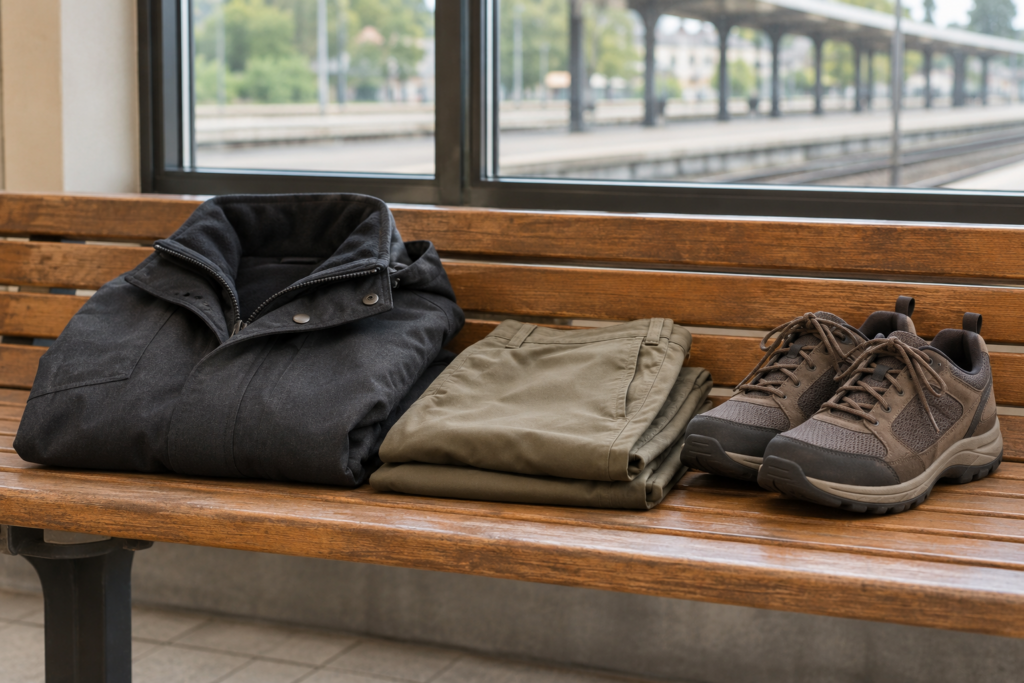
A charcoal coat, folded khaki trousers and walking shoes on a wooden train station bench.
Five travel moments

What you’ll learn

Take a window seat, look closely at an exhibit or pause at a ski lodge. Each scene asks something different of the clothes you’re wearing, from an opening at the bottom of a coat to a separate cloth supplied with a jacket.

  • How an opening at lap level can leave the upper front joined.
  • How a shorter cuff setting relates to a low rim beside your leg.
  • How a ponytail holder keeps hair gathered while you sketch.
  • Which part of getting out the door hands-free entry changes.
  • What a detachable goggle cloth contributes before you touch the lens.
  • Why inside-lens directions deserve their own reading.
  • How a supplied-cloth rule affects a traveler who already has another cloth.

Tip: Picture what you want to keep in place. At the train seat it’s the joined upper front. In the hotel it’s your hands on the map during shoe entry.

Terms in this guide

Six terms behind the examples

Some of these terms name a part of the garment, like a separating zipper. Others describe a result or action, like conversion to shorts or entry with your hands occupied.

Two-way separating zipper

A front fastener that can open from either end and come fully apart.

  • Separating: The two sides can come apart completely, as they do on an open jacket.
  • Partial opening: The front can stay joined above an opening made from below.
  • Naming: YKK also describes closed two-way zippers, whose ends stay joined.

Snap-up cuff

A pant-leg end that fastens in a raised position with a snap.

  • Location: The cuff is the bottom of the pant leg.
  • Capri position: Capri names the shorter length in Eddie Bauer’s example.
  • Category label: On another product, convertible can describe a change to shorts.

Multifunctional neckwear

Neckwear that the maker describes as having a choice of ways to wear it.

  • Product family: BUFF calls the family in this example Original EcoStretch Neckwear.
  • Alternate use: BUFF names a ponytail holder as one wearing option.
  • What it holds: The holder goes around a bundle of gathered hair.

Hands-free entry

A design that allows stepping into a shoe without handling it during that action.

  • Scope: Entry ends once your foot is in the shoe.
  • Shoe opening: In Skechers’ example the back stays open during entry.
  • Laces: The Dacey slip-in has stretch laces.

Detachable goggle cloth

A cloth intended for goggles that can be removed from the garment that supplies it.

  • Material: Obermeyer specifies microfiber on the Cirque jacket.
  • Attachment: The cloth is a distinct accessory you can hold on its own.
  • Permission: Some care directions specifically name the accessory supplied with the goggles.

Outer lens surface

The side of the goggle lens that faces out.

  • Inside surface: The side facing you can have separate care directions.
  • Blotting: A blot presses and lifts. A wipe moves along the surface.
  • Coating: Sweet Protection gives outer mirror coatings their own care section.

Tip: Translate a name into an action. For instance, separating tells you the two sides of a jacket’s front can come fully apart.

The train seat

Open the coat below, keep it joined above

Imagine settling into a window seat for a short rail ride. You plan to stay in your coat and read. In this setup, the lower front lies across your lap.

  • Picture the two parts of the coat you care about. You want it joined at chest level and the fabric over your thighs to rest to either side. A partial opening lets you give the two areas different positions.
  • The L.L.Bean Women’s Mountain Pile Fleece Coat reaches the thigh. L.L.Bean describes a two-way zipper for seated use.
  • Didriksons advises opening its two-way coat fronts from below for sitting. In the rail example, the area you want to open is down by your knees.
  • Start at the hem and open just far enough for the two lap edges to part.
  • Now look down at the book in your lap. The opening ends below the section you want joined.

For that part of the ride, you’ve set the coat to open across the lap. That’s where you wanted the two sides apart.

The garden display

A higher cuff beside a low display

Imagine an indoor garden demonstration on your trip. You stand beside a low display of labeled seedlings, close enough to read the tags. A rim projects toward your shins. You want to stay there while keeping the ends of your pants above the rim.

  • The display stays fixed and your feet stay planted on a level floor. In this hypothetical, the rim is above the unrolled hems and below the hems in the raised setting.
  • Eddie Bauer’s Women’s Sightscape Horizon Convertible Roll-Up Pants use snaps to hold the cuffs at capri length.
  • With both cuffs at the stipulated higher position, both hems sit above the rim. You’re still facing the same labels, with your feet in the same place.

The shorter setting gives you the vertical gap you wanted in that specific spot. A rim at another height would pose a different question.

The harbor sketch

Keep gathered hair together while you draw

Picture a harbor stop where you sit to sketch the boats. Your hair is long enough to gather, and you want it in one bundle while you look down at the page. A ponytail-holder position gives the neckwear that job.

  • You gather your hair for the holder before opening the book. Once you start drawing, one hand holds the book open across your knees and the other puts pencil to paper. That’s your reason for arranging your hair first.
  • BUFF identifies ponytail-holder use for Original EcoStretch Neckwear. In that position, the piece holds the bundle you gathered.
  • The holder has a bundle to go around once you’ve gathered the hair. You do that part before you settle the book on your lap.

As you look down to draw, the neckwear holds the bundle you made. Your hands are on the sketchbook and pencil.

The hotel door

Hold on to a paper map while putting on shoes

Imagine leaving a hotel room with a paper map open at the crease for the morning’s walk. Both hands are on the paper. You want to keep your hold as you put on your shoes.

  • Your shoes are already on a level floor beside a seat. Assume this is your usual, stable setting and you can step into them as positioned. You’re holding the map open where your intended street crosses the fold.
  • Skechers lists its hands-free heel panel on the GO WALK Flex – Dacey. Its explanation for that design describes stepping in with no hand on the shoe.
  • As each foot goes into its shoe, both hands can stay on the map. You step fully in, one shoe at a time.

The shoes leave your hands available for the paper during entry. That is the part of getting ready the design changes in this scene.

The ski lodge

A dedicated cloth at the ski lodge

Imagine stopping at a lodge and taking your goggles off at a table. You want to address a mark on the outward-facing surface. In this example, the jacket supplies a dedicated cloth.

  • Obermeyer documents a detachable microfiber goggle cloth on its Cirque jacket. Imagine finding that separate piece of cloth already with you at the lodge.
  • Giro’s snow-goggle guide describes a soft microfiber cloth for a gentle blot on the outside. For the hypothetical pair, suppose its own outer-lens directions allow clean, soft microfiber and the detached cloth actually meets the material, softness and condition requirements.
  • Identify which lens face you’re looking at and read its directions. Under the stated conditions, the jacket furnishes the cloth for the allowed outer-lens action.

The jacket supplies an accessory. For the action you intend, permission comes from the goggles’ own directions.

Reality check

Change one condition and see what still works

Revisit two moments with a different condition. At the lodge it’s a rule about the cloth itself. At the harbor it’s a second thing you’d like your clothing to do while you sketch.

When the instructions name the supplied cloth

In the lodge example, you have the jacket’s own cloth and directions that allow soft microfiber for an outer blot. Picture a second cloth on the table. Either cloth meets the material requirement if it satisfies those directions.

Now change the rule. Sweet Protection’s mirror-coating guidance specifies the supplied goggle bag or cloth for its outer lenses. Where the cloth came from now matters. In that version of the scene, the supplied goggle accessory has the job.

A second request at the harbor

Think back to the sketcher and add a request. You want fabric around your neck while you work. In the original scene, you’ve assigned the piece to the ponytail.

The ponytail position uses the piece to hold your hair. A separate piece would put fabric around your neck at the same time. Once you know the two jobs you want done, you can see where the first piece belongs.

Myths and misconceptions

What the feature names can lead you to assume

Product names offer a quick description. Look for the detail that answers the question you actually have, like the separating type of zipper on a jacket front.

Does a separating front always open all the way?

Full separation is one possible state. An opening from below can stop partway up with the upper span still joined.

Do convertible pants always shorten by removing part of the leg?

Eddie Bauer’s roll-up example makes capris with the lower fabric still attached. REI Co-op’s Sahara example converts into shorts.

Does neckwear describe its only wearing position?

BUFF names the family Original EcoStretch Neckwear and includes a ponytail holder among the wearing options.

Do visible laces mean you must tie them to put the shoe on?

Dacey has stretch laces as well as documented hands-free entry.

Does the label goggle cloth settle how to use it?

The label tells you the accessory’s intended purpose. Giro gives separate directions for the inner lens. Sweet Protection’s outer mirror-coating guidance identifies a specific cloth or bag.

Tip: Look for the wording that settles the question. Separating tells you a front can come apart completely. Shorts identifies the result on the REI example.

Reader questions

Details that matter in use

These follow-ups start with what you can see at the moment of use, such as where a coat ends or the laces on a slip-in shoe.

Why does the seated example use a thigh-length coat?

The thigh-length coat reaches the lap in this setup. If a shorter layer already ends above the lap, the lap is clear at the start.

What if the rim still sits above the raised cuffs?

The shorter setting has changed the pant’s length, with the cuffs still below the rim. In this version of the workshop scene, shorter cuffs still don’t give you the gap you wanted.

Does the neckwear need to start around my neck?

BUFF describes a ponytail holder as a wearing option. In the sketching example, the piece is already to hand when you gather your hair. You can start with it there.

Does hands-free entry cover positioning the shoes?

The hotel scene starts with the shoes in front of you. Skechers’ description applies to stepping in. Placing the shoes where you want them is an action you’ve already completed.

Can jacket fabric serve as the lens cloth?

The Cirque provides a separate accessory. Giro directs readers to microfiber and excludes jacket fabric.

What if I’m looking at the face closest to me?

Giro calls for gentle dabbing on the inside and warns that wiping can remove its coating. Look for that part of the guide when the face closest to you is the one you’re dealing with.

Does Sweet Protection name a goggle bag as one cloth option?

Yes. In its instructions for mirror-coated outer lenses, Sweet Protection names the supplied goggle bag or cleaning cloth.

What if I want the coat open near the collar while I’m seated?

L.L.Bean’s example can also open from the top. An opening by your collar answers a different need from the lap example. Starting at the hem is what leaves the upper span joined.

Tip: If you’re reading Giro’s goggle guide, find the directions for the lens face you’re looking at.

The takeaway

Start with the moment you want to go differently. In the train example, you want the same coat front open at the lap and fastened at the chest. Stating both aims makes it easy to say what the coat contributes.

Then ask what has to be true for the feature to do its part. At the lodge, you may already have a cloth. What you still need is the actual lens’s direction on what to use. Knowing where the garment’s job ends tells you where your own action begins.

Related reading

Explore Travel Clothing & Footwear

Review Streets organizes this topic into three reading formats. Each link takes you to the corresponding Travel Clothing & Footwear archive.