Why Travel Clothing & Footwear Size and Fit Matter

Size and fit matter when you need to replace clothing or footwear away from home. Imagine asking someone at home to read a tag over the phone. A shirt measurement might describe a person or the garment. A width code can change meaning with the shoe size and chart family.

By: Review Streets Research Lab
Updated: November 24, 2026
Explainer · 10–13 min read
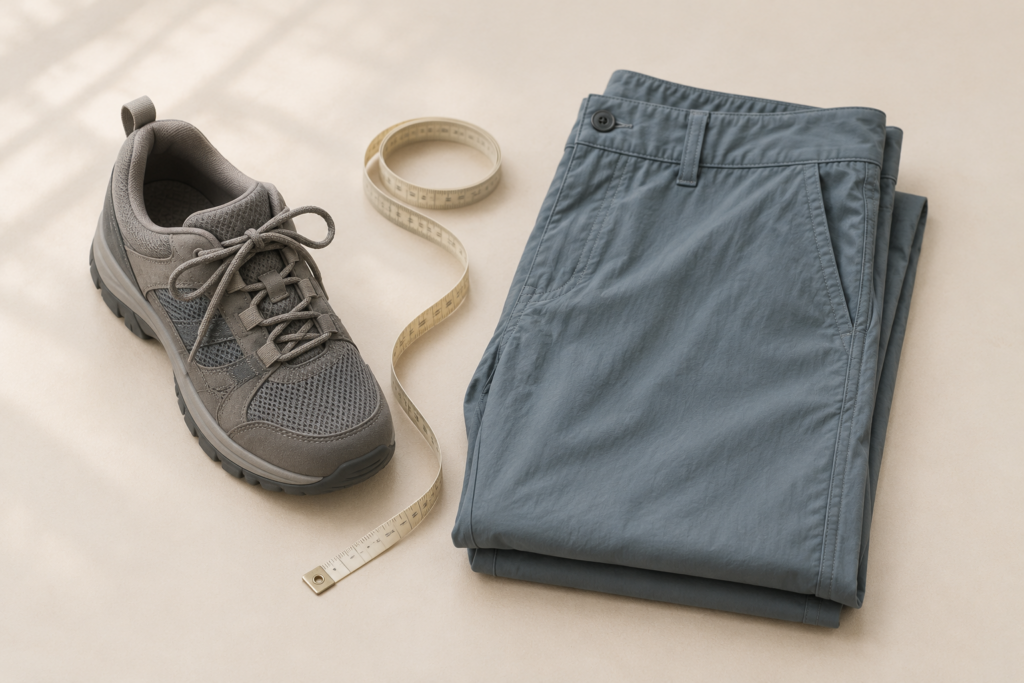
Gray lace-up sneaker, folded blue-gray trousers and a curved measuring tape.
Start here

What you’ll learn

Start with what the guide measures and what it does with the result. A hat guide can do arithmetic before you reach the chart.

  • How body measurements lead to size labels.
  • What a finished shirt measurement represents.
  • How a cut can allow room around the chest.
  • What front rise says about waistband position.
  • How a numbered shoe size leads to a width reading.
  • Why two hat guides can use different lookup rules.
  • How a new chart can move a measurement between rows.

Tip: The heading can name the reference. Proper Cloth’s shirt guide specifies chest width and describes taking it across the flat shirt.

Glossary

Six terms for reading a size record

The chart headings name the measurement. A label like M is the result of reading the appropriate row.

Body measurement chart

A table linking a wearer’s measurements to the maker’s size labels.

  • Subject: Arc’teryx uses this for its US men’s jackets and shirts.
  • Units: That chart offers centimetres or inches.
  • Label: A label such as M applies to a group of garments.

Finished garment measurement

A dimension of the finished item at a named point or in a specified state.

  • Chart wording: UNIQLO US calls these dimensions product size.
  • Measuring line: Proper Cloth gives an underarm-to-underarm line for shirt chest width.
  • State: UNIQLO measures tucks and pleats opened.

Ease

In Simplicity’s pattern guidance, the difference between comparable garment and body dimensions.

  • Reference: Body and garment figures refer to the same place.
  • Result: The difference describes how much room the pattern allows there.
  • Design: Outdoor Research accounts for use and fit across its graded size runs.

Front rise

The length up the front of trousers from the inseam junction to the waist.

  • Lower endpoint: It starts at the crotch seam.
  • Upper endpoint: It ends at the garment’s waist.
  • Leg measurement: The inseam follows the inside leg to the hem.

Shoe width code

A footwear width designation read with the numbered shoe size.

  • Column label: New Balance uses letter codes such as D.
  • Size reference: Brannock’s adult device indexes width by size.
  • Foot dimension: New Balance’s men’s tool uses the widest part of the foot.

Head circumference

The distance around the head at the line a hat guide specifies.

  • Position: Stetson specifies where the hat would sit.
  • Method: A flexible tape or string traces that line.
  • Chart entry: Sunday Afternoons gives an interval for its adult One Size label.

Tip: Compare like measurements before subtracting them. That’s what makes a difference in the figures meaningful in Simplicity’s pattern guidance.

The chest measurement

The body chart and the garment record

Illustrative scenario. A traveler needs a replacement shirt and has a chest measurement in a message. The number could describe the wearer or the finished shirt.

  • The chest entry in Arc’teryx’s US men’s jacket and shirt chart describes the wearer its size is intended to fit.
  • At UNIQLO US, the tag measurements describe the wearer. Where garment measurements are available, they have their own place on the product page.
  • Simplicity’s sewing-pattern guide compares corresponding dimensions for ease. Two chest circumferences can be subtracted because both go around the chest. A width taken straight across a shirt represents a different span.
  • Cut gives that difference a purpose. Outdoor Research adjusts its graded styles for intended fit and use. Its Trim cut is described as skimming the body, which expresses a design choice without giving an allowance in inches.
  • In a hypothetical made-to-measure shirt, suppose the body chest is 40 inches around and the finished chest is 44 inches around. That leaves 4 inches of chest ease. Proper Cloth’s method halves the finished circumference, yielding a nominal flat chest width of 22 inches.

The traveler can ask where the tape went. If the sender measured across a flat shirt, the figure describes a garment width. A reading taken around the wearer belongs in a body record.

The trouser waist

Front rise and where the waistband sits

A trouser waist has a circumference and an intended position. Levi’s rise categories describe the position, and the rise measurement gives a length up the garment.

  • In the garment rise measurement, the waist is the upper endpoint. In Bluffworks’ pants fit guide, the expected waistband position specifies the line around the body.
  • Levi’s US lists a 10¼-inch front rise for its 511 Slim men’s jeans, style 045115953, and describes a below-waist position. Its 501 Original men’s jeans, style 005013802, have a listed front rise of 11¼ inches and an at-waist description. Both specifications use size 32.
  • L.L.Bean’s US guide marks leg length along the inseam from the crotch to the hem. Eddie Bauer’s US women’s extended table holds rise constant for its Regular short and long pants inseams. The same table describes Petite and Tall proportions as changing both rise and inseam.

Illustrative scenario. A traveler texts home about their jeans. With either Levi’s style, a message saying only size 32 leaves the waist position open. That inch of difference is in the published rises, which accompany descriptions of where each pair is designed to sit.

The shoe width

The row behind a width letter

A width code is part of a chart address. The numbered size locates the row and the letter identifies a column.

  • The adult Brannock device shows that dependency on an instrument. Its width scale uses the shoe-size reading established in the preceding step to locate the width.
  • In New Balance’s US men’s table, Standard D is 10.4 cm at size 9 and 10.8 cm at size 11. New Balance’s men’s measuring aid takes width horizontally across the widest part of the foot and refers readers to the specific product’s size chart. The centimetre entries are foot-sizing references.
  • The chart family supplies a second clue. In New Balance’s US women’s chart, D is Wide and B is Standard. In the men’s chart, D is Standard.

Illustrative scenario. A traveler sends a photo of a shoe label to a friend. A visible D still leaves two blanks in a New Balance US lookup. The numbered size and family identify the entry.

The hat measurement

A hat guide sets the line and the lookup rule

Stetson charts the measurement taken at the hat’s intended position. Tilley USA’s page The Right Fit places an arithmetic step between measuring and looking up a label.

  • Stetson typically places the line at mid-forehead and about an eighth of an inch above the ear. Tilley USA’s The Right Fit uses string to trace the head at its broadest point, 1 to 2 cm higher than the tops of the ears and the eyebrow line.
  • Illustrative lookup. Assume two separately obtained readings of 56 cm, one under each guide’s placement instructions. The numbers are stipulated for the example. The Stetson chart gives size 7 at 56 cm. On Tilley USA’s The Right Fit page, adding the specified 2 cm makes the lookup value 58 cm, which the chart puts at 7¼.
  • A label can also name a range. Sunday Afternoons’ adult chart gives One Size a span of 54 to 60.5 cm and directs readers to the range in the specific hat description.

A note saying 56 cm leaves two useful details open. Which line produced the reading? Has the guide’s lookup rule already been applied?

The chart edition

When a size guide changes

Illustrative scenario. A traveler finds a size chart saved from an earlier trip. The screenshot raises two questions. Have the body reference values moved? Does the maker describe a change to the garment’s fit?

  • UNIQLO US’s women’s body-chart revision began with the Fall/Winter 2025 lineup. The body figures on the tag may differ for the same product. UNIQLO says that revision left the finished dimensions of the same product unchanged.
  • Arc’teryx US shows what a chart change looks like in its women’s jacket and shirt tables. Its table marked former fit and sizing lists chest figures of 89 cm for S and 94 cm for M. The main table lists 86 cm for S and 91 cm for M. An illustrative 89 cm body chest matches S in the former table and falls between S and M in the main one.
  • Arc’teryx US’s men’s jacket and shirt guide describes a change to fit itself. It says Medium stayed unchanged, smaller sizes became tighter and larger sizes became looser. That note gives context a list of body measurements alone could leave open.

For the traveler with the screenshot, the chart edition explains the different positions of the same chest figure. A claim about the cut of a specific Arc’teryx women’s jacket would need that jacket’s specifications. The documented same-item result comes from UNIQLO’s own revision note.

Reality check

What the records can settle

Two extra details can put a reading in context. How was it taken, and what was it meant to tell you?

Different readings of the same shirt

Illustrative scenario. Two friends in a hotel room take turns measuring a Proper Cloth shirt and get slightly different figures. For Proper Cloth’s shirt chest width, they can identify the intended line across the garment before trying to explain the discrepancy.

Proper Cloth identifies tape position and the force used in measuring as two sources of variation. Even with the same shirt on the table, the two people could get different readings.

A shoe reading is a first reference

Illustrative scenario. A traveler leaves a fitting with an adult Brannock reading written down. It records the instrument’s starting reference. A shoe style would be a separate piece of information.

Brannock says fitters still have to account for differences in manufacturing and styling. The note in the traveler’s hand can explain where the fitting began. How a particular shoe fits that traveler remains a separate question.

Size myths

Five assumptions worth untangling

A chart heading or a manufacturer’s note puts limits on what a label can tell you.

Is a jacket body chart a finished chest specification?

Arc’teryx’s US men’s jacket and shirt guide treats those body measurements as a general reference. Each item has its own specifications.

Does a longer inseam always raise the waist?

Eddie Bauer’s US women’s table shows the same rise for both its Regular short and long pants inseams.

Is D always Standard?

New Balance’s US women’s chart places D under Wide. Standard is B in that family.

Does One Size lack a defined range?

Sunday Afternoons gives the adult One Size label a lower and an upper circumference limit.

Do new tag figures prove a changed cut?

UNIQLO’s US women’s Fall/Winter 2025 revision could change the body figures on the same item’s tag while leaving its finished dimensions unchanged.

Tip: For a Sunday Afternoons hat, the description gives the size range relevant to that hat.

Follow-up questions

The details behind common size records

A recorded number can lose its context when copied. For instance, a garment width can depend on whether the maker measured its pleats open.

How does UNIQLO US measure pleated products?

UNIQLO opens the tucks and pleats before measuring. A width taken with the folds closed describes a different state of the garment.

Can a finished shirt depart from its ordered specification?

Proper Cloth’s sewing tolerance describes variation in the finished garment itself. That’s a different source of variation from differences in measuring by hand.

Does market matter on an UNIQLO chart?

UNIQLO’s US help describes its charts as US-specific. Its UK help directs readers comparing an Asia-purchased item with UK or European stock to the local chart for the region where they’re shopping.

Where does Bluffworks measure pants waist?

The Bluffworks fit guide places the tape horizontally around the body at the usual or expected waistband position.

What does arch length mean on the adult Brannock device?

It’s the heel-to-ball reading. The adult device compares the size indicated by that scale with heel-to-toe size and generally uses the larger size reading.

Is Nike’s CM/JP label the foot length?

Nike’s US men’s-based unisex chart treats the CM/JP label and foot length as separate information. The longer of the two measured feet supplies the length for Nike’s lookup.

What can head shape add to a circumference reading?

US custom hat maker Sugar Creek also considers the head’s front-to-back length relative to its side-to-side width. Equal circumference can go with different proportions.

Can a saved custom shirt size reflect newer calculations than the order itself?

A June 4, 2020 Proper Cloth note said the order history used the calculations that produced the shirt. Saved Sizes used the new calculations for certain fields, including front length. The two records could therefore display different figures for the same saved size.

Tip: Keeping a chart’s market or a note’s date with a saved number gives later readers context for differences between records.

Bottom line

A size record has a question built into it. The body figures describe a person the size is intended to fit. The product figures describe the item itself.

Back to the chest measurement in the traveler’s message. A few words about whether the tape went around the person or across the shirt tell the recipient which measurement the sender took.

Related reading

Travel Clothing & Footwear archives

Choose a Review Streets archive by format.