
Light-blocking eye mask
An eye covering worn to limit the light you see.
- Example: Manta designs its ORIGINAL for light blocking.
- Coverage: The mask has two eye cups.
- Strap: An adjustable strap is a separate part of the mask.
Travel comfort matters when a personal adjustment lets a shared plan carry on. A light-blocking mask can give one traveler a break while a roommate keeps the lamp on. Before changing the room or activity, ask what each traveler needs to keep doing.
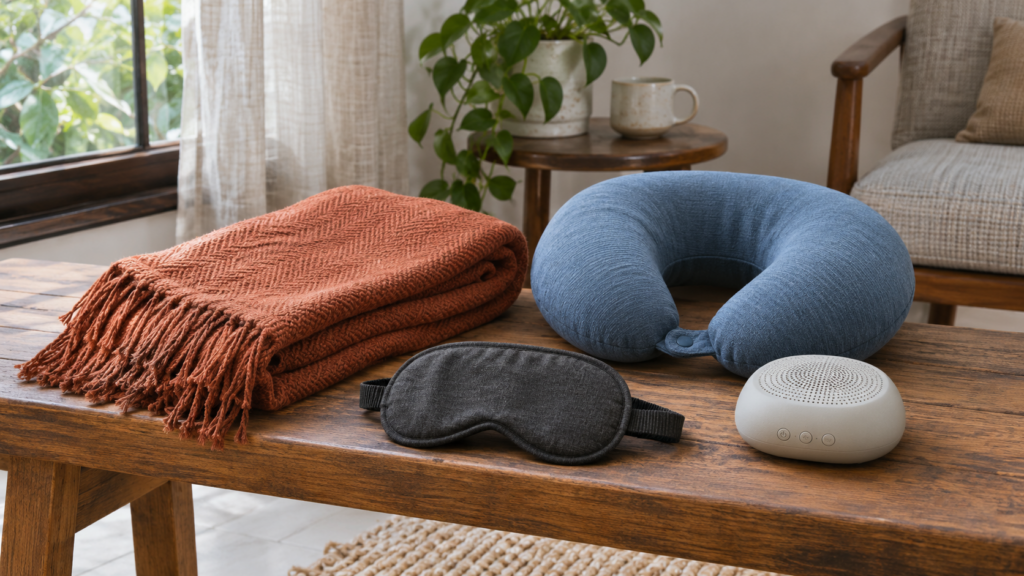
These examples start with something worth keeping. At a card table, a lap layer can go on while you stay in the game. The useful distinction is between a change you make for yourself and one the rest of the group would have to work around.
Tip: Describe the change at the scale you actually need. In the card-game example, that's a layer over your lap. The rest of the evening can stay out of the decision.
A personal travel throw is a layer for one traveler. The other names below help describe what each item contributes before the examples put it to work.
An eye covering worn to limit the light you see.
A portable blanket. The Rumpl example is sized for personal coverage.
Audio the unit supplies.
In this example, audio sent from another device to the Rohm+ during playback.
A portable place to rest the neck.
A pad for a surface you can already sit on.
Tip: Ask what the accessory supplies and what the setting supplies. A pad supplies the layer on a seat. In the bench example, where you want to sit is a decision you make first.
Imagine arriving at a guesthouse after dinner. Your roommate has a printed program under the lamp, marking places to visit tomorrow. You've settled in a chair and want a few minutes away from the bright room. An eye covering can reduce the light you see.
If the mask gives you enough of a break, the lamp can stay on. You've each decided how to spend the same few minutes.
Picture three friends midway through a card game in a holiday rental. One wants another layer across their lap and would rather finish the hand at the table. A seated lap throw can do that job.
The throw supplies one player's lap layer during the game. The next hand is still the group's decision.
Imagine two adults sharing a phone at a guesthouse. One wants sound in the room, and the other plans to read a message in the courtyard. The source of the sound matters here. Both travelers have a use for the next few minutes.
The phone is free because the unit supplies the sound. In the scene, nobody has to negotiate who goes first.
Imagine you've opened a printed story in a backed chair at the guesthouse. You want a place to rest your neck as you read. Trtl documents a reading use for its original pillow.
The original pillow has a role during awake reading. In this scene, keeping the chair and sticking with the book are the reader's choices.
Imagine two adults at a gathering during a trip. They settle on a bare bench to finish a conversation. Assume the bench is suitable and pad use is permitted. One traveler wants to add padding at their own place.
The pad changes one existing seat surface. The conversation can pick up wherever they left off.
The people in each scene already have part of what they need. The unit needs power. The cushion needs a seat. Remove either starting condition and the example ends differently.
Imagine the companion takes the phone into the hall to call the front desk. The Rohm+ was already playing a built-in track. The caller and the person in the room have settled what each wants to do.
Now suppose the unit is out of charge and has no other power. It can't play. The companion can still go make that call. The traveler in the room has yet to solve the audio problem.
Picture two travelers finding adjacent places early at a gathering. The pad supplies padding at one of those places. Both people had somewhere to sit as soon as they reached the bench.
Now imagine the only open places are at opposite ends of the bench. The ability to pad one place leaves the gap between the two places unchanged. Sitting together is still a separate problem for these travelers to solve.
A name on a product page gives you a starting point. A mask sold for blocking light can still let a wearer see light. The product's job and the result in your particular setting are two separate questions.
Manta's guide for the original mask acknowledges that you may see light after putting it on. Whether that matters depends on the break you're trying to take.
Rumpl describes personal coverage for the lap or shoulders. That gives you a way to picture the scale of the layer: think of the player at the card table.
The Rohm+ also plays its own selections. The label describes a capability. The audio source depends on which option the listener uses.
Trtl also describes using it against a seat during reading. The familiar wrap shape may be what you recognize first.
Stansport's black Closed Cell Foam Cushion uses foam for its seat padding. The category name describes what the cushion contributes to a seat.
Tip: Pay attention to the verb in the maker's example. Covering a seated lap is a specific use. That tells you how to picture the item in your plans.
Trade one premise in a scene for a new one and see what changes. Replacing a backed chair changes the surface available for the Trtl placement. A change in what the people want can also change the answer.
Seeing the page is part of both travelers' plans now. A light-blocking mask serves a different purpose. The readers might want separate places under the lamp or a chance to pass the same page back and forth. Either way, they need the light.
Rumpl says its Puffy blankets have no temperature rating. In the card game, the player had a simpler request. They wanted a layer over their lap and had another turn coming up.
The Rohm+ can play streamed podcasts. If the shared phone sends that episode, the phone is now the source of the audio in the room.
Yogasleep says the Rohm+ can recharge with a wireless charger or USB power. Whether it has power for the scene is a separate question about the unit in front of you.
A backless stool leaves the space behind the neck open, while the Trtl placement uses the surface there. You can still read on the stool if that's where you want to sit.
See the original pillow section of Trtl's use and aftercare guide. That's the model-specific description behind this example.
The V Seat supplies padding just at the place where it's used. The companion now wants padding at a second place. Both people still want to sit together.
Picture one traveler reading and another finishing a scorecard. The first wants the lamp right where it is. The second wants a layer over their lap while they sit at the table. They can name the change each needs independently.
Tip: Identify the changed detail first. Switching to a backless stool removes the surface behind the pillow. In another scene, the change may be something a companion now wants to keep doing.
Start with the activity you want to keep. A roommate can still use the lamp if you take a break with a light-blocking mask. Decide whose plans your change would touch. If your companion has something of their own underway, their answer belongs in the picture as well.
Name the part of the setup you want to leave alone first. A seat pad makes the bench example work only if you already have a suitable place to sit. The starting condition tells you whether the accessory has a job there at all.
Choose a reading format that suits the question you want to answer next.
The Travel Comfort archive for the roundup format.
The Travel Comfort archive for side-by-side coverage.
The Travel Comfort archive for buying guidance.
Choose a retailer
Prices checked regularly. We may earn a commission at no cost to you.