Why Travel Comfort Size and Fit Matter

Travel comfort size and fit matter because a size figure describes one physical relationship at a time. The Evolution X range refers to neck circumference. A blanket’s foot pouch marks its direction. The same distinction matters for pillow openings, headband speaker position and footrest height at a named setting.

By: Review Streets Research Lab
Updated: November 25, 2026
Explainer · 10–13 min read
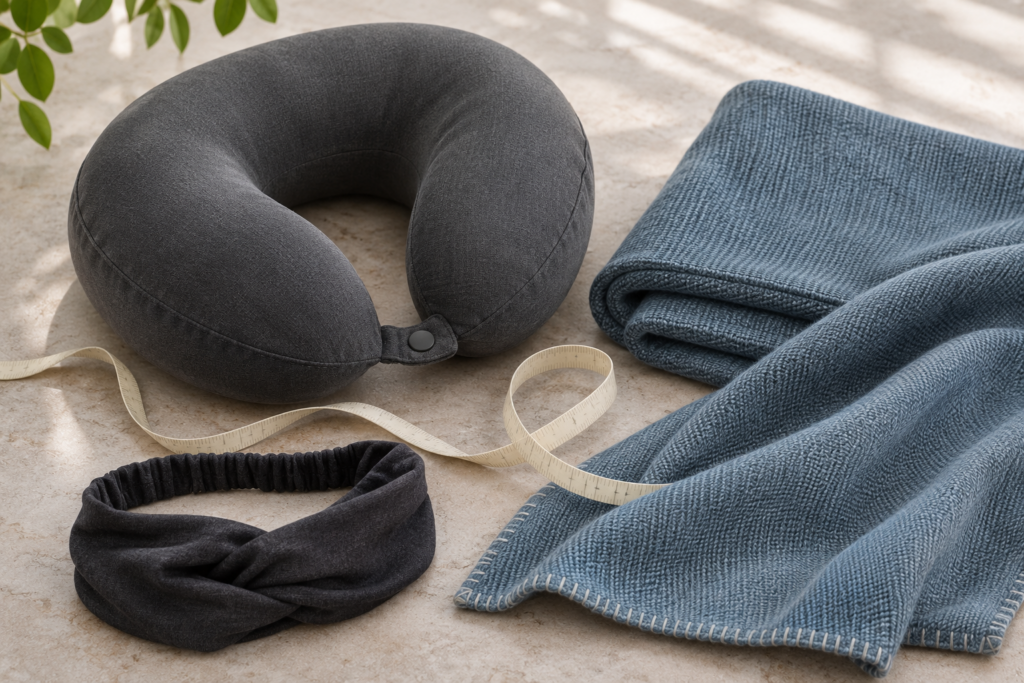
A charcoal travel neck pillow, dark cloth headband and blue blanket beside a flexible measuring tape.
What you’ll learn

How to read size and fit details

A size range, an opening and a facing direction each answer a different question about fit.

  • How to tell what the stated neck range measures.
  • How a neck pillow’s baseline setting differs from a change at its front closure.
  • Why the label on a pillow opening matters as much as its location.
  • How a foot pouch gives a blanket a direction.
  • Where headband speaker location, side and facing enter the picture.
  • Why a listed footrest height belongs with its inflation state.
  • Which details a listing can leave unresolved.

Tip: In the pillow examples, picture what you would trace. A neck circumference follows a loop around the wearer. A head-opening label points to an entrance in the pillow and leaves its measuring path open.

Key terms

Six terms for reading fit descriptions

The terms make it easier to turn a specification into a mental picture.

Reference dimension

A reference dimension is a size figure with a named subject, such as a person’s neck circumference or the length of open cloth.

  • Subject: The name beside the figure tells you what was measured. In a size range, that subject can be the wearer.
  • Axis: Length, width and height name different directions. Initials beside a group of figures can give their order.
  • Condition: A word like “open” or “fully inflated” belongs with the dimension it qualifies.

Stated size range

A stated size range gives the low and high values for the same measurement.

  • Endpoints: The low and high figures set out what the listing covers.
  • Starting setting: The baseline adjustment sets the Evolution X pillow loop’s starting circumference.
  • Separate control: A control that changes the space at the closure describes a second adjustment on the same pillow.

Aperture

An aperture is an opening. Its documented purpose tells you what goes there.

  • Location: The Snooze Pillow has a top opening and a side tunnel. Those locations make the two easier to find in a drawing.
  • Role: A word like “head,” “face” or “arm” identifies the opening’s intended role.
  • Measurement: An opening label tells you where the figure belongs. Reproducing the measurement also requires a method.

Orientation

Orientation is which way an object points relative to something else.

  • Reference end: The foot pocket on Gravel’s Layover Blanket Black gives you an end you can identify by purpose.
  • Outline: A plain outline can leave the direction of the feet unanswered.
  • Marker: An arrow can carry the direction from one drawing to the next.

Alignment

Alignment means that a feature lines up with its intended reference. For speaker placement in the Wireless guide, the references are the ears.

  • Location: In the Wireless guide, a speaker’s position can change inside the band.
  • Identity: Left and right identify the two parts. The labels stay with the parts as you describe their positions.
  • Facing: An ear-facing surface is the side directed toward the ear.

Nominal height

Nominal height is the listed vertical size, at the precision the listing gives.

  • Starting plane: In a sketch of a stationary footrest, the floor can be the starting line.
  • State label: The named layer configuration tells you which SkyRest height figure applies.
  • Precision: A figure marked approximate keeps that qualification in your notes.

Tip: A label for the part, an arrow for direction and a note for the state make a drawing easier to interpret.

Neck pillows

What the neck range describes

The Evolution X has a published neck range and two separate size controls. The range makes more sense when you know what each control changes.

  • Cabeau specifies 11–21 inches (28–53 cm) of neck circumference for the Evolution X. Circumference is the distance around something. The subject here is the wearer’s neck, so the figure describes a loop around the body.
  • The strap behind the rear zipper sets the pillow’s baseline circumference. Cabeau describes it as a one-time adjustment. “Baseline” names the setting that gives the rest of the description a starting point.
  • A cord and ball lock sit at the front. Cabeau describes that control as a way to fine-tune the space at the closure. In a sketch, the loop’s starting size and the space at its opening would have separate labels.
  • The neck range has published endpoints, while the closure is described by its function. A number with units can look like the answer to either question if it is copied without its label.
  • Cabeau also lists a lobe-position adjustment for the Evolution X. That is a separate question about where a part of the pillow sits.

When a specification and an adjustment description appear together, their different labels tell you which question each one answers. The range refers to the body. The controls describe the pillow’s geometry. Individual feel remains an open question.

Napping pillows

Which opening does what

The most prominent opening in a photo can be easier to recognize than to name. Ostrichpillow distinguishes the Original Napping Pillow’s head entry from two side openings for hands and arms.

  • Ostrichpillow’s support table lists the overall dimensions separately from the head opening. It gives the opening as about 70 cm (28 inches). The table leaves the measuring method open. The label lets you identify the feature even when the method remains unclear.
  • An illustration of the Original could use a single head-entry label and a matching pair of labels for the side openings. The generic word “opening” would leave those different jobs out of the picture.
  • Snoozeroute describes a top face opening and a side arm tunnel on The Snooze Pillow. “Top” and “side” locate the features. “Face” and “arm” say what each feature is for.

Keeping the opening’s name beside the number or picture makes that piece of the listing intelligible on its own.

Travel blankets

How a foot pouch gives a blanket direction

Length and width establish the size of an outline. FLYYPOD’s FLP_002 Transit Blanket lists two open dimensions and a foot pouch. The pouch adds a reference for which end goes where.

  • FLYYPOD lists the open FLP_002 at 180 cm long and 100 cm wide. Those figures could help you draw an outline. You’d need a feature or a label to say which of the long axis’s two ends faces the feet.
  • The FLP_002’s foot pouch supplies a reference for marking the feet-facing end in a sketch. FLYYPOD also lists a hand pouch inside the blanket. The names tell you what each feature does even in a description without a picture.
  • Gravel names a foot pocket on the Layover Blanket Black. That label gives the same sort of direction to a drawing. Questions about the pocket’s own dimensions would need a different figure.

Putting a foot-end mark and two dimensions on the drawing lets another reader recover its direction and size without the listing beside it.

Audio headbands

Where the speakers sit and which way they face

The SleepPhones Wireless guide describes a band already in place with the speakers away from the ears. It’s possible to identify the fabric’s overall position and still have a question about the parts inside it.

  • The guide uses the ear as the reference for speaker location. The Wireless manual describes speakers that move inside the band. That gives an individual part its own position to describe.
  • In the Wireless guide, red stitching marks the right speaker and green marks the left. Imagine drawing each as a labeled dot. A dot can move on the page while keeping its label.
  • The guide identifies a surface intended to face the ear. A small arrow beside the dot would show which side faces which way even if the dot itself stays put.

A precise note might name which speaker is involved, where it sits or which way its surface faces. Each tells the next person which detail the note describes.

Inflatable footrests

Why a footrest height needs a setting

A stated height becomes more useful with the inflation condition next to it. The distance is the dimension. The condition tells you which shape the dimension belongs to.

  • Imagine a side drawing with a line for the floor and a higher line for the product’s top. The label for the state belongs on the higher line. Velmesta describes separately inflatable layers, with one for the low setting and two or three for higher settings.
  • The Trip Topp listing puts the SkyRest at about 15 cm with one layer, about 30 cm with two layers and about 38 cm with three layers. “About” applies throughout the sequence.
  • Subtracting the printed SkyRest figures gives a difference of about 15 cm from one layer to two and about 8 cm from two layers to three. Both changes add one to the layer count. The differences come from the approximate listing values.

For SkyRest, the difference in listed heights varies between consecutive layer states. The setting label tells you which figure to look up. It saves you from having to assume what comes next.

Reality check

What a sketch can tell you

These two hypothetical sketches preserve details an outline alone would leave ambiguous.

The same outline, turned around

Hypothetical example. A traveler draws the FLP_002 outline and marks the pouch end “feet.” They turn the rectangle half a turn while leaving the sketch of the traveler in place. The outline stays the same. The “feet” mark now points the other way.

The dimensions size this simple outline. The foot-pouch label orients it. The pouch opening needs more detail.

Two lines above the floor

Hypothetical example. Two people sketch the SkyRest as an office footrest. Each starts with the floor line and draws a mark above it for the top of the footrest. One draws the one-layer state and the other draws the two-layer state.

Both marks can match the listing once each is tied to its layer state. To show where the top would sit with someone’s feet on it, the sketch would need a separate height measurement.

Common mix-ups

How fit specifications get misread

A range, a number or a part name can suggest more than the product description says.

Does the Evolution X neck range describe how much its front closure moves?

Cabeau gives endpoints for neck circumference. The closure has a separate description that identifies the space it adjusts and leaves the travel unspecified.

Can the Original Napping Pillow’s head-opening figure be taken as a head-size limit?

The figure is an approximate label for the opening, with the measuring convention unspecified. A size limit for a head would need a separate statement about the wearer.

Do the FLP_002’s pouches serve the same purpose?

FLYYPOD lists one pouch for hands and another for feet. The longer label tells you which one a drawing refers to.

Can sliding a SleepPhones Wireless speaker change which side its stitching identifies?

The speakers can slide inside the band. The stitching still identifies the same left or right speaker after it moves.

Does the number of valves tell you how many heights a footrest lists?

HOMCA lists two valves and three height settings for its inflatable Travel Foot Pillow. The two counts describe different things.

Tip: A valve is a part you can point to. A height setting describes the configuration of the footrest. Read those as separate details when both appear in the same listing.

Frequently asked questions

Reading the details one at a time

These answers cover the small distinctions that can disappear when specifications are copied or shortened.

Does Cabeau give a rear-strap position for each neck measurement?

The Evolution X description gives the neck-range endpoints and identifies the rear strap. It leaves individual strap positions unstated.

Are 70 cm and 28 inches two exact figures for the Original’s head opening?

Ostrichpillow gives one approximate opening figure in two units. Carrying a conversion to more decimal places would imply extra precision.

Does the Mini Handy Pillow have a thumb opening for either hand?

Yes. Ostrichpillow describes a thumb opening on both sides for right- or left-hand use. A separate opening on one side is for the arm.

What does “Port Pocket” refer to on the BP75 blanket?

The BP75 sheet lists foot pockets separately from the Port Pocket, which it identifies for decoration access and valuables.

Which speaker surface does the SleepPhones Wireless guide say faces the ear?

The Wireless guide identifies the soft gray side as ear-facing. A note about the face describes the surface, while a right or left label names the whole component.

What does the Original SnoozeBand’s 4 mm specification measure?

The figure describes component thickness. To specify a location, the description would need a reference point in the band.

Does the Original SnoozeBand’s one-size label apply to the speakers’ placement?

The label describes the one-size stretch band. SnoozeBand identifies adjustable speakers separately.

Which state does the kilofly LIF326’s 25 cm height describe?

Kilofly orders its figures length, width and height. It gives 25 cm as the height in the fully inflated entry.

Tip: To draw the Original’s head opening to scale, ask how the maker took the measurement. That method would tell you which span or path to draw.

The takeaway

Fit starts with a physical reference. A dimension is easier to use when you can name what it measures and when it applies. For placement, the equivalent detail is what the part is meant to line up with.

A close-up can identify the foot pouch. For orientation, look for a view that locates it on the blanket.

Related reading

Explore Travel Comfort

Browse archives by article format.