
Screen diagonal
The length across opposite corners of the display.
- Endpoints: Use the display rectangle as the reference.
- Units: Inches and centimetres are length units.
- Shape: A diagonal alone leaves the proportions open.
Size and fit matter because screen spans and pixel counts answer different questions, and a new tag can fit the holder you already own. With paper sizing, insert limits and watch weights, the same habit helps. Read what the figure measures and which parts or conditions it covers before drawing a conclusion.
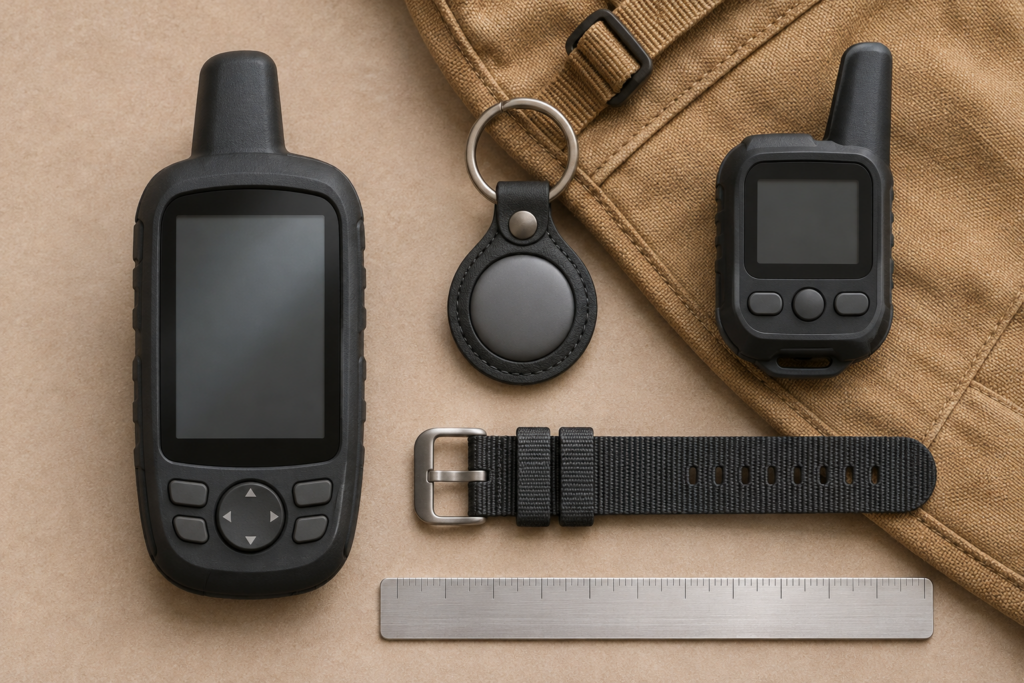
Start with the physical question you’re trying to answer. You might be reading a display specification, identifying a part you already own or working out what a number includes.
Tip: When taking notes, treat the spec heading, the value and any parenthetical wording as a single entry. That way a number you copy today still makes sense when you return to it.
Use these terms to label a figure before you decide how to use it.
The length across opposite corners of the display.
The count of picture positions along each of the display’s two grid directions.
A physical fit identified for one holder across more than one generation of a device.
The ratio of a reproduced length on paper to the intended length.
The largest cross-strap dimension specified for a particular part.
Which pieces a weight entry includes.
Tip: Finish the phrase ‘I’m trying to find out whether…’ before looking up a value. That gives you a way to tell whether you’ve found an answer or merely a related number.
A handheld GPS spec sheet can list the screen in inches and in pixels.
Use separate fields for size and resolution when taking notes.
Imagine replacing a suitcase tag and wanting to keep its holder. Look up the holder by model.
For the traveler with that holder in usable condition, Nomad’s compatibility list supports keeping it with either named tag.
Consider sizing an elastic strap for an Xplora X6Play. Its UK specifications list GPS among the location sources. Xplora lists a compatible X6Play elastic strap. The paper tool needs to reproduce its intended lengths.
The useful question is how large the tool came out on paper. The scale rule applies to the sheet you measure with.
ZOLEO gives a 25 mm maximum for the strap infill of US Cradle Kit MOU-PE-ZOLCRA01.
An over-width strap fails that criterion. That is enough to resolve the width question while leaving the rest of the setup outside the comparison.
Two gram figures can cover different sets of parts. Leave room on each line for what the number includes and how it was obtained. Those fields make sense of what happens when a band enters the calculation.
Garmin states the included-band value. The Fitbit total is arithmetic. When the figures move into a comparison, keep an explicit label for how each was obtained.
An inventory can hold a model name, a weight or a short note on fit. In these two examples, a few words beside the entry can make the answer usable later.
Imagine packing at home and getting as far as ‘replace suitcase tag’ on your list. You’ve identified the holder as the Tidal v2 and it’s in usable condition. Nomad lists the incoming AirTag 2 and the outgoing original for that suitcase holder.
Now suppose there’s an unmarked holder in the same drawer. Putting the two side by side still leaves you lacking a model name for the second one. The Tidal v2 entry leaves that holder’s fit open.
Suppose you’re recording the two watches for a trip inventory. If you read Garmin’s unlabeled first figure as excluding its band, Fitbit’s documented figure is higher in that first comparison. Keep the assumption visible in the inventory.
The nominal Fitbit total is below Garmin’s stated weight with its supplied band, reversing that order. Put this in a second row. A heading of ‘weight’ on its own could make the two results look like a disagreement.
Try these five readings and see what each one would require the documentation to say.
Equal grids settle the resolution entry. For physical size, read the lengths.
The measurements describe the tags. The holder’s listing identifies the supported pairing.
A complete-looking page can still be reduced. Use the specified scale to print the tool.
It belongs to the strap infill.
A band can be excluded or explicitly included. Read the wording beside the value before you copy it.
Tip: If a copied number seems to contradict a spec you remember, go back to the table headings as well as the figures.
Use these details to decide how far a specification answers your question.
A diagonal leaves the proportions open. Published dimensions are rounded.
The Tidal v2 listing covers the two named AirTag generations. Check the exact pairing for any other model.
The UK page gives its print setting. Its linked sizing PDF could not be inspected. The card check comes from the separate Denmark English PDF.
Xplora’s UK guide gives printing instructions for its elastic-strap sizing tool. Its X6Play strap appears in a separate listing. If you’re looking at another watch or another type of band, you still need to identify the relevant measuring instructions for that item.
Use the width at the section that passes through the infill. Imagine a drawing with a strip that widens partway along. Read the dimension arrow for that section.
The strap infill and camera mount insert have separate entries.
The band figure is an average. Extra decimal places in the nominal total would overstate precision.
Google lists a bumper in the box. The calculation adds only the band. The watch entry leaves bumper inclusion unspecified.
Tip: If two documents turn up for the same product, save the link alongside the detail you used. That gives you a way to find the same entry again.
Read the figure as part of a sentence. Before you bring a number into your own notes, write down the thing it describes and keep any qualification next to it.
Try writing the smallest conclusion your evidence allows. ‘This strap meets the width criterion’ leaves overall fit open. A small conclusion like that gives you a clear place to pick up the next question.
Choose a format to continue reading.
Open the travel navigation and tracking list archive.
Visit the archive for side-by-side comparisons.
Go to the buying guide archive for this travel category.
Choose a retailer
Prices checked regularly. We may earn a commission at no cost to you.